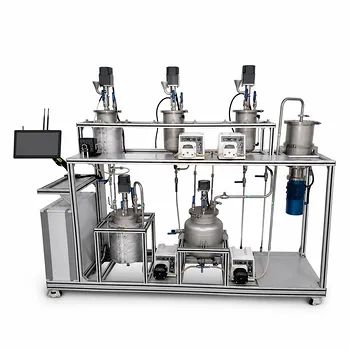
Pretreatment is the key that unlocks the entire bioconversion process. Lignocellulosic biomass has a highly resistant fibrous matrix where cellulose is bound by hemicellulose and surrounded by lignin. Pretreatment dismantles this natural barricade – it separates hemicellulose from cellulose, disrupts the lignin-carbohydrate structure, and dramatically increases the cellulose surface area available for enzymatic hydrolysis into fermentable sugars like glucose. In a pilot plant, the essential equipment to study this stage consists of a thermochemical pretreatment reactor, a solid-liquid separation system, and a precisely controlled enzymatic hydrolysis reactor.
Transforming straw, wood, or bagasse into bio-based sugars requires first cracking nature’s armor. Without effective pretreatment, downstream enzymatic conversion stalls. A bioprocess pilot plant must therefore combine robust chemical/thermal reactors, separation units, and hydrolysis vessels to systematically deconstruct biomass and validate sugar release before scaling up.
Why Lignocellulosic Pretreatment Is Non-Negotiable
The Recalcitrant Structure You Are Trying to Break
Biomass isn’t just a pile of sugars waiting to be tapped. Cellulose polymer chains are tightly packed in a matrix of hemicellulose and interwoven lignin. The lignin acts as a physical barrier and a chemical shield, making the cellulose nearly invisible to enzymes. Without pretreatment, enzyme accessibility is minimal, and yield is economically unviable.
The Core Missions of Any Pretreatment Step
- Disrupt the lignin-carbohydrate complex. The primary goal is to break the ester and ether bonds that lock lignin to hemicellulose, opening the structure.
- Separate hemicellulose from cellulose. By fractionating these components, you prevent hemicellulose from sterically hindering cellulase enzymes.
- Maximize cellulose surface area. Swelling and defibrillation create more docking sites for enzymes, accelerating hydrolysis kinetics and lowering enzyme loading.
These three actions convert a recalcitrant solid into a digestible substrate – and in a pilot plant, you must be able to measure and control each of them.
The Core Pilot-Plant Equipment Suite for Pretreatment Studies
Thermochemical Pretreatment Reactor: The First Point of Attack
This is where the complex matrix is chemically and physically ruptured. Pilot-scale units must handle high temperature, pressure, and corrosive environments. Common configurations include:
- Steam explosion units: Biomass is saturated with high-pressure steam and then rapidly depressurized, causing explosive decompression and fiber separation.
- Acid or alkali reactors: Dilute sulfuric acid or sodium hydroxide is added under controlled heat (e.g., 160–200°C) to hydrolyze hemicellulose or solubilize lignin. The reactor needs precise control over temperature, residence time, and chemical dosing to correlate severity with structural disruption.
Solid-Liquid Separation: Isolating the Unlocked Fibers
After thermochemical treatment, you have a slurry of cellulose-rich solids, dissolved sugars, lignin fragments, and inhibitors. To study the pretreatment’s effect on the solid fiber alone, you must cleanly separate the liquid phase. Pilot plants employ:
- Filter presses or rotary vacuum filters for batch or semi-continuous separation.
- Centrifuges for faster throughput and finer solid recovery. This step allows you to quantify removal of hemicellulose and lignin, while also assessing the purity of the cellulose stream that will proceed to enzymatic hydrolysis.
Enzymatic Hydrolysis Reactor: Validating the Pretreatment’s Success
The ultimate test of any pretreatment is how easily the resulting fiber can be broken down into monomeric sugars. A dedicated enzymatic hydrolysis vessel features:
- Precise temperature control (typically 50°C) and pH regulation to match optimal cellulase activity.
- Gentle agitation to ensure solid-liquid contact without denaturing enzymes. By running hydrolysis on pretreated solids, you directly measure yields of D-glucose, D-xylose, and L-arabinose. This data links pretreatment conditions to fermentable sugar output and allows systematic optimization of enzyme dose and hydrolysis time.
Understanding the Trade-offs in Pretreatment Development
Severity vs. Inhibitor Formation
High temperature and acid concentration increase hemicellulose removal and cellulose accessibility, but they also generate degradation products like furfural, hydroxymethylfurfural (HMF), and organic acids. These inhibitors can cripple downstream fermentation microbes. A pilot plant must therefore find the sweet spot where sugar yield is maximized while inhibitor production stays below a toxic threshold.
Chemical vs. Mechanical Complexity
Steam explosion is relatively low in chemical demand but can leave localized “hot spots” causing uneven pretreatment. Acid processes offer more uniform separation but require expensive corrosion-resistant materials and neutralization steps. The pilot plant equipment choice directly influences the operating cost profile and informs the scalability path.
Flexibility in Feedstock Handling
Raw biomass varies in moisture, particle size, and composition. A pilot plant designed to study pretreatment must accommodate different materials and be able to adjust pretreatment severity on the fly. Rigid, single-feedstock setups will limit your ability to generate transferable process data.
Making the Right Choice for Your Pilot Plant Goal
Your equipment configuration should mirror the specific data you need to derisk future scale-up. Let the primary goal guide the setup.
- If your primary focus is maximizing sugar yield: Combine a dilute-acid or steam-explosion reactor with efficient solid-liquid separation and a highly controllable enzymatic hydrolysis vessel. This lets you dial in enzyme loading and residence time to push cellulose conversion above 90%.
- If your primary focus is minimizing inhibitor formation: Choose a milder alkaline pretreatment (like lime) or a liquid hot water process, and couple the reactor with online analytical monitoring of degradation products. The hydrolysis step then verifies that sugar release remains high without compromising the fermentation.
- If your primary focus is process scale-up and techno-economic feasibility: Invest in a fully instrumented, continuous or semi-continuous reactor train. Include robust separation equipment such as a screw press or continuous centrifuge, and use the resulting mass and energy balances to model chemical recovery and overall production cost.
Each piece of equipment – from the pretreatment reactor to the hydrolysis vessel – is a diagnostic tool that reveals whether your conditions will work at industrial scale. Select the combination that answers the most urgent technical and economic questions for your bioprocess.
Summary Table:
| Equipment Type | Primary Function | Key Parameters Monitored |
|---|---|---|
| Thermochemical Reactor | Disrupts the lignin-carbohydrate matrix and opens fiber structure | Temperature, pressure, residence time, chemical dosing |
| Solid-Liquid Separator | Isolates cellulose-rich solids from dissolved sugars and inhibitors | Separation efficiency, cake moisture, solid recovery rate |
| Enzymatic Hydrolysis Vessel | Converts pretreated fiber into fermentable monomeric sugars | pH, temperature, agitation speed, sugar yields (glucose/xylose) |
Accelerate Your Bioprocess Research with LABPARK
Are you looking to scale up your bioconversion studies or equip your laboratory with industry-standard systems? LABPARK provides premium Educational and Vocational Unit Operations Pilot Plants in chemical engineering, bioprocess & biotech, and environmental & water treatment.
Engineered specifically for universities, research institutes, and enterprises, our customizable pilot-scale equipment helps you model precise pretreatment conditions, optimize enzymatic hydrolysis, and bridge the gap between lab-scale discovery and industrial production.
Contact our technical experts today to discuss your pilot plant requirements and receive a tailored solution!
Related Products
- Carbon Material Thermal Pretreatment Multiphase Separation Educational Pilot Plant
- High-Gravity Emulsification and Mass Transfer Educational Pilot Plant
People Also Ask
- What challenges do gravity transitions present for pressure control in multiphase separation pilot plants?
- How does steady-state multiplicity affect the operation and safety of exothermic reactions within a CSTR pilot plant? - Guide
- Why is temperature regulation via a cooling jacket a critical feature in CSTR pilot plants used for laboratory training?
- What parameters to monitor transitioning from Batch to CSTR? Master Pilot Plant Setup
- How to select the right unit operations pilot plant for liquid separation? A complete guide.