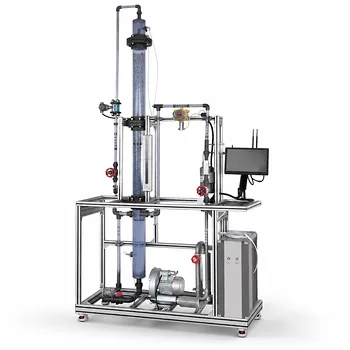
Wall flow isn’t just a minor nuisance—it’s a direct threat to the accuracy and credibility of every experiment run in a packed column. In educational pilot plants, mitigating this phenomenon is critical because it causes severe liquid maldistribution, which slashes mass transfer efficiency and prevents students from observing true process behavior. The solution is to physically interrupt the falling liquid at regular intervals using devices like conical redistributors, inclined-plate collectors, or multifunctional trough-sieve distributors that collect the wall-bound liquid and spray it evenly back across the packing.
While students often assume liquid flows as an ideal sheet, wall flow silently steals separation power. Understanding why we break the packing bed and how redistributors work transforms a mere experiment into a lesson on real-world column design constraints.
Why Wall Flow Sabotages Separation Performance
The deep need here isn’t just a definition—it’s grasping how a seemingly small physical effect destroys the core purpose of any mass transfer column.
The Physics of Liquid Migration
As liquid trickles down through random or structured packing, it has a natural tendency to drift outward. Capillary forces, bed inhomogeneity, and simple gravity combine to pull the liquid from the densely packed center toward the smoother, lower-resistance wall region.
Once at the wall, this liquid forms a fast-moving film that largely bypasses the gas-liquid contact zones inside the packing. The result is a massive loss of interfacial area—the very contact surface needed for absorption, distillation, or stripping to work.
The Educational Cost of Ignoring Maldistribution
In a pilot plant, the goal is to show students a faithful model of industrial operation. If wall flow goes unchecked, a column can produce optimistic or unpredictable separation results that fail to match theory. Worse, students may never see the stark difference that proper distribution makes, missing a core lesson in scale-up and operational troubleshooting.
By deliberately segmenting the bed and using redistribution devices, instructors can visually demonstrate—often with tracer dyes—how fluid stagnates or channels near the wall and how a well-placed redistributor immediately restores a flat concentration profile. This turns an abstract textbook concept into an observable, memorable event.
How to Combat Wall Flow in Packed Columns
Addressing the surface need, the answer lies in two complementary strategies: splitting the packing into short segments and placing engineered devices between them.
The Strategy of Bed Segmentation
A single tall bed is a guarantee of wall flow. The remedy is to divide the packing into multiple independent sections, each short enough that the liquid hasn’t had time to fully migrate to the wall before it’s caught.
For random packings like Pall rings, the maximum segment height-to-diameter ratio (h/D) ranges from about 2.5 to 15, with common values between 5 and 10. For structured packings, segments are limited to 15–20 times the Height Equivalent to a Theoretical Plate (HETP). Staying within these limits ensures that each layer delivers near-ideal efficiency.
Liquid Redistribution Devices
Once the packing is cut into sections, a device must sit between them to intercept the wall flow and spray it evenly back onto the next bed. In educational pilot plants, three main classes appear:
Simple conical redistributors are just a sloped metal cone that catches liquid sheeting down the wall and directs it toward the center. They are cheap and easy to fabricate, but they provide no true redistribution—they merely shift the point of liquid entry. As a result, they are only acceptable for columns under 0.6 m in diameter, where wall effects are less dominant.
Inclined-plate liquid collectors paired with distributors offer a more rigorous solution. A series of angled plates catch both the wall liquid and the liquid exiting the packing above, feeding it into a sealed chamber. From there, a separate distributor (often a perforated pipe or trough) sprays the liquid uniformly across the cross-section. This decouples collection from distribution, giving high control and repeatability—a valuable teaching point.
Multifunctional trough-sieve distributors combine collection, distribution, and gas separation into a single compact unit. They are frequently used in demonstration columns because they simplify the internals while showing students how industrial columns balance liquid spreading with minimal gas pressure drop. The sieve holes are sized to give each drip point a consistent flow, even at turndown.
Understanding the Trade-offs
No single redistributor is perfect for every educational scenario. Being transparent about these limitations builds the deep understanding engineers need.
- Simplicity vs. uniformity: Conical devices are easy to explain but produce poor point-source distribution, potentially creating new dry spots. This can confuse students if they expect perfect performance.
- Diameter dependency: Many redistributors have a minimum column diameter below which fabrication costs or gas blockage become impractical. A conical device, for example, loses effectiveness above 0.6 m.
- Tracer validation matters: The best educational experience comes from pairing any redistributor with a dye washout test. Students can see that even a “good” device won’t fix a poorly installed bed or an incorrectly sized segment height.
- Maintenance and flooding risk: Trough-sieve designs can trap debris, and if not properly designed for the gas load, they may restrict flow and cause premature flooding—an advanced lesson but a frustrating one if unplanned.
Making the Right Choice for Your Educational Pilot Plant
Your selection must match the learning objective and the column’s scale.
- If your primary focus is demonstrating wall flow visually: Use bed segmentation with simple conical redirectors in a glass column, and inject a dye tracer. Students will directly see migration and the corrective effect of the cone at a low cost.
- If your primary focus is achieving data that mirrors industrial mass transfer correlations: Opt for an inclined-plate collector with a dedicated multi-point distributor, keeping segment height strictly within h/D < 10. This ensures the HETP values students calculate are meaningful.
- If your primary focus is teaching integrated process design: Install a multifunctional trough-sieve distributor. It compacts the system and allows discussion of gas handling, liquid head, and distribution all from one device.
By tying the physical hardware to a clear educational outcome, you turn wall flow from an unnoticed error into the central, teachable challenge that real chemical engineers solve every day.
Summary Table:
| Device Type | Working Principle | Key Pros | Limitations |
|---|---|---|---|
| Conical Redistributors | Sloped metal cone redirects liquid from wall to center | Cheap, simple design; good for visual learning | Poor point-source distribution; limited to columns <0.6 m |
| Inclined-Plate Collectors & Distributors | Angled plates collect liquid to feed a separate distributor | High control & repeatability; decouples collection & distribution | More complex; higher fabrication costs |
| Multifunctional Trough-Sieve Distributors | Integrates collection, distribution, & gas separation | Compact; consistent drip point flow; teaches integrated design | Risk of debris clogging; potential flooding if improperly sized |
Optimize Your Lab's Mass Transfer Experiments with LABPARK
Mitigating wall flow is just one step in achieving precise, reliable column operations. LABPARK provides state-of-the-art Educational and Vocational Unit Operations Pilot Plants in chemical engineering, bioprocess & biotech, and environmental & water treatment. Designed specifically for universities, research institutes, and enterprises, our pilot plants feature industry-standard internals and transparent designs that turn complex mass transfer theories into observable, hands-on learning experiences.
Ready to upgrade your laboratory setup? Contact us today to discuss your customized pilot plant requirements!
Related Products
- Packed Bed Absorption Educational Unit Operations Pilot Plant
- Absorption and Desorption Educational Unit Operations Pilot Plant
People Also Ask
- How Do Flow Regimes Transition in Packed Bed Pilot Plants? Key Scale-up Insights
- How does reactant concentration determine absorption column control? Gas-film vs. dual-film.
- How is the packing height of an absorption column calculated? Master HTU & NTU Concepts
- How does static vs. operating holdup affect pilot plant calibration? Avoid Critical Scale-Up Errors
- Why is counter-current flow selected for gas absorption? Maximize Pilot Plant Efficiency