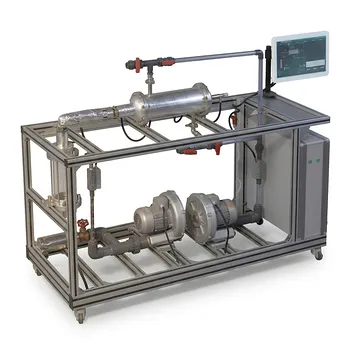
A rapid quench isn't just a cooling step — it's the defining moment that locks in product value. In pilot plants simulating hydrocarbon pyrolysis, integrating transfer line exchangers (TLX) or quench coolers immediately after the reactor is critical. It slashes the cracked gas temperature from 800–900°C to a safe level in milliseconds, instantly freezing the reaction mixture. This prevents destructive secondary reactions that would otherwise devour the desired olefins and foul the equipment with coke.
The core challenge of pyrolysis isn't just cracking the feed — it's preserving the high-value molecules you've created. In a pilot plant, a TLX is the engineering tool that demonstrates this preservation, replicating the industrial imperative of maximizing ethylene and propylene yield while recovering energy and teaching students how to manage the most time-sensitive step in the process.
Why Pyrolysis Demands an Instant Stop
The Race Between Valuable Cracking and Parasitic Side Reactions
Hydrocarbon pyrolysis thrives on a paradox. You need extreme heat to break chemical bonds, but the very products you want are thermodynamically unstable at that temperature.
Once the target cracking depth is reached, the newly formed olefins like ethylene and propylene are highly reactive. If they linger at 800–900°C, they rapidly engage in secondary polymerization and condensation reactions. These parasitic pathways consume your hard-won olefins, converting them into heavy tars and solid coke.
The yield loss isn't marginal — it's catastrophic. Without an immediate quench, the process defeats its own purpose. The hot reactor outlet becomes a furnace where your product is burned as fuel for unwanted chemistry.
How Coking Cripples a Pilot Plant and Mirrors Industrial Reality
Coke deposition isn't merely a yield problem; it's an operational nightmare. Heavy coking from unchecked secondary reactions clogs the reactor outlet, increases pressure drop, and forces frequent shutdowns for decoking.
In a pilot plant used for training or process development, this teaches a vital lesson: industrial crackers operate continuously for weeks, and coking is the single biggest factor limiting run length. The quench cooler is the first line of defense, proving that a properly designed TLX directly extends operational stability.
The TLX as a Multifunctional Learning Tool
Freezing the Reaction Mixture for Accurate Separation Training
A pilot-scale cracking unit isn't just a reactor. It's a miniature flowsheet that must feed a downstream separation section. The quench cooler ensures that the cracked gas entering the fractionation train has the same composition it had at the reactor exit.
This frozen snapshot allows students to practice separating ethylene, propylene, and other fractions from a realistic, stable feed. Without the quench, the gas composition would shift continuously as secondary reactions proceed, destroying the basis for any meaningful separation exercise.
Teaching Energy Integration Through Double-Pipe or Shell-and-Tube Design
Modern ethylene plants recover enormous amounts of high-grade heat from the cracked gas by generating high-pressure steam in transfer line exchangers. A pilot plant TLX, often designed as a double-pipe or shell-and-tube exchanger, directly models this energy integration.
Students learn that quenching is not just about product preservation — it's about capturing waste heat to drive the entire plant. The TLX becomes a hands-on demonstration of how a process can simultaneously quench the reaction and produce steam for turbines or reboilers, linking process control with energy economics.
Common Pitfalls and Trade-offs in Pilot-Scale Quenching
The Dilemma of Cooling Speed Versus System Integrity
A quench cooler must be aggressive, but not reckless. If the temperature drop is too steep or uncontrolled, thermal shock can stress materials and, in extreme cases, cause localized condensation of heavy components that gums up the exchanger.
Pilot plants often face a delicate balance: the exchanger must have sufficient surface area to achieve a rapid drop, yet maintain a turbulent flow regime to minimize fouling and ensure uniform heat transfer. Designing for this sweet spot is a key engineering challenge that the pilot plant must explicitly address.
Fouling and Maintenance: The Real Curriculum
Even with a perfect quench, some coke precursors will deposit on the tube walls over time. A pilot TLX will foul, and that fouling is itself a learning outcome. Students observe how heat transfer deteriorates, requiring periodic decoking or cleaning.
This trade-off — between product preservation and inevitable maintenance — reveals why industrial TLXs are carefully sized and why steam generation control is so tightly integrated. The pilot plant transforms an abstract design problem into a tangible, dirty reality.
Making the Right Choice for Your Pilot Plant Goal
The criticality of the TLX isn't up for debate, but how you emphasize it depends on your educational or development objective.
- If your primary focus is maximizing product yield for process research: Design the quench for the fastest possible cooling rate and validate that olefin selectivity matches industrial benchmarks. Use the TLX to quantify how even a few milliseconds of delay destroy value.
- If your primary focus is training operators in industrial-scale heat recovery: Select a TLX configuration that closely mimics a commercial shell-and-tube steam generator. Prioritize steam-side control and demonstrate how quench performance directly affects boiler feedwater dynamics.
- If your primary focus is understanding coking and unit run-length: Run the pilot plant under deliberately varied quench conditions. Let students correlate quench outlet temperature with coking rate, pressure drop buildup, and decoking frequency, turning the TLX into a living laboratory for fouling studies.
A pilot plant without an integrated quench cooler isn't simulating pyrolysis — it's simply destroying the evidence of its own success. By freezing the reaction at its peak, the TLX turns a high-temperature batch experiment into a faithful miniature of one of the world's most critical continuous processes.
Summary Table:
| Challenge in Pyrolysis | Role of TLX / Quench Cooler | Key Benefit / Learning Outcome |
|---|---|---|
| Olefin Degradation | Rapidly cools cracked gas in milliseconds | Freezes reaction to preserve ethylene & propylene |
| Coking & Clogging | Limits secondary reactions at 800–900°C | Reduces fouling, extending unit run lengths |
| Energy Recovery | Models double-pipe/shell-and-tube exchangers | Demonstrates industrial heat integration & steam production |
| Downstream Training | Maintains stable outlet gas composition | Enables accurate separation & fractionation training |
Optimize Your Unit Operations Training and Research with LABPARK
Are you looking to bridge the gap between academic theory and industrial reality? LABPARK provides state-of-the-art Educational and Vocational Unit Operations Pilot Plants in chemical engineering, bioprocess & biotech, and environmental & water treatment.
Tailored for universities, research institutes, and enterprises, our pilot plants deliver hands-on experience with critical components like transfer line exchangers, ensuring safety, process efficiency, and reliable data acquisition.
Ready to elevate your engineering lab? Contact LABPARK today to discuss your custom pilot plant requirements!
Related Products
- Shell and Tube Heat Exchanger Heat Transfer Coefficient Determination Educational Pilot Plant
- Three-Tube Heat Transfer Educational Pilot Plant for Unit Operations Training
- Comprehensive Multi-Modal Heat Transfer Unit Operations Pilot Plant for Engineering Training
- Dual Mode Heat Transfer Pilot Plant for Unit Operations Training
People Also Ask
- Why Apply LMTD Correction in Shell-and-Tube Pilot Plants & How to Determine It
- How is the fouling factor (Rd) evaluated? Key Pilot Plant Insights for Students
- How is fouling factor demonstrated using shell and tube pilot plants? Practical Lab Guide
- Why is simulating and calculating fouling factors crucial when operating educational heat exchanger pilot plants?
- How do tube pitches affect equivalent shell diameter (De)? Math & pilot plant impact explained.