The flow rate scale is inherently nonlinear because the flow rate through a differential pressure (DP) flowmeter is proportional to the square root of the differential pressure. This square-root relationship compresses the scale markings at low flows and stretches them at high flows. The result is a display where small changes in pressure correspond to large shifts in flow reading at the bottom end, severely compromising accuracy when you measure near the meter's minimum range.
A DP flowmeter’s nonlinear scale means that measuring flow in the lowest portion of its range invites disproportionately large errors. In any fluid flow experiment, you must actively avoid the bottom 10–20% of the meter's span and confirm whether your transmitter already linearizes the signal via a square-root extractor.
Why the Square-Root Relationship Creates a Nonlinear Scale
The Basic Flow Equation
The fundamental relationship governing a DP flowmeter is simple: flow rate ( Q ) is proportional to the square root of the differential pressure ( \Delta P ) (( Q \propto \sqrt{\Delta P} )). This is not a linear function.
If you double the differential pressure, the flow rate increases by only about 41%. The reading on a standard gauge or transmitter—which responds directly to pressure—therefore does not move in lockstep with the actual flow.
Visualizing Scale Crowding
Imagine a scale where the first half of the pressure span represents only the lower 70% of the flow range, while the remaining 30% of flow is crammed into the upper half of the scale. Small pressure fluctuations at the low end produce wild swings in the indicated flow.
The markings become tightly packed near zero and spread far apart at the high end. This makes it nearly impossible to read or control low flow with precision directly from a differential pressure reading.
The Practical Consequence: Error Amplification at Low Flows
What Happens When You Operate in the Lowest 10–20%
The reference explicitly warns: measuring flow rates near the lower limit of the meter leads to significant errors. Every instrument has some inherent uncertainty in the pressure reading, and that uncertainty gets magnified geometrically by the square-root relationship at low values.
A small absolute error in differential pressure can translate into a large percentage error in flow. In a laboratory experiment where energy balances, heat transfer coefficients, or reaction kinetics depend on precise flow data, these errors can corrupt entire datasets.
The Role of the Square-Root Extractor
Many modern DP transmitters include a square-root extractor. This device linearizes the output signal—usually a 4–20 mA current—so that the transmitted value is directly proportional to flow, not differential pressure.
If your transmitter already incorporates this feature, the signal you record or display is linear. However, verifying this is a critical step that many lab engineers overlook, assuming linearity where none exists.
How to Mitigate This in Your Lab Experiments
Establish a Safe Operating Window
Always design your experiment to keep the expected flow rates well above the meter’s cut-off point. The primary reference advises avoiding the lowest 10% to 20% of the flowmeter’s range entirely.
If your application demands a turndown that forces you into this zone, you are using the wrong meter. Select a DP flowmeter sized so that your minimum required flow sits safely above 20% of the maximum calibrated span.
Verify the Transmitter Configuration
Before collecting critical data, confirm the output signal type. Check the transmitter’s data sheet or configure the device software to see whether a square-root extraction is enabled.
If you are reading a raw differential pressure signal and performing your own conversion, apply the square-root calculation explicitly in your data acquisition system. Never treat the raw pressure as a linear proxy for flow.
Understanding the Trade-offs
The Turndown Limitation
DP flowmeters suffer from a limited turndown ratio (typically 3:1 to 5:1 for reasonable accuracy). The square-root relationship imposes a hard physical limit on how far down you can throttle before measurement uncertainty becomes unacceptable.
Efforts to extend the lower range by damping signal noise or averaging readings cannot overcome the fundamental nonlinearity; they only mask the problem.
The Square-Root Extractor Isn’t a Cure-All
Even with a square-root extractor, the underlying differential pressure signal still originates from a low-pressure region at low flows. The extractor linearizes the output scale, but it does not eliminate the original measurement uncertainty or improve the signal-to-noise ratio at the bottom of the range.
You still must respect the 10–20% minimum threshold. Linearization simply makes the usable portion of the range easier to read and control.
Making the Right Choice for Your Experiment
Selecting and operating a DP flowmeter in a laboratory environment boils down to matching the instrument’s characteristics to your experimental needs.
- If your primary focus is high-accuracy fluid flow experiments: Never operate a DP flowmeter below 20% of its maximum rated flow. Scope the meter so that your lowest test condition stays comfortably above that threshold.
- If your primary focus is monitoring a process with a wide flow turndown: Consider pairing the DP meter with a square-root extractor, but remain aware that this only linearizes the scale—it doesn’t rescue the low-end accuracy. You may need an alternative meter type if low-flow data is critical.
- If your primary focus is teaching fluid dynamics principles in a unit operations lab: Use the nonlinear scale as a teaching moment. Let students see the crowding and calculate the error magnification, then have them verify the square-root extraction in the transmitter.
By respecting the square-root law and imposing a firm lower operating limit, you turn a potential measurement pitfall into a manageable, well-understood constraint of your experimental system.
Summary Table:
| Key Aspect | Effect on Measurement | Best Practice for Engineers |
|---|---|---|
| Square-Root Law | Scale crowded at low flows, stretched at high flows. | Calculate flow using $Q \propto \sqrt{\Delta P}$ or verify transmitter. |
| Low-Flow Operation | High error amplification in the bottom 10-20% span. | Avoid the lowest 20% of the meter's maximum range. |
| Square-Root Extractor | Linearizes the output signal (e.g., 4-20 mA). | Confirm configuration; note it does not improve low-end accuracy. |
Optimize Your Fluid Flow Experiments with LABPARK
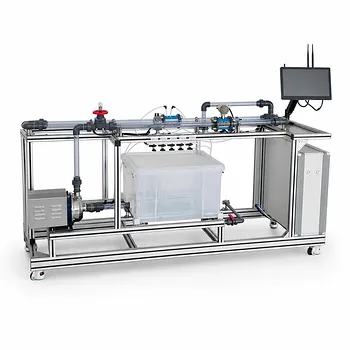
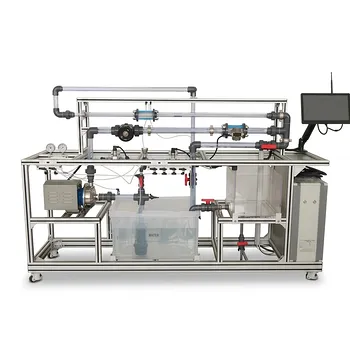
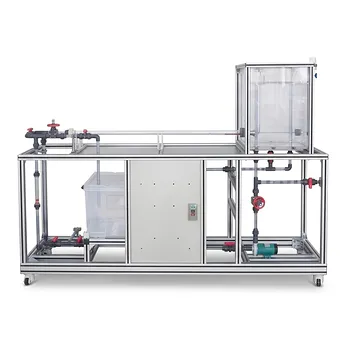
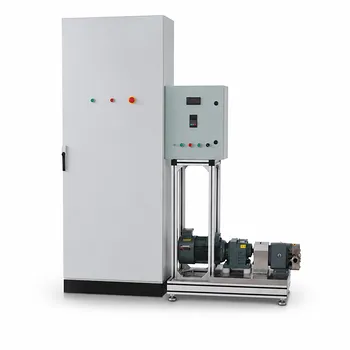
Accurate flow measurement is critical for reliable data in chemical engineering and environmental research. LABPARK provides state-of-the-art Educational and Vocational Unit Operations Pilot Plants in chemical engineering, bioprocess & biotech, and environmental & water treatment designed specifically for universities, research institutes, and enterprises.
Whether you need to teach fluid dynamics principles or conduct advanced research, our pilot plants ensure precise control, safety, and measurement accuracy. Contact us today to discover how we can enhance your laboratory's hands-on capabilities and training outcomes.
Related Products
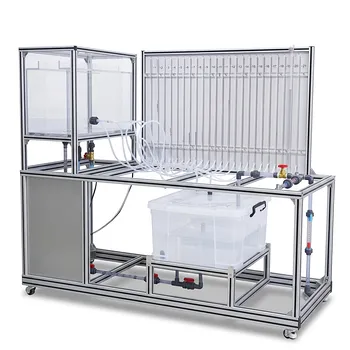
- Orifice and Venturi Flowmeter Calibration Educational Pilot Plant for Fluid Mechanics Laboratory
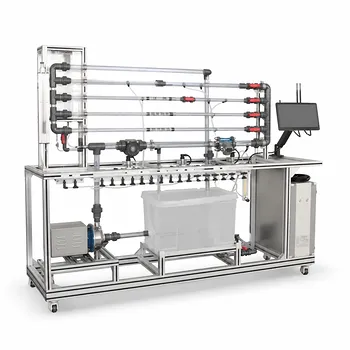
- Centrifugal Pump Performance and Orifice Flowmeter Calibration Educational Pilot Plant
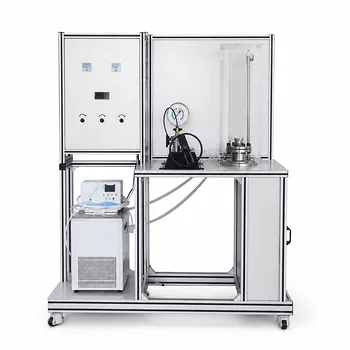
- Fluid Reynolds Number Demonstration Educational Unit Operations Pilot Plant
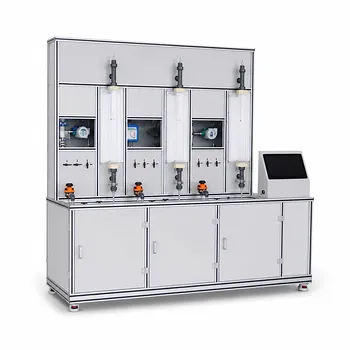
- Quantitative Dosing and Liquid Flow Control Educational Unit Operations Pilot Plant
- Bernoulli Equation Demonstration Unit Operations Pilot Plant
People Also Ask
- What is the difference between static and stagnation pressure? Master Pilot Plant Flow Measurement
- How do pilot plants demonstrate siphon pressure variations? Visualizing Bernoulli's Energy Balance
- How do fluid mechanics training pilot plants facilitate the visualization and calculation of laminar and turbulent flows?
- How to update chemometric calibration models in pilot plants? Best practices for process engineers.
- Why are the laws of similitude critical in fluid flow pilot plants? Scale Up Safely