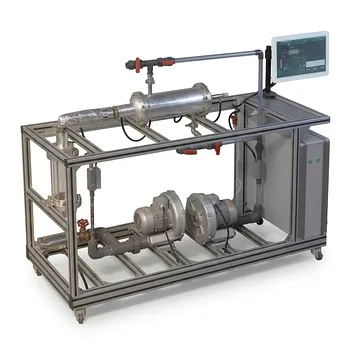
The simplest design in the heat exchanger family is almost always the best starting point for training. The double-pipe (concentric tube) heat exchanger is selected as the introductory module because its transparent geometry allows students to physically see and directly calculate the fundamental principles of heat transfer—co-current and counter-current flow, heat transfer coefficients, and pressure drops—without the complexity of multi-pass or plate configurations.
Before students can master complex industrial heat exchangers, they must first grasp the basic physics of thermal energy exchange. The double-pipe unit removes the opaque variables of intricate designs, turning an abstract textbook concept into a tangible, observable, and mathematically straightforward training tool.
Why Pure Simplicity Wins in Early Education
The double-pipe exchanger’s core value in a training lab is its ability to isolate the first principles of heat transfer from the noise of advanced engineering. It acts as a living schematic diagram that students can dismantle, measure, and model with minimal error.
The Geometry Is Immediately Understandable
There are no hidden baffles, stacked corrugated plates, or intricate shell-side flow paths. A student sees one fluid flowing inside an inner tube, and another flowing in the annular space between the inner and outer tube.
This simple concentric design means the heat transfer area is a single, uniform cylinder. The surface area for heat exchange is simply π × D × L, a straightforward geometry that eliminates the complexity of calculating equivalent diameters or surface extensions found in more exotic exchangers.
Direct Mathematical Verification Reinforces Theory
Because the flow channels are simple pipes, students can calculate the Reynolds number, Nusselt number, and convective heat transfer coefficients using standard correlations for flow inside a tube and flow in an annulus.
These theoretical predictions can then be directly compared to experimental results. When a student sees the measured outlet temperature match the calculated value to within a few percent, the abstract formulas in their textbook become validated reality. This builds foundational confidence that is critical before they face the built-in uncertainties of shell-and-tube or plate exchangers.
Demonstrating the Two Fundamental Flow Regimes
The most critical operational concept in heat exchanger theory is the difference between co-current (parallel) and counter-current flow. No other basic design illustrates this duality so cleanly.
Counter-Current Flow: The Thermal Efficiency Benchmark
By simply reversing the connections on a double-pipe unit, students can instantly switch to counter-current operation. They observe firsthand how this configuration delivers a higher log mean temperature difference (LMTD), can achieve an outlet temperature of the cold fluid that exceeds the outlet temperature of the hot fluid, and thus requires a smaller surface area for the same heat load.
This tangible demonstration of thermodynamic potential is far more memorable than a lecture.
Co-Current Flow: Understanding Thermal Limits
Running the same unit in co-current flow shows the limiting behavior—that both outlet temperatures asymptotically approach each other. The students see the data plateau. This visually enforces the practical rule that co-current flow is useful for preventing overheating of temperature-sensitive materials but is thermally less efficient. The double-pipe unit makes this trade-off an experimental observation, not just a bullet point.
Hardware Designed for Hands-On Learning
Training equipment must survive constant use, curious hands, and inevitable mistakes. The double-pipe exchanger’s materials and construction are inherently suited for this rugged environment.
Built from Standard, Robust Components
As the references note, these units are constructed from standard pipes and fittings. They are highly pressure-resistant and mechanically robust. There is no fragile gasket network like in a plate heat exchanger that can be pinched by an over-tightening student. A student can accidentally deadhead a pump against this unit with a far lower risk of catastrophic failure compared to a gasketed plate frame.
Ease of Disassembly Reveals the Inner Workings
The simple design, often connected by unions or flanges, allows students to disassemble the unit, inspect the inner tube for fouling, and clean it mechanically. This physical interaction is invaluable. They can literally scrape off a fouling layer they created in a previous experiment, then measure how its presence degraded the overall heat transfer coefficient. This turns the concept of "fouling factor" from a table lookup into a direct, physical lesson on maintenance and efficiency loss.
Scalability and Modular Flexibility in the Lab
A single double-pipe unit has a known limitation: a limited heat transfer area per unit length. However, this limitation itself becomes a teaching opportunity.
Connecting Units in Series to Expand Capacity
When the experimental heat load increases, students can connect multiple double-pipe sections in series using the 180° return bends. This modularity teaches the concept of adding heat transfer area while keeping the flow velocity constant, directly mirroring the concept of using hairpin or multi-tube sections in industrial practice when a single pipe run is insufficient.
It also provides a clear demonstration of unit operations’ scalability. A student’s small benchtop experiment is conceptually identical to a large industrial battery of double-pipe exchangers.
Understanding the Trade-offs
No responsible introduction would be complete without acknowledging where the double-pipe design falls short. In training, these limitations are features, not bugs.
Low Heat Transfer Area Per Unit Length
A significant volume of fluid only exchanges heat through a single pipe’s surface. Industrial processes requiring massive surface areas are typically better served by shell-and-tube or compact plate exchangers. However, in a training setting, this low area means flows are manageable and safety risks from high-speed, high-volume hazardous fluids are inherently lower.
Practical Limits on Physical Size
If a straight pipe is too long, it can sag, leading to uneven fluid distribution and creating stagnant zones. This introduces a real-world mechanical design constraint that students learn to calculate. They must consider pipe supports and thermal expansion—early lessons in practical plant design that a fully optimized industrial exchanger would hide behind expansion joints and complex supports.
Not Suitable for All Pedagogical Lessons
A double-pipe unit does not easily teach the complexities of cross-flow, multiple tube passes, or the intricate hydraulic and thermal coupling in a plate exchanger. Its very simplicity means it is a focus tool. The training curriculum strategically uses it as a first module, then moves students to jacketed vessels with agitators (to teach forced convection) and finally to more complex exchangers where temperature pinch points and bypass streams become the lesson.
Making the Right Choice for Your Training Program
When selecting an introductory heat exchanger module, the decision should be driven by your core educational objective. Use that objective to guide your choice, knowing the double-pipe unit’s clear role.
- If your primary focus is teaching first-principles thermodynamics and fluid mechanics: Choose the double-pipe exchanger. Its straightforward geometry eliminates ambiguity and allows students to directly verify empirical correlations, building a foundation of trust in their calculations.
- If your primary focus is demonstrating industrial complexity and efficiency optimization: Start with the double-pipe unit for the first experiment, but immediately follow it with a plate or shell-and-tube module. Use the double-pipe data as a performance baseline from which students can measure the efficiency gains of more advanced designs.
- If your primary focus is operator training on maintenance and fouling: The double-pipe unit is an ideal first step because of its easy disassembly for inspection and cleaning, making the physical consequences of fouling a tangible lesson before scaling up to more complex multi-pass units.
The double-pipe heat exchanger is not the most efficient industrial design, but for a training module, it is arguably the most effective. It strips heat transfer down to its observable, calculable essence, building the intellectual confidence students need to later face the beautiful and complex black boxes of modern process engineering.
Summary Table:
| Feature | Educational Value | Practical Benefit |
|---|---|---|
| Simple Geometry | Easy area calculation ($\pi D L$) | Visually transparent concentric flow |
| Flow Regimes | Direct co-current vs. counter-current comparison | Clear demonstration of LMTD limits |
| Robust Construction | High pressure resistance & high durability | Safe for student disassembly & cleaning |
| Modular Design | Connect units in series to expand capacity | Simulates industrial scaling principles |
Upgrade Your Chemical Engineering Lab with LABPARK
Looking to enhance your thermal unit operations training? LABPARK designs and manufactures industry-grade Educational and Vocational Unit Operations Pilot Plants tailored for universities, research institutes, and enterprises. Our specialized solutions cover chemical engineering, bioprocess & biotech, and environmental & water treatment.
Bring foundational thermodynamics to life with durable, modular training systems. Contact LABPARK today to discuss your laboratory requirements and request a customized quote!
Related Products
- Dual Mode Heat Transfer Pilot Plant for Unit Operations Training
- Shell and Tube Heat Exchanger Heat Transfer Coefficient Determination Educational Pilot Plant
- Comprehensive Multi-Modal Heat Transfer Unit Operations Pilot Plant for Engineering Training
- Three-Tube Heat Transfer Educational Pilot Plant for Unit Operations Training
People Also Ask
- Why is the study of thermal boundary layers and Prandtl numbers critical in heat transfer unit operations pilot plants?
- When is ε-NTU preferred over LMTD in pilot plants? Predict heat exchanger performance without iteration.
- How do unit conversions affect pilot plant calibration? Avoid errors in heat transfer data analysis
- Why is the prevention of scale formation on heat exchanger surfaces a critical learning objective? Key Lessons
- How is the thermal resistance of a thick-walled hollow cylinder calculated? Key Equations