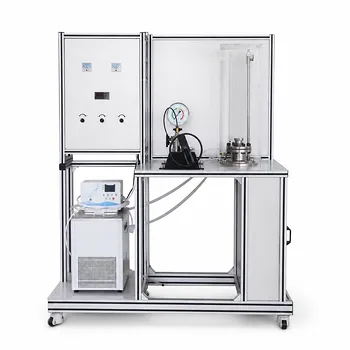
Replace mercury-in-glass thermometers with electronic instruments because they remove two preventable hazards: toxic mercury release and glass contamination. In chemical engineering and bioprocess pilot plants, thermometers can break during processing, sampling, cleaning, or maintenance. Digital temperature sensors, RTDs, and thermocouples provide safer, process-compatible measurement while also supporting electronic data acquisition and control.
The recommendation is fundamentally about risk reduction and process integration. Electronic instruments avoid mercury spills and reduce the likelihood of glass fragments entering process streams, while allowing temperature measurements to be recorded, monitored, and used by modern control systems.
Why Mercury-in-Glass Thermometers Are Poor Pilot-Plant Choices
Breakage Can Contaminate the Process
Glass thermometers are vulnerable to impact during routine operations. A collision with a vessel, pipe, sampling tool, or piece of handling equipment can release glass fragments directly into a process stream.
This is especially serious in bioprocessing, where contamination can compromise cultures, samples, and experimental results. In chemical processing, broken glass can create both product-quality concerns and a difficult cleanup operation.
Mercury Creates a Toxicity Hazard
If a mercury-in-glass thermometer breaks, mercury can escape as droplets or vapor. Mercury is hazardous to people and can contaminate equipment, work surfaces, waste streams, and potentially the material being processed.
The resulting incident may require isolation, specialized cleanup, contaminated-waste handling, and an investigation. Replacing the instrument before an accident occurs is a more reliable control than depending on emergency procedures.
Pilot Plants Have Frequent Physical Interaction
Pilot plants are used for sampling, equipment modification, calibration, teaching, and maintenance. These activities create more opportunities for accidental contact than a fully enclosed production process.
The risk is therefore not limited to normal operation. Instrument selection must also account for the physical realities of experimental work and frequent operator access.
How Electronic Instruments Improve the Measurement System
RTDs Support Critical Temperature Control
Resistance temperature detectors, or RTDs, are appropriate where temperature accuracy and repeatability are important. They are well suited to chemical reactors, bioprocess fermenters, and other locations where temperature directly affects process performance.
For example, reaction rates can change substantially with temperature, while excessive heat in a fermenter can damage cells or denature enzymes. An RTD can provide the precision needed to detect and control these deviations.
Thermocouples Provide Rugged Monitoring
Thermocouples are generally more rugged and less expensive than RTDs. Their lower precision makes them suitable for less critical monitoring points, particularly where durability and cost matter more than very fine temperature control.
Using thermocouples across pilot-plant skid modules can provide broad process visibility without specifying high-accuracy sensors at every location.
Electronic Signals Enable Data Acquisition
Electronic sensors can transmit measurements to digital control systems such as programmable logic controllers or supervisory control and data acquisition systems. This enables continuous logging, alarms, trends, and automated control actions.
A mercury thermometer provides a local visual indication. An electronic instrument can become part of the plant’s wider measurement and control architecture.
What Sensor Selection Must Consider
Match Accuracy to Process Criticality
The best sensor is not necessarily the most accurate sensor. Critical temperature points should receive sensors with suitable accuracy and repeatability, while less sensitive locations may be adequately served by more economical instruments.
Over-specifying sensors increases cost without necessarily improving the experiment. Under-specifying them can hide process deviations or produce unreliable mass and energy balances.
Match Construction to the Process
An electronic instrument should be selected with an appropriate protective sheath, connection method, chemical compatibility, temperature range, pressure rating, and hygienic or cleanable design where required.
Replacing mercury with electronics does not automatically make an installation safe. The complete sensor assembly must withstand the process and must not introduce another contamination or mechanical failure risk.
Consider the Operating Temperature Range
Optical pyrometers may be appropriate for non-contact measurements at extremely high temperatures, such as furnace tube walls or high-temperature thermal-processing equipment. RTDs and thermocouples are more typical for ordinary pilot-plant process temperatures.
The measurement technology should follow the operating conditions rather than being chosen solely because it is electronic.
Understanding the Trade-offs
Electronic Sensors Still Require Protection
RTDs and thermocouples can be damaged by vibration, corrosion, thermal shock, wiring faults, or improper installation. A failed electronic sensor may provide an incorrect reading rather than an obvious physical indication of failure.
Good practice includes appropriate installation, calibration, signal validation, and alarms for implausible or rapidly changing measurements.
Accuracy, Cost, and Durability Are Different Priorities
RTDs generally offer higher accuracy, while thermocouples are often more rugged and economical. Selecting RTDs everywhere may add unnecessary expense; selecting thermocouples for every critical control point may sacrifice needed precision.
Pilot plants benefit from using a deliberate mix of sensor types based on process risk and measurement requirements.
Removing Glass Does Not Remove Every Collision Risk
Other glass equipment, vessels, and sampling components may still be present in a pilot plant. Material handling equipment should be coordinated to reduce collisions, and plastic sampling containers may be appropriate where they are chemically and operationally compatible.
The objective is a broader reduction in breakage and contamination risks, not simply a one-for-one thermometer replacement.
Sensor Data Still Needs Interpretation
A digital reading is not automatically a reliable process measurement. Researchers and students must understand calibration, units, response time, sensor placement, and the relationship between measured temperature and actual process conditions.
These considerations are essential when troubleshooting deviations or using measurements in process models and material or energy balances.
Making the Right Choice for Your Goal
The recommendation should be applied as part of a complete instrument-selection and risk-assessment process.
- If your primary focus is personnel and process safety: Replace mercury-in-glass thermometers with properly protected electronic sensors to eliminate mercury spills and substantially reduce glass-fragment hazards.
- If your primary focus is precise process control: Use RTDs at critical points such as reactors and fermenters, where temperature variation can significantly affect reaction or biological performance.
- If your primary focus is economical, rugged monitoring: Use thermocouples at less critical locations where durability and cost-effectiveness are more important than maximum precision.
- If your primary focus is high-temperature measurement: Use a suitable non-contact instrument, such as an optical pyrometer, when temperatures exceed the practical range of contact sensors.
- If your primary focus is modern pilot-plant training: Integrate electronic sensors with PLC or SCADA systems so measurements can support logging, alarms, control, and process analysis.
Choosing electronic instruments gives pilot plants safer temperature measurement while improving the quality, traceability, and usefulness of process data.
Summary Table:
| Sensor option | Best suited for | Main advantages | Key considerations |
|---|---|---|---|
| RTD | Reactors, fermenters, and critical control points | High accuracy and repeatability | Higher cost; requires suitable protection and calibration |
| Thermocouple | General monitoring and skid modules | Rugged, economical, and wide temperature range | Lower precision than RTDs; verify signal integrity |
| Optical pyrometer | Very high-temperature or inaccessible surfaces | Non-contact measurement | Requires suitable surface conditions and line of sight |
| Mercury-in-glass thermometer | Legacy local indication only | Simple visual reading | Mercury toxicity, glass-breakage risk, contamination, and no digital integration |
Improve Pilot-Plant Safety and Process Control
Replace mercury-in-glass thermometers with properly selected electronic instruments from LABPARK. Our Educational and Vocational Unit Operations Pilot Plants support chemical engineering, bioprocess and biotech, and environmental and water-treatment training, research, and scale-up.
LABPARK helps universities, research institutes, and enterprises choose RTDs, thermocouples, protective assemblies, and integrated measurement systems that match process temperature, accuracy, pressure, chemical compatibility, hygienic requirements, and control needs. Electronic sensors can reduce mercury and glass-contamination hazards while enabling PLC or SCADA data logging, alarms, trending, and automated control.
Contact LABPARK to discuss a safer, process-compatible pilot-plant configuration tailored to your teaching, research, or industrial application.
Related Products
- Comprehensive Heat Transfer Coefficient Determination Educational Unit Operations Pilot Plant
- Educational Compression Refrigeration Performance Determination Unit Operations Pilot Plant
- Carbon Dioxide PVT Curve Determination Educational Unit Operations Pilot Plant
People Also Ask
- Why is the study of thermal boundary layers and Prandtl numbers critical in heat transfer unit operations pilot plants?
- When is ε-NTU preferred over LMTD in pilot plants? Predict heat exchanger performance without iteration.
- Why is the prevention of scale formation on heat exchanger surfaces a critical learning objective? Key Lessons
- How do unit conversions affect pilot plant calibration? Avoid errors in heat transfer data analysis
- What fluid routing rules can heat transfer pilot plants demonstrate? Optimize shell vs. tube design.