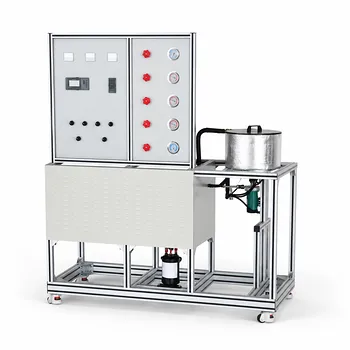
Here is the reality: In any fractionation or stripping pilot plant, determining the mixture’s dew point is not a theoretical exercise; it is the bedrock for setting all safe and efficient overhead operating parameters.
The dew point is the precise temperature at which a vapor starts to condense. For a pilot plant, this calculation directly determines the minimum allowable temperature for the column’s overhead vapor line and the inlet of the overhead condenser. If you operate below that temperature, unwanted condensation begins, flooding trays with unintended liquid and corrupting your data. If you operate far above it without purpose, you waste energy and potentially degrade heat-sensitive products. This one parameter defines the boundary between a successful separation run and a failed experiment.
Identifying the dew point is critical because it fixes the absolute lower thermal limit for the overhead system. In a stripper, it dictates the minimum temperature to keep the overhead product fully vaporized. In a fractionator, it defines the condenser setpoint required to initiate the controlled condensation that creates the essential liquid reflux, making it the master switch for both mass transfer and hydraulic stability in the pilot plant.
The Dew Point as a Thermodynamic Gateway
At its core, the dew point is the temperature where a vapor mixture at a given pressure becomes saturated and yields its first droplet of liquid. Mathematically, it’s the condition where the sum of vapor mol fractions divided by their equilibrium K-factors equals 1.0 ($\sum Y/K = 1.0$). This single equation encapsulates the vapor-liquid equilibrium for the entire overhead mixture.
Understanding this point allows you to pinpoint the exact moment a gas stream will begin to condense. It moves the operation from guesswork to precise thermodynamic control, which is non-negotiable when scaling learnings from the pilot plant to a full-scale unit.
Setting the Boundary Conditions in Fractionation
The Overhead Condenser’s Non-Negotiable Limit
In a fractional distillation pilot plant, the top of the column functions because of reflux—the liquid sent back down to contact rising vapor. That reflux can only be generated if the overhead vapor stream is cooled below its dew point inside the condenser.
The calculated dew point therefore defines the maximum operating temperature for the condenser outlet. If your cooling medium cannot bring the vapor below that dew point, you will get no condensate, no reflux, and no fractionation. The column essentially becomes a single-stage flash vessel.
Establishing the Column’s Thermal Anchor
Multi-component distillation uses the dew point and bubble point to bracket the entire column temperature profile. The condenser setpoint must be linked to the dew point of the top vapor. Setting it incorrectly causes either incomplete condensation (vapor losses) or excessive subcooling, which upsets the internal reflux ratio and wastes chilling energy.
This anchor point ensures that the vapor leaving the top tray is optimally cooled just enough to form the downward liquid flow, stabilizing mass transfer across every stage.
Preventing Catastrophic Failure in Stripping Operations
The Danger of an Unplanned Liquid Phase
In a stripping pilot plant—such as a crude column side stripper—the entire objective is to remove a lighter component from a liquid using a rising vapor stream. The dew point of the overhead vapor mixture tells you the absolute minimum temperature that must be maintained in the stripper’s top head and vapor line.
If the metal temperature drops below the dew point, vapor condenses prematurely. This unintended liquid can trickle back down, collapse the vapor flow, and flood the top tray, instantly destroying the stripping efficiency and making mass balance closure impossible.
The Role of Superheated Steam
The primary reference highlights a stripper operating at 34.7 psia with an overhead dew point of 313°F. That number dictates whether plain steam or superheated steam is required as the stripping medium. If saturated steam cools the system below 313°F, condensation will occur. Superheated steam is introduced specifically to keep the operating temperature safely above the dew point, ensuring the entire overhead product remains in the vapor phase until it reaches the intended condenser.
The Hidden Dangers of Ignoring the Dew Point
Data Corruption and Run Destruction
In pilot-scale drying and stripping units, the consequence of dipping below the dew point is immediate and visible. Moisture condenses back onto the drying product, caking the material and ruining the run. In a distillation column, invisible deep-wall condensation can cause intermittent weeping, tray instability, and pressure fluctuations, yielding purity and yield data that are worthless for scale-up.
Equipment Damage and Safety Hazards
Condensation in exhaust ducts or baghouses can clog filters and cause corrosion. But more critically, in systems with water-sensitive compounds, an unplanned liquid phase can lead to rapid exothermic reactions or corrosion rates that compromise the pilot plant’s structural integrity. The dew point calculation is a frontline safety check.
Understanding the Trade-offs
The Energy Cost of Over-Safety
While operating far above the dew point prevents condensation, it imposes a heavy penalty. Higher process gas temperatures demand significantly more heating utility on the front end and larger, costlier cooling systems to reject that heat later. For the pilot plant, this can mask true energy consumption data, making the full-scale design appear economically unfeasible.
The Reflux Ratio Tug-of-War
In fractionation, setting the condenser too cold (far below the dew point) might appear safe but it artificially inflates the reflux ratio. This delivers an overly optimistic separation that cannot be replicated economically at scale. The pilot plant’s true purpose is to teach the optimal setpoints, not just the safest ones. The dew point calculation is the objective foundation for that optimization process.
Making the Right Choice for Your Pilot Plant Goal
The dew point is your primary thermodynamic reference. Apply it deliberately based on your specific unit operation:
- If your primary focus is operating a stripping column: Use the overhead dew point to set the minimum wall temperature and to specify the required degree of superheat for your stripping steam. Keep the top tray and vapor line above that temperature at all costs to prevent back-condensation and flooding.
- If your primary focus is running a fractional distillation column: Tie the condenser outlet temperature strictly to the calculated dew point of the top vapor. This ensures controlled condensation for reliable reflux without over-subcooling, anchoring the entire column’s temperature profile and mass balance.
- If your primary focus is a pilot-scale drying or humidification process: Continuously calculate the exhaust gas dew point. Maintain the process temperature with a safe superheat margin to guarantee condensation-free ducts and valid moisture removal data from the product.
In every case, the dew point transforms from a textbook number into the single most important thermal boundary that separates a successful pilot run from a compromised one.
Summary Table:
| Unit Operation | Role of Dew Point | Operational Impact of Failure |
|---|---|---|
| Fractionation | Sets max condenser temp to initiate reflux | Zero reflux, loss of separation efficiency |
| Stripping | Defines min column head temp to keep vapor state | Premature condensation, tray flooding, data loss |
| Drying | Guides exhaust gas temp to avoid condensation | Product re-wetting, duct corrosion, filter clogging |
Elevate Your Chemical Engineering Lab with LABPARK
Bridge the gap between thermodynamic theory and practical application. LABPARK provides high-quality Educational and Vocational Unit Operations Pilot Plants in chemical engineering, bioprocess & biotech, and environmental & water treatment.
Tailored for universities, research institutes, and enterprises, our pilot systems empower students and researchers to master critical parameters like dew point control, reflux optimization, and column hydraulics.
Why partner with LABPARK?
- Robust, industrial-grade components scaled for education and research.
- Comprehensive curriculum support and safety-first designs.
- Tailored configurations to meet your specific curriculum or R&D goals.
Ready to upgrade your laboratory? Contact LABPARK today to request a custom quote and technical consultation!
Related Products
People Also Ask
- Why Switch Unit Operations Flow Configurations? Impact on Experimental Measurements
- Why is distinguishing between elastic and plastic deformation critical? Prevent tablet capping.
- How is unsteady-state flow analyzed & taught? Master Transient Systems in Unit Ops
- What are the differences between set-point, servo, and program control? Master unit operations training.
- How to use pilot plants to estimate gas compression costs? Master scale-up economics.