When gravity isn't enough to pull phases apart, centrifugal sedimentation becomes the essential technique for liquid–solid, liquid–liquid, and gas–solid systems that contain very fine particles or phases with only a tiny density contrast. The core reason is simple acceleration: by subjecting a mixture to a high centrifugal field, the effective driving force for particle movement can be hundreds or even hundreds of thousands of times greater than normal gravity. In chemical engineering pilot plants, this principle is demonstrated directly by running hydrocyclones and centrifuges alongside conventional gravity settling columns, letting researchers track separation kinetics and instantly see the otherwise impossible separations achieved.
Gravity settlers rely solely on buoyancy differences and fail completely when the phases are too similar in density or when particles are too small. Centrifugal sedimentation overcomes both limits by amplifying the net gravitational force, and unit-operations pilot plants make this acceleration tangible by letting you compare the two methods under identical conditions.
The Limits of Gravity-Driven Separation
Gravity settlers appear in countless process flowsheets because they are simple, passive, and cost nothing to operate. But their performance collapses in several common industrial scenarios.
When Density Differences Vanish
Even a moderate density difference can be overcome if the liquid–liquid or gas–solid interface is stable and the contact time is long. When the density gap between two liquid phases drops below about 100 kg/m³, however, the buoyant force becomes so weak that settlement can take days—or never happen at all. Stable emulsions, where tiny droplets are mechanically or chemically stabilized, defy gravity entirely.
The Challenge of Fine Particles and Emulsions
Particle size has a nonlinear impact on settling rate. According to Stokes' law, terminal velocity scales with the square of the particle diameter. That means a 1‑µm particle settles 100 times slower than a 10‑µm particle under identical gravity. In practice, sub‑10‑µm particles, gel‑like agglomerates, or droplets in stable emulsions exhibit gravitational settling times that are completely impractical for continuous processing. Gravity separation simply cannot meet the throughput or residence-time constraints of a modern plant.
How Centrifugal Force Transforms Sedimentation
Centrifugal equipment doesn’t change the underlying physics—it multiplies the effective body force acting on every particle.
The Separation Factor ($K_c$)
The ratio of centrifugal acceleration to gravitational acceleration is called the separation factor, or $K_c$, defined as $K_c = r \omega^2 / g$. This single number quantifies how much “stronger” the driving force becomes. Even a modest hydrocyclone can deliver a $K_c$ on the order of 5–50, while industrial decanter centrifuges routinely reach 3,000–10,000, and high‑speed tubular centrifuges can exceed 100,000. Because terminal velocity increases linearly with $K_c$, a 100‑µm particle that takes ten minutes to settle under gravity can be separated in a fraction of a second inside a centrifuge.
Practical Orders of Magnitude
- Hydrocyclones ($K_c \approx 5$–2500) use no moving parts and harness flow momentum to generate a swirling vortex. They excel at handling large volumes of dilute slurries and gas‑solid mixtures.
- Sedimentation centrifuges (decanter, disc‑stack) leverage $K_c$ values in the tens of thousands to break emulsions, clarify fermentation broths, and recover fine catalyst particles.
- Ultra‑centrifugal units (tubular, zonal centrifuges) reach $K_c$ > 100,000, making them indispensable for sub‑micron solids and nano‑emulsions.
This immense acceleration shatters the kinetic barrier that stalls gravity settlers. What was a thermodynamic possibility becomes a practical, continuous operation.
Understanding the Trade-offs
While centrifugal sedimentation is a powerful enabler, it is not a universal solution and carries its own set of compromises.
When Gravity is Still the Better Choice
For systems with a large density difference (>300 kg/m³), relatively large particles (>150 µm), and low throughput, gravity settlers remain the logical choice. They have zero energy input, no rotating parts, and virtually no maintenance. The capital cost and complexity of a centrifuge are simply unjustified when a simple tank does the job.
Beyond Acceleration: Process Implications
Centrifuges introduce shear that can damage sensitive biological products or break flocs. High‑g environments can also cause unwanted compaction in filtration centrifuges (when solids are the target), though sedimentation centrifuges designed for clarified liquid avoid this. Moreover, pilot‑scale data from a hydrocyclone cannot always be linearly scaled up; the flow patterns and particle residence-time distributions change with geometry. This is exactly why side‑by‑side pilot‑plant studies are so critical.
Demonstration in Unit Operations Pilot Plants
Pilot plants are where the theory meets measurable reality. They transform abstract force ratios into tangible process results.
Side-by-Side Comparison
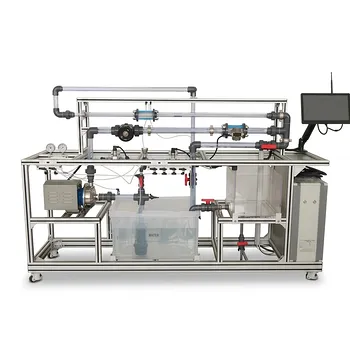
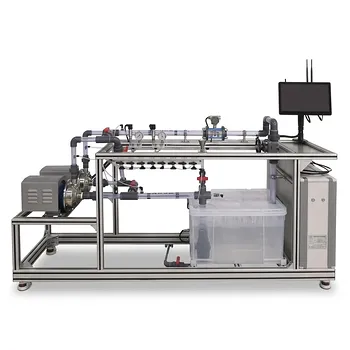
A typical unit‑operations module will pair a lab‑scale gravity settling column with a hydrocyclone or disc‑stack centrifuge on the same feed stream. Students and researchers can inject a known suspension—say, a dilute clay slurry or a colored emulsion—and then sample the clarified overflow from both units at timed intervals. The gravity column may show a murky, slowly clearing interface over hours, while the centrifuge delivers clear liquid in seconds. Turbidity meters, particle‑size analyzers, and phase‑volume readings produce hard numbers that validate the $K_c$ advantage.
Studying Separation Kinetics and Equipment Sizing
Pilot‑scale centrifuges are instrumented with flow meters, pressure sensors, and variable‑speed drives. That allows direct measurement of the residence time required to reach a given cut size. By running the same mixture through a gravity column, engineers can calculate the equivalent settling area that would be needed to match the centrifuge’s throughput—often revealing that a gravity unit would need to be the size of a small warehouse. This stark comparison teaches the core lesson: centrifugal sedimentation is not just faster; it is the only feasible path when space, time, or quality constraints are non‑negotiable.
Choosing the Right Separation Approach for Your Process
Your decision should always start with the nature of the mixture and the target product, not with the equipment itself.
- If your primary focus is clarifying a liquid from fine suspended solids (<50 µm) or breaking a stable emulsion: A sedimentation centrifuge is the go‑to solution. The high $K_c$ yields rapid clarification, and pilot‑plant data can pin down the exact g‑force needed.
- If your primary focus is dewatering a cake or recovering large, crystalline solids (>150 µm): Begin by evaluating a gravity thickener or a filtration centrifuge; sedimentation centrifuges may cause unwanted fines carryover and are not designed to deliver a dry solid.
- If you must design a process with extremely low energy consumption and the density difference is above 300 kg/m³: A gravity decanter deserves first consideration. Run a pilot‑scale gravity column to verify the settling curve before assuming centrifugation is required.
- If you are scaling up a new bioprocess with shear‑sensitive cells or proteins: Always test both a gravity settler (if viable) and a low‑shear centrifuge in the pilot plant. The balance between recovery yield and product integrity can only be found experimentally.
The fundamental lesson from pilot‑plant studies is that centrifugal sedimentation is not an upgrade to gravity—it’s a different regime entirely, one that makes the impossible routine by multiplying the force that drives separation. When you see the two side by side, the physics becomes undeniable.
Summary Table:
| Feature | Gravity Sedimentation | Centrifugal Sedimentation |
|---|---|---|
| Driving Force | Normal Gravity ($1\ g$) | Centrifugal Field ($K_c$ up to 100,000+) |
| Target Particle Size | Large particles ($>150\ \mu\text{m}$) | Fine particles ($<50\ \mu\text{m}$ & emulsions) |
| Density Difference | Requires $>300\ \text{kg/m}^3$ | Effective below $100\ \text{kg/m}^3$ |
| Separation Speed | Slow (hours to days) | Rapid (seconds to minutes) |
| Typical Equipment | Gravity settlers, settling columns | Hydrocyclones, disc-stack centrifuges |
Ready to bring advanced separation physics to your lab? LABPARK provides state-of-the-art Educational and Vocational Unit Operations Pilot Plants in chemical engineering, bioprocess & biotech, and environmental & water treatment. We help universities, research institutes, and enterprises validate separation kinetics and train future engineers with hands-on, industry-grade equipment. Contact LABPARK today to find the perfect pilot plant solution for your facility!
Related Products
- Centrifugal Pump Performance and Orifice Flowmeter Calibration Educational Pilot Plant
- Centrifugal Pump Performance Determination Educational Unit Operations Pilot Plant
- Chemical Pipeline Assembly and Fluid Transport Practical Training Unit Operations Pilot Plant
People Also Ask
- What features should instructors look for in pump & flowmeter pilot plants? Key Selection Guide
- Why start a centrifugal pump with a closed outlet valve? Protect your pilot plant motors.
- How to update chemometric calibration models in pilot plants? Best practices for process engineers.
- How can cavitation and slurry erosion be studied and mitigated using fluid transport and centrifugal pump pilot plants?
- How do pilot plants demonstrate siphon pressure variations? Visualizing Bernoulli's Energy Balance