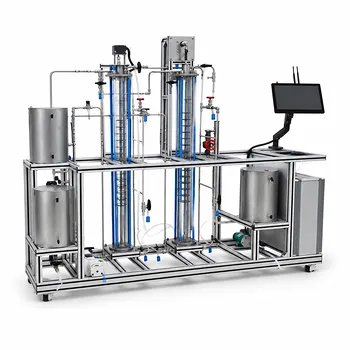
The simple answer: A liquid distributor is the single most critical internal component in a pilot-scale falling film evaporator because it alone creates the uniform, thin liquid film that coats each heating tube. Without precise distribution, dry spots form instantly, leading to severe fouling, a collapse in heat transfer efficiency, and thermal degradation of your product.
The entire performance of a falling film evaporator hinges on one principle: a continuous, undisturbed liquid film. The distributor is that physical gatekeeper—get it wrong, and even the best heat exchanger design will fail. In pilot-scale work, where you are proving a process before scaling up, this component’s design directly determines whether your data is trustworthy and your product is viable.
The Hidden Risk of an Uneven Film
Why Uniform Wetting Is Non-Negotiable
In a falling film evaporator, the feed liquid travels down the inside (or outside) walls of vertical tubes as a gravity-driven film. The boiling heat transfer coefficient is directly governed by whether that film remains intact and within the optimal thickness range. If the liquid flow per unit perimeter drops below a critical minimum, the film can rupture.
A ruptured film exposes dry metal. These dry spots instantly overheat, causing localized product burn-on, scaling, and an exponential drop in heat transfer. For heat-sensitive compounds, this also means irreversible degradation, ruining an entire pilot batch.
The Distributor as the First Line of Defense
The liquid distributor sits at the top of each tube, receiving the feed and converting it into a perfectly even curtain. Its job is twofold: to spread the liquid across the full tube circumference and to prevent vapor from channeling upward through the liquid inlet. A single flaw here ripples through the entire evaporator, making the distributor the foundational design choice.
Why Pilot-Scale Units Demand Exceptional Distributors
Amplified Consequences in Small Batches
Pilot plants work with smaller volumes and frequently test extreme conditions. A slight distribution inconsistency that might be averaged out in a massive industrial unit becomes a catastrophic failure in a pilot rig. Small-scale tubes have much lower total liquid holdup, so even a momentary dry streak can quickly foul the heat transfer surface and end an experiment prematurely.
Flexibility and Scale-Up Validation
A pilot plant’s core mission is to generate reliable data for scale-up. You will vary feed rates, concentrations, and temperatures. Your liquid distributor must maintain a uniform film across this entire operating window. If the film fails at low turndown rates, you lose the ability to test your process boundaries. The right distributor gives you the operating elasticity needed to explore your process limits safely.
Common Liquid Distributor Designs for Pilot Falling Film Evaporators
Spiral Groove Cylindrical Distributors
This design features an inner cylindrical plug with a spiral groove machined into its outer surface. When inserted into the top of the heating tube, the feed enters tangentially and is forced along the spiral path, creating a high-velocity swirling film. The centrifugal action ensures uniform tangential distribution and rapid wetting of the entire tube circumference.
- Best for: Processes demanding an immediate, vigorous film with high heat transfer coefficients right from the inlet.
- Watch out: The spiral must be precisely machined; clogging risks increase with viscous or solids-laden feeds.
Conical Distributors with Recessed Faces
Here, a cone is positioned above the tube, often with a slightly recessed or undercut face. Feed liquid cascades down the cone’s surface and transfers smoothly onto the tube wall. The recessed profile prevents the natural tendency of liquid to concentrate toward the center and drip into the tube core. It delivers a smooth, cohesive sheet without splashing.
- Best for: Applications where a gentle, laminar film entry is critical to avoid foaming or entrainment of liquid into the vapor space.
- Watch out: Requires precise leveling; any tilt will direct all the liquid to one side of the tube, creating instant dry spots.
Serrated Tube End Distributors
One of the simplest designs: the top edge of each heating tube is machined with a series of small, evenly spaced teeth or V-notches. Liquid pools slightly in a header above the tube sheet and spills over each tooth, creating many small individual streams that quickly merge into a film around the tube perimeter. It ensures even distribution around the full perimeter with no moving parts.
- Best for: Pilot setups that prioritize simplicity, frequent tube cleaning, or quick changes between tube sizes. It is highly resistant to plugging by fibrous solids.
- Watch out: Sensitivity to header level—if the feed rate fluctuates widely and the header depth changes, the flow over each notch becomes uneven. Turndown ratio is therefore limited compared to active designs.
Understanding the Trade-offs and Operational Limits
The Minimum Wetting Rate and Recirculation
No distributor can maintain a film if the total liquid flow rate is too low. Each fluid has a minimum wetting rate—defined by its viscosity, density, and surface tension—needed to keep a continuous film. In pilot evaporation, when you want to achieve a high concentration ratio and the forward-feed rate drops below this critical point, the solution is to recirculate a portion of the concentrate back into the feed.
A practical rule from pilot operation: if the evaporation rate of the feed exceeds 30%, you should strongly consider a recirculation loop. Recirculation boosts the liquid rate entering the distributor, keeping the film stable while still delivering your net evaporation target. This directly compensates for a distributor’s physical limits at low flow.
Clogging and Maintenance Reality
Pilot plants often handle experimental, crude, or fouling-prone solutions. The most efficient distributor design is useless if it plugs within an hour. A spiral groove distributor offers superior film initiation but has a higher clogging risk than an open serrated edge. When choosing, balance your need for film quality with the expected cleanliness of your feed. For long-duration runs with unknown scaling potential, a simple, easily cleaned design can save your experiment.
The Boiling Regime Connection
The heat transfer coefficient plateaus inside a narrow window of film thickness. If a distributor generates a film that is locally too thin, you risk dry spots. If it generates a thickened stream, thermal resistance rises and evaporation rate drops. The ideal distributor puts you squarely in the optimal film heat transfer regime across your entire planned operating flow range—not just at the design point.
Making the Right Choice for Your Pilot Goal
Your final selection should be guided by what you are trying to prove in your pilot campaign and how your feed behaves. Consider these focused recommendations:
- If your primary focus is handling heat-sensitive, high-value products: Choose a distributor that guarantees instantaneous, complete wetting with no stagnant zones—a well-machined spiral groove cylindrical distributor offers the vigorous swirling action needed. Pair it with a recirculation loop to stay well above the minimum wetting rate at all times.
- If your primary focus is maximum flexibility across varying feed rates and fluid viscosities: The conical distributor with a recessed face delivers a stable sheet without splash and resists center channeling, offering a forgiving turn-down ratio. Ensure your mounting system allows for precise leveling.
- If your primary focus is simplicity, fast cleaning, and rugged operation: A serrated tube end distributor is hard to beat. It has no small internal channels, is easy to inspect, and can be quickly swapped between tube sizes—ideal for a research pilot plant where the setup changes every week.
- If you are developing a process that will be scaled up: Match your pilot distributor type to the industrial design you intend to use. This ensures the film dynamics and wetting behavior you observe at small scale are directly translatable, avoiding a common scale-up pitfall.
Master the liquid distribution, and you master the foundation of your falling film evaporator. Your pilot plant will generate reproducible, reliable data, protect your product from degradation, and give you the confidence that what you see at small scale will repeat when you build the full-size unit.
Summary Table:
| Distributor Type | Best For | Key Watchout |
|---|---|---|
| Spiral Groove Cylindrical | Heat-sensitive feeds requiring instant, vigorous wetting. | High clogging risk with viscous or solids-laden feeds. |
| Conical with Recessed Face | Gentle, laminar film entry; preventing foam and splash. | Requires precise leveling to prevent uneven distribution. |
| Serrated Tube End | Simple, rugged operation and quick cleaning. | Highly sensitive to liquid header level fluctuations. |
Optimize Your Process Scale-Up with LABPARK
Are you looking to achieve precise, repeatable results in your pilot operations? LABPARK provides premium Educational and Vocational Unit Operations Pilot Plants in chemical engineering, bioprocess & biotech, and environmental & water treatment for universities, research institutes, and enterprises.
Whether you need to configure falling film evaporators or custom distillation systems, our expert team is here to help you design the perfect setup.
Contact our technical experts today to discuss your project requirements and request a quote!
Related Products
- Rising and Falling Film Evaporation Educational Unit Operations Pilot Plant
- Comprehensive Liquid-Liquid Extraction Pilot Plant for Engineering Education
People Also Ask
- How do educational unit operations pilot plants bridge theory and design? Bridge the Engineering Gap
- How do educational unit operations pilot plants address safety and waste management when scaling up?
- How is the heat transfer area calculated for an evaporation unit operations pilot plant during experimental design? Guide
- How to select educational evaporator pilot plants for thermal & scaling solutions? Complete Guide
- What are the structural characteristics & applications of rising-falling film evaporators in unit operations training?