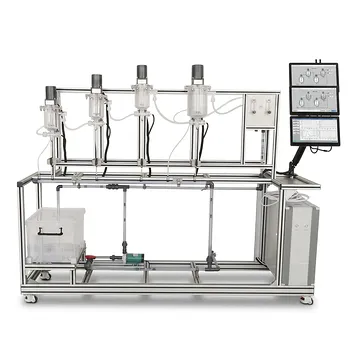
The defining preference for a Distributed Control System comes down to one word: resilience.
A centralized control system funnels every algorithm into a single computer. If that computer fails—even momentarily—the entire pilot plant grinds to a halt, potentially ruining ongoing experiments, compromising chemical safety, and wasting valuable lab time. A DCS avoids this by distributing control functions among localised field controllers while keeping a unified view for the operator. The result is a system where a failure in one loop does not cascade into a total plant shutdown, meeting the twin demands of a teaching lab: safety and experimental continuity.
A DCS is not just a safer choice; it’s the architecture that mirrors modern industrial practice. By spreading risk across multiple controllers, it preserves teaching uptime and gives students hands-on experience with the very control standards they will encounter in the process industries.
The Single-Point Failure That Makes Centralized Control a Liability
A pilot plant in an educational or research setting is deliberately complex—linking reactors, distillation columns, heat exchangers, and storage vessels. Every one of those unit operations depends on the control system.
One Processor, One Catastrophic Risk
In a centralized architecture, all control calculations live on a single process computer.
If that computer experiences a hardware glitch, a software crash, or even a planned reboot, every loop—pressure, flow, temperature, level—goes blind simultaneously.
For chemical processes that can be exothermic, pressure-sensitive, or catalyst-critical, such a blackout is not an inconvenience; it’s an immediate safety hazard.
The Educational Cost of Failure
In a university lab, a shutdown means more than lost material.
It disrupts carefully scheduled student experiments, destroys steady-state conditions that may have taken hours to establish, and can damage fragile catalysts or separation media.
When the goal is learning, unpredictability erodes trust in the equipment and undermines the entire pedagogical objective.
How a Distributed Control System Divides and Conquers Risk
A DCS fundamentally restructures the control problem. It splits decision-making across multiple field-mounted or backplane-based controllers, each responsible for a limited set of functions.
Localised Controllers, Isolated Failures
Instead of one brain, a DCS deploys several semi-autonomous brains.
If a controller managing the feed preheater fails, the distillation column’s controller continues regulating reflux and boil-up. The reaction loop, the absorption tower, and the solvent recovery unit all keep running.
This risk dispersion means one fault affects only a localized segment, leaving the rest of the pilot plant operational—exactly what is needed when multiple student teams are working on different unit operations simultaneously.
Centralised Monitoring Without Centralised Vulnerability
Operator stations in a DCS consolidate real-time data from every controller.
This gives the lab instructor or researcher a single, coherent picture of the entire process without reintroducing a single point of control failure. The controllers themselves execute the logic; the operator stations are passive viewers and configurators.
Even if an operator station goes offline, the underlying control loops continue to execute safely.
Beyond Safety: The Educational and Research Advantage
The DCS architecture is not just a damage-limitation tool. It directly serves the mission of teaching modern chemical engineering.
Industrial-Grade Control Algorithms as a Teaching Tool
A DCS natively provides a library of control strategies—basic PID, cascade, feedforward, ratio, and split-range.
Students can move from simple level control to complex multi-variable schemes without patching together separate hardware. The system becomes a living textbook where they see real-time process response under industrial-standard loop structures.
Modularity That Mirrors Real Plant Design
Modern DCS platforms are inherently modular.
When a new unit operation—say a membrane module—is added to the pilot plant, the lab can deploy an additional controller and integrate it into the existing HMI infrastructure without rewiring a central computer. This mirrors how process plants expand, making the pilot plant a faithful scale model not just of chemistry, but of automation architecture.
Training on the Interface of Industry
The HMI graphics, alarm management, and trending tools in a commercial DCS are nearly identical to those a graduate will see in a chemical park.
Running a distillation column through a DCS isn’t just about controlling the process; it’s about learning to navigate the interface that dominates the modern control room. This familiarity reduces the training gap between academia and the workplace.
Aligning with Standalone Unit Operation Pedagogy
Educational pilot plants are frequently designed as independent, self-contained skids for each operation.
This pedagogical choice allows students to master fundamentals without the distraction of total site integration. A DCS complements this perfectly: each skid can be controlled by its own dedicated processor, yet all can be monitored from one location. The control system therefore reinforces the standalone nature of the teaching equipment while still offering a window into plant-wide coordination.
Recognizing the Trade-offs
No architecture is perfect, and adopting a DCS in a teaching lab brings considerations that must be weighed against its clear reliability benefits.
Higher Initial Complexity and Cost
A DCS requires multiple controllers, a communication network, and engineering workstations.
Compared with a single-PC centralized setup, the upfront capital cost and the effort for initial configuration are greater. For labs with extremely modest budgets and no hazardous chemistry, this overhead can be a real barrier.
Network Health Becomes Critical
While a single controller failure is isolated, the communication backbone that ties the nodes together is not entirely risk-free.
If the plant network is poorly designed (e.g., a single, non-redundant switch), loss of communication can still disrupt operator visibility and inter-controller coordination. Redundancy planning must extend to the network itself.
Potential Overkill for Simple, Benign Demonstration Rigs
For a small, single-loop water tank demo, a DCS may offer far more than is pedagogically or operationally necessary.
In such cases, a simple, well-guarded centralized system might suffice—provided the risk of failure is low and no hazardous materials are involved.
Making the Right Choice for Your Educational or Research Lab
Your decision should be driven by the nature of your chemical processes and your primary instructional goals. Consider these guidelines:
- If your primary focus is safety and 24/7 research continuity: A DCS’s risk dispersion is non-negotiable. It protects your experiments and your personnel in a way no centralized system can.
- If your primary focus is teaching modern industrial control standards: A DCS is essential. The HMI, alarm philosophy, and modular engineering environment are direct replicas of what students will use professionally.
- If your primary focus is maximizing flexibility for future expansion: The plug-and-play nature of a DCS controller addition makes it the clear winner. Your pilot plant can grow incrementally without a control system redesign.
- If your primary focus is a minimal budget for a non-hazardous, static teaching rig: A well-engineered centralized PLC system might be acceptable, but you must accept the trade-off of a total plant shutdown on any processor failure.
By choosing the architecture that aligns with your lab’s real risk profile and educational mission, you turn the control system from a mere tool into a core component of the learning experience.
Summary Table:
| Feature | Distributed Control System (DCS) | Centralized Control System |
|---|---|---|
| System Resilience | High (No single point of failure; local loops continue) | Low (Single processor crash halts the entire plant) |
| Safety & Continuity | Safe local shutdowns; other unit operations run | Immediate hazards; disrupts all ongoing experiments |
| Industrial Training | Mirrors modern industrial process control rooms | Outdated representation of modern scale automation |
| Scalability | High (Modular additions with plug-and-play nodes) | Low (Requires complex rewiring of the central PC) |
Upgrade Your Lab with Resilient Pilot Plant Solutions
At LABPARK, we design and supply state-of-the-art Educational and Vocational Unit Operations Pilot Plants in chemical engineering, bioprocess & biotech, and environmental & water treatment.
Whether you represent a university, research institute, or enterprise, our pilot plant systems integrate robust, industry-standard control architectures that prioritize process safety, uptime, and hands-on professional learning.
Ready to elevate your training and research capabilities? Contact our engineering experts today to design a pilot plant tailored to your exact specifications!
Related Products
People Also Ask
- How does MRF model impeller rotation in CFD? Key Boundary Conditions Explained
- How can a CSTR pilot plant demonstrate reactor staging? Visualize volume savings.
- How does steady-state multiplicity affect the operation and safety of exothermic reactions within a CSTR pilot plant? - Guide
- What parameters to monitor transitioning from Batch to CSTR? Master Pilot Plant Setup
- Why is temperature regulation via a cooling jacket a critical feature in CSTR pilot plants used for laboratory training?