If you're quantifying magnesium in the complex mineral scales that foul boiler tubes and heat exchangers, the trusted gravimetric method relies on precipitating the element as magnesium hydroxyquinolate using 8‑hydroxyquinoline in a hot, ammonium‑hydroxide‑neutralized solution. The choice of drying temperature is not a trivial detail—it directly determines which chemical species you weigh. Drying at 105°C locks the precipitate in as the dihydrate salt, whereas drying at 130–140°C converts it to the anhydrous form. Maintaining precise, uniform temperature during this final step is the single greatest factor governing the accuracy of the magnesium number you report for your water‑treatment pilot study.
Magnesium in water‑formed boiler deposits is isolated and weighed as a hydroxyquinolate complex, but the analytical value is only as reliable as your drying oven. The temperature you select—105°C for the dihydrate or 130–140°C for the anhydrous salt—defines the stoichiometry of the weighed solid, and even a modest drift outside that window introduces systematic gravimetric error that cascades through the entire deposit analysis.
The Gravimetric Determination of Magnesium in Boiler Scale
The procedure distills magnesium into a well‑defined crystalline precipitate that can be captured on filter paper, dried, and turned into a direct weight measurement. Understanding the chemistry and the practical reasons for its continued use in pilot‑plant curricula reveals why this classic method remains indispensable.
Precipitation with 8-Hydroxyquinoline
After the scale sample is brought into solution—typically through acid digestion and carbonate fusion to destroy silicates—the magnesium is separated from iron, aluminum, and phosphate interferences. The clarified solution is made hot and carefully neutralized with ammonium hydroxide. A slight excess of 8‑hydroxyquinoline (oxine) is then added. Under these conditions, magnesium precipitates quantitatively as a bright yellow, granular complex of fixed composition.
The filtered precipitate is thoroughly washed to remove excess reagent and extraneous salts, then subjected to controlled drying. At this point, the drying temperature dictates the final molecular form: the dihydrate ( \text{Mg(C}_9\text{H}_6\text{NO)}_2 \cdot 2\text{H}_2\text{O} ) or the anhydrous ( \text{Mg(C}_9\text{H}_6\text{NO)}_2 ). The choice is yours, but it must be deliberate and executed with precision.
Why Gravimetry Remains a Trusted Method in Pilot Studies
In a teaching or research pilot plant that simulates industrial water‑treatment unit operations, the goal is often to correlate scaling rate with anti‑scalant dose, blowdown frequency, or feed‑water chemistry. Gravimetric methods deliver absolute, standards‑free mass measurements that circumvent calibration‑drift issues common with instrumental techniques. For an element like magnesium that often appears as a minor but mechanistically significant scale constituent, the direct weight of a stoichiometric precipitate gives a defensible, transparent number that students and engineers can trust.
The Critical Role of Drying Temperature
The difference between 105°C and 130–140°C is not a scale of convenience; it represents a chemical boundary. Crossing it changes what is on the balance pan, and therefore the factor that converts gross precipitate weight into magnesium oxide or elemental magnesium.
Dihydrate vs. Anhydrous: A Tale of Two Salts
At 105°C, the precipitate retains two water molecules of crystallization per magnesium center. This dihydrate is stable and well‑characterized, but it is inherently heavier than its anhydrous counterpart. If your laboratory protocol has been validated using the dihydrate gravimetric factor, you must dry exactly at this temperature. Moving to 130–140°C drives off both water molecules, yielding the lighter, anhydrous chelate. The gravimetric factor that converts weighed precipitate to ( \text{MgO} ) or ( \text{Mg} ) will be smaller, reflecting the loss of water mass.
The Consequences of Imprecise Temperature Control
A drying oven that overshoots the 105°C set‑point may partially dehydrate the precipitate, leaving you with a mixture of hydrated states and an unpredictable average molecular weight. The resulting error in your reported magnesium concentration is not random—it is a bias that will under‑ or over‑estimate magnesium depending on which temperature standard was intended. Similarly, if you aim for the anhydrous form but never quite reach 130°C, residual water inflates the weight and makes the scale appear to contain more magnesium than it actually does. In a pilot plant study comparing anti‑scalant chemistries, such an error can lead you to incorrectly judge the efficacy of a treatment program.
Magnesium Determination in the Larger Analytical Scheme
Magnesium is rarely the only scale component, and its measurement is intertwined with the rest of the deposit analysis. The supplementary references from water‑treatment pilot plant literature reveal that the accurate magnesium number is necessary to correct a major silica‑related interference.
From Silicate Interference to Accurate Silica Measurement
When a boiler deposit is treated with hydrofluoric and sulfuric acids, any magnesium originally present as magnesium silicate (( \text{MgO}\cdot\text{SiO}_2 )) is converted to magnesium sulfate (( \text{MgSO}_4 )). Because ( \text{MgSO}_4 ) has a higher formula weight than ( \text{MgO} ), the residue left after acid volatilization is artificially heavy. This leads to an underestimation of silica loss—the analyst believes less silica was present because the residue retained more mass. The correction requires first determining the true weight of ( \text{MgO} ) in the residue (by the hydroxyquinolate method), then converting that to the equivalent ( \text{MgSO}_4 ) weight using the factor 120.4/40.3. The difference between the two is added back to the measured silica loss, giving the correct silica value. Without an accurate magnesium determination, the entire silica balance is compromised.
Other Interfering Elements: Manganese and Barium
The supplementary notes further caution that manganese, common in natural water and accelerated by certain bacteria, will also precipitate with 8‑hydroxyquinoline if not removed beforehand. Barium can partially survive acid‑insoluble residue steps and co‑precipitate, masquerading as aluminum or lead components in other parts of the analytical scheme. These elements highlight why a well‑designed pilot‑plant curriculum includes ion‑exchange separation to isolate phosphate and careful group precipitation to remove iron and aluminum before magnesium is touched.
Understanding the Trade‑offs and Common Pitfalls
No analytical method is free of compromise, and the magnesium hydroxyquinolate gravimetric procedure demands respect for its subtle boundaries.
The Delicate pH Balance
The primary reference specifies a “neutralized solution containing ammonium hydroxide.” This is intentionally vague to an experienced analyst but critical: the pH must be high enough to ensure complete precipitation yet low enough to avoid dissolving the amphoteric aluminum and iron hydroxides that were previously removed. A pH near 9–10, buffered by ammonium hydroxide‑ammonium chloride, is typical. Drifting too alkaline risks re‑dissolving interfering metals or, worse, precipitating magnesium hydroxide that would not be recovered as the hydroxyquinolate.
Co‑precipitation Risks and How to Mitigate Them
Even with careful pH control, manganese and trace heavy metals can become entrained in the hydroxyquinolate lattice. The burden is on the analyst to perform a prior separation—usually by digesting with ammonium hydroxide to flocculate iron and aluminum as hydroxides, which also scavenges phosphate, and then treating the filtrate for magnesium. Ignoring this sequential separation is the most common source of “large errors” noted in the supplementary references. In a pilot‑plant laboratory, the trade‑off is time: thorough separation adds hours, but skipping it renders the magnesium value useless for engineering decisions.
Making the Right Choice for Your Pilot‑Plant Analysis
The drying temperature protocol you choose should mirror the gravimetric standard your laboratory has adopted and the level of detail required for your scaling study.
- If your primary focus is simple, rapid magnesium quantification without moisture‑balance concerns: Dry the precipitate at 130–140°C to obtain the anhydrous salt. The weight is stable and less sensitive to ambient humidity, making the final mass reading more reproducible.
- If your laboratory reference standard requires the dihydrate or you are cross‑referencing historical boiler‑scale data: Set the oven precisely to 105°C and verify the temperature with a calibrated thermocouple. Do not assume the oven dial is correct.
- If you need the magnesium number to correct an HF‑H₂SO₄ silica loss value: Double your care; the magnesium figure will be mathematically amplified through the 120.4/40.3 factor. Use only the anhydrous or dihydrate form consistently and document your choice transparently in the pilot‑plant log.
A single gram of boiler scale can reveal the hidden story of heat‑transfer fouling, anti‑scalant performance, and water‑chemistry failure—but only if your magnesium measurement is built on rigorous precipitation chemistry and unwavering temperature control.
Summary Table:
| Drying Temperature | Precipitate Form | Chemical Formula | Analytical Impact |
|---|---|---|---|
| 105°C | Dihydrate | Mg(C₉H₆NO)₂ · 2H₂O | Retains crystallization water; requires strict temperature control to prevent partial dehydration. |
| 130–140°C | Anhydrous | Mg(C₉H₆NO)₂ | Drives off water molecules; yields a lighter, highly stable salt less sensitive to humidity. |
Enhance Your Water Treatment Research with LABPARK
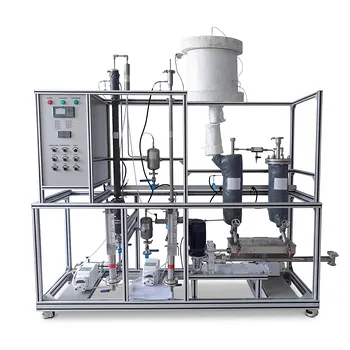
Accurate analytical chemistry relies on high-quality experimental setups. LABPARK provides advanced Educational and Vocational Unit Operations Pilot Plants in chemical engineering, bioprocess & biotech, and environmental & water treatment for universities, research institutes, and enterprises.
Our pilot plants simulate real-world industrial environments, allowing students and researchers to effectively study boiler scale formation, water chemistry, and purification processes.
Ready to upgrade your laboratory capabilities? Contact us today to explore our pilot plant systems!
Related Products
People Also Ask
- How Do Temp, Pressure & S:C Ratio Affect Methane Reforming? Optimize Your Pilot Reactor
- How to Integrate WGS & Purification in Steam Reforming Pilot Plants to Protect Fuel Cells from CO Poisoning
- What are the differences between steam reforming and ATR in pilot plants? Key Design Guide
- How is carbon deposition controlled in steam reforming? The Critical Role of S/C Ratio
- What is the difference between allothermal and autothermal steam reforming in pilot plants?