The ammonia precipitation method is the clear analytical choice for separating aluminum and chromium in boiler scale deposits because it overcomes two critical flaws of the basic succinate approach: painfully slow precipitate dissolution in acids, and the succinate ion’s ability to alter chromium’s oxidation state, compromising separation integrity. In pilot plant work, where rapid, reliable scale composition data directly drives fouling mitigation strategies, this difference isn’t just academic—it’s what keeps your corrosion and scaling models accurate.
For a water treatment pilot plant, time and chemical fidelity are non‑negotiable. The ammonia method earns its place because ammonium chloride buffering holds calcium and magnesium in solution, while the resulting hydroxide precipitate dissolves quickly in dilute acid, and crucially, it does not interfere with the oxidation state of chromium. The succinate method fails on both practical and chemical fronts: its precipitates resist dissolution and the succinate ion forcibly reduces hexavalent chromium to trivalent, destroying your ability to quantify speciation.
The Stakes: Why This Separation Matters in Pilot Plant Research
Understanding Scale Chemistry Under Realistic Conditions
Boiler scale isn’t a single substance. It’s a complex mixture of precipitated salts, corrosion products, and hardness ions. In environmental and water treatment pilot systems, you deliberately stress conditions to see what forms. Aluminum and chromium often appear as key indicators—aluminum from feedwater carryover or treatment chemicals, chromium from alloy corrosion.
The Analytical Bottleneck
To decide on pretreatment or chemical dosing, you need to know whether chromium is in its soluble hexavalent form or an insoluble trivalent deposit. You also need to isolate both metals from massive amounts of calcium and magnesium. The separation step you choose directly determines whether your subsequent elemental analysis is a true snapshot or a distorted picture.
Why the Succinate Method Falls Short
A Precipitation That Won’t Let Go
The basic succinate method relies on forming an aluminum‑chromium‑succinate precipitate that is notorious for its stubbornly slow dissolution in dilute acids. In a pilot plant curriculum, where dozens of samples may need processing within a working shift, this sluggishness becomes an unacceptable bottleneck. Each extra hour of waiting introduces the risk of contamination or changes in the deposit’s mineralogy.
Unwanted Redox Chemistry
The more insidious problem is the succinate ion’s interaction with chromium. Succinate acts as a mild reducing agent in a boiling solution. When hexavalent chromium—Cr(VI), often present as chromate—is present, succinate converts it to trivalent Cr(III). This destroys any possibility of distinguishing between the two oxidation states. Since hexavalent chromium is soluble and toxic while trivalent chromium is particulate, losing this distinction masks critical information about corrosion mechanisms and treatment efficacy.
A Compromised Mass Balance
Because Cr(III) hydroxide will co‑precipitate, you might still capture total chromium. But if your goal is to determine how much chromium was leaching as chromate, that data is gone. The succinate method forces a chemical change that doesn’t reflect the actual deposit in the boiler, turning your pilot plant into a misleading black box.
The Ammonia Precipitation Advantage
Clean Chemistry Through Selective Buffering
The ammonia method adds ammonium chloride and aqueous ammonia to the sample after copper has been removed. The NH₄Cl/NH₃ buffer maintains a pH around 8–9, where aluminum and chromium(III) form gelatinous, easily filterable hydroxides. Meanwhile, calcium and magnesium remain comfortably in solution because their hydroxides are either soluble or stabilized by the high ammonium ion concentration.
Rapid, Reproducible Dissolution
Once filtered and washed, the mixed hydroxide precipitate dissolves swiftly in warm, dilute hydrochloric or nitric acid. There’s no organic succinate matrix clinging to the metal ions. This direct dissolution means you can move straight into atomic absorption, ICP, or colorimetric analysis without the wait that cripples the succinate method.
Preserving the True Oxidation State
Without a reducing organic acid in the mix, any chromium that was originally hexavalent stays hexavalent through the separation. It does not co‑precipitate with the hydroxides—it remains in the filtrate. This allows you to analyze the filtrate for Cr(VI) and the precipitate for trivalent chromium and aluminum. Pilot‑scale studies on scale formation suddenly gain the power to track corrosion‑induced chromate release with real fidelity.
Understanding the Trade‑offs and Hidden Pitfalls
The Copper Interference Must Be Addressed
The ammonia method isn’t flawless. Copper, if present, will form a deep‑blue tetraamminecopper(II) complex that stays in solution and can contaminate later steps or catalyze undesirable side reactions. The method explicitly requires pre‑removal of copper, usually via precipitation as sulfide or extraction. Skipping this step can give falsely high chromium readings or discoloration that interferes with colorimetric endpoints.
Volatility and pH Sensitivity
Ammonia is volatile, and the buffer’s effectiveness depends on a narrow pH window. In a busy pilot plant lab, sloppy pH adjustment can cause incomplete precipitation or, worse, co‑precipitate magnesium as Mg(OH)₂. Both ruin the separation. This demands careful technique, but the gain in speed and accuracy justifies the extra care.
When Succinate Might Seem Tempting
If your work is limited to aged deposits where all chromium is already reduced to trivalent, and if throughput isn’t a concern, the succinate method’s single‑step precipitation might appear simpler. However, in any pilot study where you are mapping how operating conditions influence scale chemistry, the reduction of hexavalent chromium by succinate permanently obscures cause‑and‑effect relationships.
Making the Right Choice for Your Pilot Plant Analysis
Your analytical protocol shapes the insight you extract from every scale sample. Choose based on what you truly need to know.
- If your primary focus is tracking chromium speciation and corrosion mechanisms: Use the ammonia precipitation method. It’s the only one that leaves Cr(VI) unchanged, giving you a clear window into whether your alloy surfaces are passivating or actively pitting.
- If your primary focus is maximum throughput of simple total‑metal data: Still use the ammonia method after copper removal. The faster dissolution saves more time than any perceived simplicity of the succinate route, and you avoid the risk of incomplete recovery from a recalcitrant precipitate.
- If your primary focus is educating students on classic wet chemistry techniques: The succinate method offers a historical lesson, but pairing it with a direct comparison to the ammonia method teaches the critical importance of redox side‑reactions and dissolution kinetics.
The bottom line: An accurate separation is a data‑generation engine, not just a sample prep step. By choosing ammonia precipitation, you ensure every hour spent on the pilot plant translates into actionable, chemically honest scale‑formation intelligence.
Summary Table:
| Feature | Ammonia Precipitation Method | Basic Succinate Method |
|---|---|---|
| Dissolution Speed | Swift and rapid in dilute acids | Stubbornly slow; creates bottlenecks |
| Chromium Redox State | Preserved (distinguishes Cr(VI) vs Cr(III)) | Altered (reduces Cr(VI) to Cr(III)) |
| Interfering Elements | Requires pre-removal of copper | Less sensitive to copper, but loses speciation |
| Data Accuracy | High; reflects true corrosion mechanism | Low; distorts oxidation state distribution |
Optimize Your Water Treatment Research with LABPARK
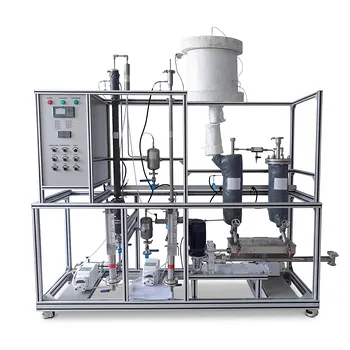
Accurate analytical data is the backbone of effective scale prevention and water treatment studies. LABPARK provides state-of-the-art Educational and Vocational Unit Operations Pilot Plants in chemical engineering, bioprocess & biotech, and environmental & water treatment for universities, research institutes, and enterprises.
Ready to elevate your laboratory and research capabilities? Contact LABPARK today to discover how our customizable pilot plant solutions can streamline your scale-formation and corrosion analyses.
Related Products
People Also Ask
- How Do Temp, Pressure & S:C Ratio Affect Methane Reforming? Optimize Your Pilot Reactor
- How to Integrate WGS & Purification in Steam Reforming Pilot Plants to Protect Fuel Cells from CO Poisoning
- What are the differences between steam reforming and ATR in pilot plants? Key Design Guide
- How is carbon deposition controlled in steam reforming? The Critical Role of S/C Ratio
- What is the difference between allothermal and autothermal steam reforming in pilot plants?