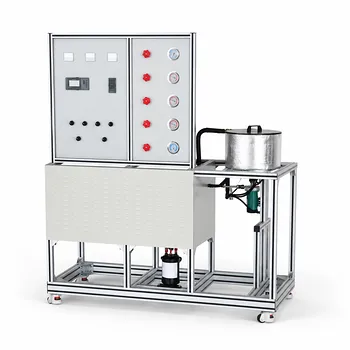
Compressive force is the master variable that directly dictates the internal architecture of a tablet. In a chemical engineering unit operations pilot plant, increasing the compressive force forces powder particles closer together, which increases the tablet’s density while simultaneously decreasing its porosity. This inverse relationship is quantified by the equation Porosity = 1 – (tablet density / true density of the powder), and understanding it is critical for balancing dissolution rate, mechanical strength, and defect-free production.
The central takeaway: Higher compressive force drives the compacted bed toward its true density, systematically collapsing internal voids. While this boosts mechanical integrity up to a point, it also reduces porosity—the very feature needed for rapid disintegration and drug release. Pilot-plant studies must therefore map force to porosity and density to pinpoint the compaction sweet spot, where the tablet is strong enough to survive handling yet porous enough to meet therapeutic dissolution targets.
The Fundamental Link Between Force, Porosity, and Density
The Immediate Response to Load
When the punch of a tablet press applies compressive force to a powder bed, the particles rearrange and pack more efficiently. Air is expelled from the interparticle voids, and the remaining pores shrink in both size and number. This densification directly increases the apparent density of the compact.
Because porosity is simply the fraction of the tablet volume occupied by air, the math is straightforward: as tablet density rises, porosity falls. The relationship Porosity = 1 – (tablet density / true density) is the fulcrum on which compaction analysis pivots.
Why This Matters on a Pilot Plant
In a unit operations pilot plant, you are not just making tablets—you are building a compaction profile for a specific formulation. By systematically varying compressive force and measuring the resulting density and porosity, you generate a curve that reveals how the material consolidates. This curve is your primary tool for predicting critical quality attributes like dissolution rate and hardness.
The Microscopic Events Driving Macroscopic Change
From Loose Packing to Interlocked Bed
At the start of compression, particles slide past one another with minimal force. As load increases, elastic and plastic deformation begin. Brittle materials fragment, creating fresh, clean surfaces, while ductile materials flow and fill voids. Both mechanisms reduce the distance between particle surfaces and increase the area available for contact.
Once that intersurface distance drops below about 100 nm, Van der Waals forces become the dominant binding glue, forming strong, stable agglomerates. This transition from simple proximity to genuine bonding is what transforms a loose powder pack into a coherent solid.
The Surface Area Paradox During Compaction
The fragmentation of granules initially increases the specific surface area, providing more sites for interparticle bonding. This produces a linear rise in tablet hardness and tensile strength. However, this is not a limitless gain. At very high forces, the intense plastic flow and fusion weld particles together to the point where the specific surface area actually decreases again. The material starts to behave more like a continuous solid, losing the microstructural texture that aids drug release. Pilot-plant monitoring of this surface area inflection is key to avoiding over-compaction.
The Compaction Curve and the Optimal Force Window
Plotting Porosity Against Force
One of the most instructive plots in pilot-plant work is porosity versus the logarithm of compressive force. This consolidation profile typically shows an initial sharp drop in porosity as voids collapse, followed by a more gradual decline as deformation mechanisms harden the material. The shape of this curve is a fingerprint of the powder’s compressibility and consolidation behavior.
Identifying the Sweet Spot
There is a finite operating window where the tablet is dense enough to handle and transport, yet porous enough to disintegrate quickly. Below this window, insufficient consolidation leaves large voids and weak bonding, causing low mechanical strength and internal cracking. Above the window, excessive force can drive porosity so low that dissolution slows unacceptably, and—worse—introduce defects like lamination.
The Danger of Over-Compaction: Lamination and Beyond
When Force Turns Destructive
If compressive force is pushed past the material’s elastic limit, the internal stress-strain state changes irreversibly. Instead of forming stronger bonds, the compact develops micro-cracks that propagate into horizontal splitting—lamination. This occurs because the effective surface area for stable bonding actually reduces as over-consolidation fuses particles and locks in residual stresses.
Crystal Structure and Force Sensitivity
The threshold for lamination is not universal. Materials with cubic crystal lattices often exhibit more symmetrical deformation and a wider safe compression range, while rhombohedral lattices may fail abruptly under high load. A pilot plant is the environment where these structure-property relationships are quantified, allowing you to select crystal forms that are truly manufacturable.
The Role of Dry Granulation and Ribbon Density
A Prior Step with Cascading Effects
When the process includes dry granulation, the density you apply upstream in the roller compactor has a profound effect on final compactability. Ribbons compressed at lower roller pressures have a lower apparent density but higher compactability during tableting, because they require less work to deform again. In contrast, high-density ribbons may flow well but become hard and resistant to further densification, demanding far more tableting force for the same final tablet porosity.
Pilot-plant optimization must therefore treat ribbon density as a tunable variable that balances granule flow properties against downstream compression efficiency.
Understanding the Trade-offs
Every compaction decision embodies a compromise between competing quality attributes. A clear-eyed pilot-plant study will deliberately explore these tensions.
- Strength versus dissolution: A denser, lower-porosity tablet is mechanically sturdy but may fail to release the drug in the required time window. Over-compression sacrifices bioperformance for robustness.
- Processability versus compactability: High-ribbon-density dry granules improve flow and weight uniformity but become harder to compact, requiring higher tableting forces that risk lamination.
- Initial surface area gains versus later fusion: Fragmentation at moderate forces boosts bonding area and strength, but exceeding the optimal force window fuses the created surfaces, reducing porosity without further strength gain and potentially leaving residual stress.
- Material stiffness and elastic recovery: Ductile materials may accommodate high forces better, while brittle, elastic materials may rebound after ejection, causing capping or lamination if the force was miscalibrated.
Pilot-plant data should map these trade-offs explicitly, so the final parameter set is a conscious, data-driven choice rather than a historical default.
Making the Right Choice for Your Pilot Plant Study
The connection between compressive force, porosity, and density is not just a textbook relationship—it’s the practical lever you pull to design a tablet that works. Tailor your compaction experiments to the specific goal at hand.
- If your primary focus is achieving target dissolution rates: Focus on the porosity vs. log force curve and identify the minimum compressive force that yields acceptable mechanical strength while preserving an open pore network for rapid disintegration.
- If your primary focus is mechanical integrity and defect-free manufacturing: Determine the upper force limit where lamination or capping first appears for your specific material, and operate well within that safe zone, even if it means accepting slightly slower dissolution.
- If your primary focus is quantifying material consolidation behavior: Gather density and porosity data across a wide force range, then calculate the Heckel or Kawakita parameters to describe plasticity and yield pressure—data that scales directly to production.
- If your process includes dry granulation: Do not treat tableting force in isolation; varying roller compaction pressure to control ribbon density is equally critical, as it dictates how much additional work the final blend can absorb before over-compaction sets in.
Use your pilot plant not as a miniature factory, but as a diagnostic instrument. By systematically mapping the force–porosity–density landscape, you transform an abstract relationship into a precise manufacturing control strategy.
Summary Table:
| Compressive Force Level | Tablet Density | Tablet Porosity | Mechanical Strength | Primary Risk/Outcome |
|---|---|---|---|---|
| Low | Low | High | Poor | Capping, low hardness |
| Optimal | Balanced | Balanced | Strong | Ideal dissolution & handling |
| High (Excessive) | Very High | Very Low | Brittle/Weak | Lamination, slow dissolution |
Optimize Your Compaction Research with LABPARK
Are you looking to master powder technology and tablet compression analysis? LABPARK provides state-of-the-art Educational and Vocational Unit Operations Pilot Plants in chemical engineering, bioprocess & biotech, and environmental & water treatment. Tailored for universities, research institutes, and enterprises, our pilot plants enable precise data collection to map compaction curves and prevent manufacturing defects.
Take your pharmaceutical and chemical engineering research to the next level—contact us today to find the perfect pilot plant solution!
Related Products
People Also Ask
- Why Switch Unit Operations Flow Configurations? Impact on Experimental Measurements
- Why is distinguishing between elastic and plastic deformation critical? Prevent tablet capping.
- How is unsteady-state flow analyzed & taught? Master Transient Systems in Unit Ops
- What are the differences between set-point, servo, and program control? Master unit operations training.
- How to use pilot plants to estimate gas compression costs? Master scale-up economics.