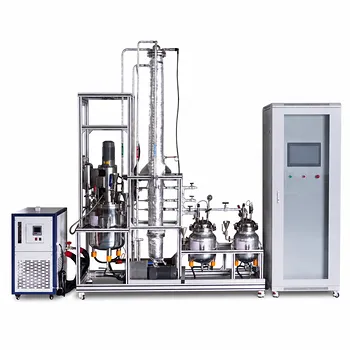
The choice between polyurethane foam and calcium silicate for pilot plant insulation is not a battle of "better" materials—it's a decision defined by your plant's temperature extremes and chemical environment. Each material dominates a distinct zone of the operational envelope. Calcium silicate provides the rugged, high-temperature backbone for hot processes, while polyurethane foam delivers lightweight, chemically resistant performance where heat loads are moderate. Understanding this split is the key to safe, efficient, and durable insulation design.
For a unit operations pilot plant, calcium silicate is the go-to material for high-temperature lines and vessels where moisture intrusion is a risk. Polyurethane foam excels in low-to-moderate temperature applications that demand excellent chemical resistance and versatility. Your selection should be driven first by the maximum service temperature, and second by the chemical and moisture conditions of the specific equipment.
The Fundamental Difference: Temperature Limits
The most critical line in the sand between these two insulations is their thermal endurance. Placing the wrong material on a hot pipe can lead to system failure, safety hazards, and costly rework.
Calcium Silicate: Built for the Heat
Calcium silicate is engineered for high-temperature service. It is a rigid, non-combustible insulation that can routinely handle continuous operating temperatures up to 650°C (1200°F), with some formulations going even higher.
This makes it the standard choice for steam lines, high-temperature reactors, and heat exchanger shells. Its structural integrity remains stable under thermal cycling that would instantly degrade foam-based materials.
Polyurethane Foam: A Defined Performance Ceiling
Polyurethane foam has a clear and lower thermal limit. Even high-heat-resistant formulations are typically not recommended for continuous use above approximately 100-120°C (212-250°F).
Beyond this point, the foam’s cellular structure can degrade, lose insulating properties, or, in the worst case, pose a fire risk. For any pilot plant stream operating above this threshold, polyurethane is simply not an option.
Beyond Temperature: Chemical and Environmental Resilience
Once the temperature filter is applied, the next decisive factor in a pilot plant is how the insulation handles moisture and chemical spills.
Moisture Resistance: A Contrast in Behavior
Calcium silicate inherently resists moisture absorption better than many other high-temperature fibrous materials. Its rigid, closed-cell-like matrix limits water ingress, which is crucial for preventing corrosion under insulation (CUI) on outdoor or wash-down piping.
However, it is not completely impervious. Polyurethane foam, with its high percentage of closed cells, provides an excellent vapor barrier. This makes it exceptionally effective at preventing condensation on cold or chilled water lines, where moisture pickup into the insulation would be catastrophic.
Chemical Exposure: PU’s Hidden Strength
The primary reference highlights a key advantage: polyurethane foam offers excellent chemical resistance. In a pilot plant, solvents, acids, and alkalis can easily spill or leak.
Polyurethane foam is largely inert to many of these chemicals, acting as a protective shell that won't quickly degrade upon contact. Calcium silicate, being cementitious, can be attacked by strong acids. While an outer jacketing is always recommended, a break in that jacket is far more damaging to calcium silicate than to a chemically resistant foam.
Mechanical and Installation Considerations
Pilot plants are dynamic, with constant modifications. The physical nature of the insulation affects installation speed and future maintenance access.
Rigidity and Structural Integrity
Calcium silicate is a hard, dimensionally stable material. It provides load-bearing support and can span pipe hangers as rigid pipe-support inserts. This structural strength is a major advantage on large-diameter vessels and high-temperature piping that moves with thermal expansion.
Application and Versatility
Polyurethane foam is lightweight and can be applied in several forms. It comes as pre-formed pipe sections, fabricated sheets, or even as a spray-applied foam, which is invaluable for insulating complex valve bodies, irregular flanges, and tight spaces.
Calcium silicate is limited to rigid blocks and pipe sections. For oddly shaped equipment in a pilot plant, the versatility of polyurethane often reduces installation time and eliminates awkward air gaps.
Understanding the Trade-offs
No material is perfect. A balanced decision requires acknowledging the downsides of each choice in the context of your total cost of ownership.
The Cost-Performance Equation
Calcium silicate typically has a higher material and installation cost due to its density and the labor required for cutting and fitting. However, its longevity at high temperatures justifies this expense for permanent, high-heat assets.
Polyurethane foam is often more economical for low-temperature insulation. But specifying it for a service temperature near its upper limit is a false economy. The risk of premature failure and replacement negates any initial savings.
Thermal Conductivity and Space Constraints
Polyurethane foam boasts a significantly lower thermal conductivity than calcium silicate. To achieve the same heat loss reduction, a polyurethane foam layer can be much thinner.
This is a critical trade-off in a pilot plant where space around pumphouses and pipe racks is limited. If your temperature is within the safe range, PU foam can save valuable physical space while meeting the required thermal performance.
Making the Right Choice for Your Pilot Plant
The correct material maps directly to your specific unit operation. Use these decision points as a practical guide.
- If your primary focus is on high-temperature operations (steam, hot oil, reactors above 120°C): Choose calcium silicate without hesitation; its thermal durability and structural strength are non-negotiable for safety and reliability.
- If your primary focus is on low-to-moderate temperature systems with aggressive chemical environments: Select polyurethane foam to leverage its chemical resistance and prevent rapid degradation from incidental spills.
- If your primary focus is on preventing corrosion under insulation (CUI) on outdoor or chilled-water piping: A closed-cell polyurethane foam, properly installed with vapor-tight joints, provides a superior moisture barrier compared to rigid calcium silicate alone.
- If your primary focus is on insulating complex geometries or needing rapid, flexible installation: Polyurethane’s spray-applied or easy-to-cut sheet forms will reduce engineering hours and improve fit on irregular vessel heads and valve assemblies.
By filtering your decision through temperature first, then chemical and moisture conditions, you will consistently select an insulation system that performs reliably from the pilot plant’s first cold flow test to its final high-temperature campaign.
Summary Table:
| Feature | Polyurethane (PU) Foam | Calcium Silicate |
|---|---|---|
| Max Service Temp | < 120°C (250°F) | Up to 650°C (1200°F) |
| Chemical Resistance | Excellent (highly inert to acids/solvents) | Moderate (susceptible to strong acids) |
| Moisture Resistance | Excellent vapor barrier (closed-cell) | Moderate (hygroscopic; risks CUI if jacket fails) |
| Form & Rigidity | Lightweight, spray-applied, sheets, or pre-formed | Heavy, rigid, dimensionally stable blocks/sections |
| Best Used For | Chilled lines, complex shapes, low-temp processes | High-temp steam lines, reactors, heat exchangers |
Optimize Your Pilot Plant Design with LABPARK
Selecting the right insulation is critical to the safety, efficiency, and durability of your chemical process. LABPARK provides cutting-edge Educational and Vocational Unit Operations Pilot Plants in chemical engineering, bioprocess & biotech, and environmental & water treatment.
We empower universities, research institutes, and enterprises with robustly engineered systems designed to withstand demanding thermal and chemical environments.
Ready to elevate your research or training facilities? Contact LABPARK today to discuss your custom project requirements!
Related Products
People Also Ask
- What challenges do gravity transitions present for pressure control in multiphase separation pilot plants?
- How does steady-state multiplicity affect the operation and safety of exothermic reactions within a CSTR pilot plant? - Guide
- Why is temperature regulation via a cooling jacket a critical feature in CSTR pilot plants used for laboratory training?
- What parameters to monitor transitioning from Batch to CSTR? Master Pilot Plant Setup
- How to select the right unit operations pilot plant for liquid separation? A complete guide.