When selecting a dryer for a pilot plant, the decision turns on two distinct priorities: protecting delicate particle structures from mechanical damage, and containing hazardous substances to safeguard operators. For shear-sensitive crystals (like fragile needles that break easily), you should choose a tumble dryer or a static tray dryer—these exert minimal mechanical force, preserving particle size and bulk density. For potent or toxic compounds, the focus shifts to complete containment; here, closed, agitated systems like rotary cone dryers or agitated filter dryers are the standard, as they prevent exposure while their internal mixing accelerates drying.
The core insight is this: gentle, passive handling protects the product, while active, sealed processing protects the person. When both factors are present—a hazardous material that is also shear-sensitive—you must prioritize safety first, then engineer gentleness inside a sealed environment, often by selecting a low-shear, vacuum-capable conical dryer.
Matching Equipment to Fragile, Shear-Sensitive Materials
Crystal shape, size, and mechanical strength dictate the force a dryer can safely apply. In a pilot plant, preserving these characteristics is essential for meaningful scale-up data.
The Problem with Agitation
Highly agitated dryers (conical screw dryers, paddle dryers, high-shear mixers) exert compressive and impact forces that can fracture needle-like or plate-like crystals.
Broken particles lead to a smaller, wider particle size distribution, lower bulk density, and poor flow properties—all of which complicate downstream formulation or tabletting steps. In a research setting, this destroys the very product attributes you need to study.
Tumble Dryers: Gentle Rotation, Minimal Shear
A tumble dryer works by slowly rotating a vessel (often under vacuum) so that the wet solids gently cascade in a “slumping” motion. The key advantage is extremely low shear: particles interact mostly with each other and the smooth vessel wall, not with impellers or blades.
This makes the tumble dryer the go-to choice for fragile, crystalline intermediates where maintaining the original crystal habit is a primary goal. Drying times are longer than in agitated systems, but the product integrity gain is often decisive.
Static Tray Dryers: No Movement, Maximum Protection
When even tumbling is deemed too aggressive, a static tray dryer offers a zero-shear solution. Wet cake is spread onto trays inside a heated, often vacuum-enabled, chamber. There is no particle motion—only conduction and radiation from the shelves, plus gentle convection if gas flow is used.
This method is ideal for extremely friable solids or for small, high-value pilot batches where any attrition is unacceptable. The trade-off is poor heat transfer; drying cycles can stretch for hours or even days, and the final product often requires manual scraping, which is unsuitable for toxic materials.
Equipment for Potent, Hazardous Compounds: Containment First
When the material is toxic, potent (e.g., high-cytotoxicity APIs), or poses an exposure risk, dryer selection is dominated by operator and environmental protection. Open handling is never acceptable.
The Mandate of Closed Systems
Closed systems physically isolate the wet cake, drying atmosphere, and dry product from the surrounding room. This includes sealed vessels, integrated gloveports, double-valve systems for charging and discharging, and dedicated dust collection with HEPA filters.
The primary goal is minimizing operator exposure. Any breach—such as opening a tray dryer to scoop out a toxic powder—would require complex and costly isolator or air-purifying-respirator controls, making open equipment impractical for potent compounds.
Rotary Cone (Conical) Dryers: Sealed Agitation with High Heat Transfer
A rotary cone dryer (or conical vacuum dryer) consists of a double-cone or slanted-cone vessel that rotates about an axis while an internal agitator, often a helical ribbon, gently stirs the bed. The entire vessel is sealed, and drying occurs under vacuum.
This design directly addresses the dual needs of a hazardous material: full containment and active mixing. The agitation dramatically improves heat transfer from the jacketed wall to the solids, cutting cycle times by 50–80 % compared to a static vacuum tray dryer. The result is a safer, faster, and more uniform process.
Filter Dryers: Combining Filtration and Drying in One Vessel
For potent materials arriving as a slurry, an agitated nutsche filter dryer offers the ultimate in containment. Filtration, washing, and drying all occur within a single sealed vessel, with no intermediate transfers that could cause exposure.
The flat, heated bottom and a slow-moving agitator (often with a retractable blade) provide mixing for drying and then smooth solids discharge. While the agitation is less intense than in some dedicated dryers, it still accelerates drying while keeping the process entirely enclosed—a major advantage for high-hazard pilot plants.
When Safety and Fragility Collide
A challenging real-world scenario arises when a compound is both highly potent and extremely shear-sensitive. In this case, you cannot sacrifice containment for gentleness; safety is non-negotiable.
- If the material is only moderately shear-sensitive, a low-speed rotary cone dryer or a filter dryer with an intermittent agitation cycle can work well. The agitation can be run in short pulses just enough to enhance heat transfer without breaking particles.
- If the material is extremely fragile, a static tray dryer inside a full isolator or glovebox may be the only option, despite the poor drying efficiency. Some pilot plants use vacuum static dryers with inert gas bleeding, maintaining containment while avoiding any particle movement.
- Always test with small batches in a pilot dryer with adjustable rotation/mixing speed to find the maximum allowable agitation that preserves particle size. This data is invaluable for scale-up.
Understanding the Trade-offs
Every dryer choice comes with inherent compromises. The right decision balances your primary objective against secondary costs.
Drying Time vs. Product Quality
Agitated, closed systems (conical, filter dryers) reduce drying time through forced convection/conduction and constant bed turnover. However, that same motion can degrade particle integrity.
Static tray dryers protect product quality at the expense of very long cycles and less uniform final moisture. For a pilot plant teaching unit operations, this trade-off between speed and quality is itself a valuable lesson.
Containment Complexity vs. Operational Simplicity
Enclosed dryers require robust sealing systems, pressure-rated vessels, and complex dust-handling setups. They are more expensive, harder to clean, and demand more training.
Open tray dryers or tumbler dryers (without containment add-ons) are far simpler but are completely unsuitable for hazardous materials. The cost of the dryer is dwarfed by the cost of secondary containment enclosures if you choose the wrong type.
Heat Sensitivity Add-on
Often, hazardous materials are also heat-sensitive. In such cases, vacuum operation becomes critical. Both rotary cone dryers and static tray dryers are readily available as vacuum vessels, allowing drying at low temperatures. Agitated nutsche filter dryers can also be operated under vacuum, making them the most integrated solution for heat-sensitive, potent compounds.
Making the Right Choice for Your Pilot Plant
Tailor your selection to the primary risk you need to manage. Use these goal-oriented guidelines to decide.
- If your primary focus is preserving fragile particle structure: Start with a static vacuum tray dryer for the most delicate crystals, or a tumble dryer if a small amount of gentle tumbling is acceptable. Avoid any dryer with internal agitation.
- If your primary focus is operator safety with a potent/toxic compound: Choose a hermetically sealed, agitated dryer—a rotary cone dryer for wet cake or a filter dryer for a slurry. Ensure it is vacuum-capable if the material is also heat-sensitive.
- If the material is both hazardous and extremely shear-sensitive: Prioritize containment first. Select a low-speed rotary cone dryer with pulsed agitation and validate at small scale. If even that causes breakage, design a high-containment static drying process inside an isolator.
- If your goal is to teach the principles of drying in a unit ops lab: Match the demonstration to the learning objective. Use a static tray dryer to show drying curves and kinetics; a rotary cone or filter dryer to illustrate the dramatic effect of agitation on heat transfer and cycle time under containment.
The right dryer transforms your pilot plant from a source of scale-up uncertainty into a reliable predictor of manufacturing reality—always aligning the equipment’s strengths with the material’s most critical vulnerability.
Summary Table:
| Material Type | Recommended Dryer | Key Benefit | Main Limitation |
|---|---|---|---|
| Shear-Sensitive (Fragile) | Tumble Dryer / Static Tray Dryer | Preserves crystal structure & size | Longer drying times |
| Potent / Hazardous | Rotary Cone / Agitated Nutsche | Complete containment & high safety | Higher cost & cleaning complexity |
| Both (Fragile & Hazardous) | Low-speed Rotary Cone (Pulsed) | Combines containment with low shear | Requires careful process validation |
Optimize Your Unit Operations with LABPARK
Are you looking to equip your university, research institute, or enterprise with advanced drying and processing systems?
LABPARK provides state-of-the-art Educational and Vocational Unit Operations Pilot Plants in chemical engineering, bioprocess & biotech, and environmental & water treatment. Our systems are designed to deliver reliable scale-up data, ensure operator safety, and enhance hands-on learning.
Contact our experts today to find the perfect pilot plant solution for your facility!
Related Products
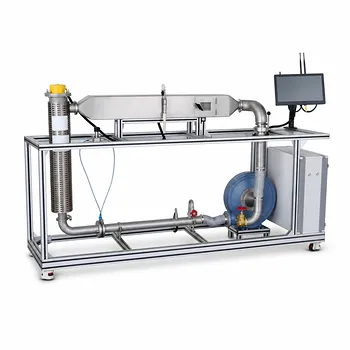
- Circulating Wind Tunnel Drying and Convective Heat Transfer Coefficient Determination Educational Pilot Plant
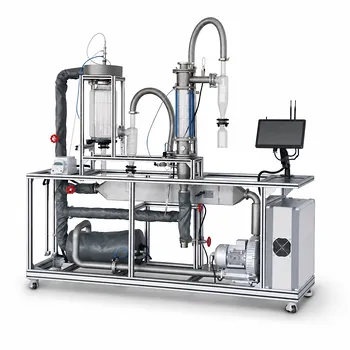
- Multi-Functional Drying Educational Unit Operations Pilot Plant
People Also Ask
- Why transition from laminar to turbulent flow is critical in convective heat transfer pilot plants?
- How does a unit operations pilot plant demonstrate fluid velocity vs heat transfer coefficient?
- How do tube arrangement & orientation affect condensation heat transfer? Optimize pilot plant performance.
- Why Are Thermal Properties Critical in Pilot Plants? Key Material Selection Factors
- What characterizes the transition to the falling rate drying period? Key scale-up insights.