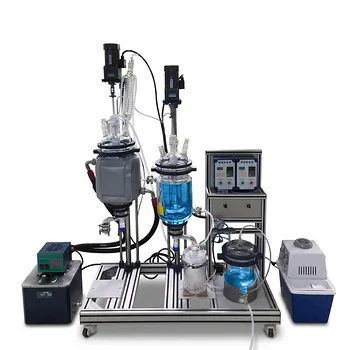
The heart of a crystallization pilot plant lies not in the hardware, but in the solute’s own physical personality. When selecting between an Oslo and a DTB crystallizer for educational or research purposes, your decision must be grounded in three non‑negotiable factors: the solute’s solubility–temperature curve, the target crystal size distribution (CSD), and the settling velocity of the crystals. For a unit‑operations laboratory, the choice also turns on which specific fluid dynamic mechanisms you need to demonstrate—from perfect fluidized‑bed classification to the gentle, internal circulation of a draft‑tube system.
Core Takeaway: The Oslo crystallizer is the definitive tool for producing exceptionally uniform crystals when their settling velocity exceeds 20 mm/s, while the DTB crystallizer handles a wider range of materials, requires only a settling velocity above 3 mm/s, and routinely delivers crystals in the 600–1200 µm range. The real educational value emerges not from picking one, but from understanding which physics each embodies.
The Solute’s Solubility Blueprint – Cooling, Evaporation, or Something Else
Before any equipment is chosen, you must map the solute’s solubility‑temperature relationship. This determines how supersaturation will be generated, which in turn influences crystallizer selection.
Matching the Method to the Solubility Curve
Cooling crystallization is the natural choice when solubility drops sharply with decreasing temperature.
If the solute shows little change in solubility over a wide thermal range, evaporative crystallization becomes necessary to remove solvent and drive nucleation.
For highly heat‑sensitive compounds or intermediate behaviours, vacuum adiabatic cooling bridges the two extremes.
Why the Method Matters for Oslo vs. DTB
Oslo crystallizers excel when the supersaturation can be developed in a separate, external chamber (cooling or evaporation) and then delivered to a fluidized bed.
DTB crystallizers integrate supersaturation generation inside the same vessel through a draft‑tube loop, making them inherently more versatile for reactive crystallization, evaporation, and vacuum cooling.
If the pedagogical goal is to demonstrate how a chemical reaction forms an insoluble product directly in the crystallizer, a DTB is the clear winner.
The Twin Pillars – Crystal Size Demands and Settling Velocity
The primary reference makes the distinction razor‑sharp: these two crystallizers are separated by the minimum settling velocity of the crystals they can process.
Oslo Crystallizer – The Classification Purist
An Oslo unit relies on fluid velocity alone to classify crystals in a fluidised bed.
Only crystals with a settling velocity greater than 0.02 m/s (20 mm/s) can remain suspended and grow, while fines are carried upward and dissolved.
This hard threshold yields an extraordinarily narrow crystal size distribution, ideal for showing students how a “perfect” cut size is maintained in a classified bed.
DTB Crystallizer – The Gentle Giant
A DTB’s low‑speed propeller and draft tube create a gentle, high‑flow internal circulation loop that suspends crystals with a settling velocity as low as 3 mm/s.
This wider operating window allows the unit to produce larger crystals (typically 600–1200 µm) with high slurry densities (30–40%).
For education, the DTB illustrates how low shear and an annular baffle can simultaneously grow crystals and remove fines through a clarification zone—without ever subjecting the product to a pump impeller.
What You Can Teach – Fluid Dynamics and Crystallization Kinetics
The real power of a pilot‑scale crystallizer in an academic setting is its ability to make invisible forces visible.
Demonstrating Distinct Nucleation Mechanisms
Oslo units avoid contact‑induced nucleation entirely because the mother liquor circulation loop contains almost no crystals; the impeller never strikes a growing particle.
DTB units minimize, but do not eliminate, contact nucleation through low‑shear mixing, giving students a practical contrast between “gentle” and “zero‑contact” crystalline environments.
Showing How Hydrodynamics Shape Crystal Quality
Running the Oslo, students observe how fluidization velocity directly controls bed height, crystal residence time, and product uniformity.
In the DTB, they tweak impeller speed to see the balance between adequate suspension and excessive secondary nucleation.
When both units sit in the same laboratory, researchers can systematically isolate the effects of shear rate, classification intensity, and residence‑time distribution on the final crystal size distribution—a rare opportunity that mirrors real industrial scale‑up challenges.
Understanding the Trade‑offs – No Crystallizer Is Universal
Transparency about limitations builds a trustworthy teaching tool.
The Oslo’s Delicate Balance
The fluidized bed must operate within a narrow velocity window. Too high a flow rate strips away crystals; too low a flow rate collapses the bed.
This constraint caps production capacity and demands a stable, well‑characterised crystal system with a settling velocity safely above 20 mm/s.
Setting up an Oslo for a new compound often requires extensive fluidization trials, which can consume precious lab time.
The DTB’s Classification Imperfections
While the baffle zone clarifies mother liquor and removes fines, classification is less sharp than in a pure fluidized bed.
Some fine crystals may still escape destruction and widen the CSD—a valuable lesson for students on the real‑world trade‑off between throughput and uniformity.
The internal impeller, even at low speed, introduces a small amount of shear that can be problematic for extremely fragile needle‑shaped crystals.
Footprint and Flexibility
An Oslo typically requires two separate vessels (a supersaturation chamber and a fluidized‑bed vessel) plus piping, making it a larger‑footprint installation.
A DTB packs the entire operation into one compact column, ideal for laboratories with limited space that still want to demonstrate evaporative, cooling, and reactive modes in a single unit.
Making the Right Choice for Your Pilot Plant’s Mission
The optimal crystallizer is the one that aligns with what you need to teach or investigate. Use these goal‑specific guidelines to decide.
- If your primary focus is producing perfectly uniform crystals and teaching fluidized‑bed classification: Choose the Oslo crystallizer, and confirm your target compound readily forms crystals with a settling velocity above 20 mm/s.
- If your primary focus is demonstrating evaporative or reactive crystallization with a forgiving, high‑density slurry: Choose the DTB crystallizer, and target crystal sizes in the 600–1200 µm range with a settling velocity greater than 3 mm/s.
- If your primary focus is building a comprehensive unit‑operations laboratory that compares contacting mechanisms: Integrate both types. Run the same solute on the Oslo and the DTB to let students measure how classification intensity and shear alter nucleation rates, shape, and size distribution.
A well‑configured crystallization pilot plant becomes far more than a collection of vessels—it is a physical textbook where every pump, baffle, and fluid stream tells a story about how nature builds order.
Summary Table:
| Feature / Parameter | Oslo Crystallizer | DTB (Draft Tube Baffle) Crystallizer |
|---|---|---|
| Min. Settling Velocity | > 20 mm/s (0.02 m/s) | > 3 mm/s (0.003 m/s) |
| Target Crystal Size | Highly uniform, narrow CSD | 600–1200 µm (larger, wider CSD) |
| Primary Suspension Method | Fluid velocity alone (fluidized bed) | Low-speed propeller & draft tube |
| Nucleation Environment | Zero-contact (no impeller contact) | Low-shear internal circulation loop |
| Best Pedagogical Use | Fluidized-bed classification dynamics | Evaporative, cooling, & reactive crystallization |
Upgrade Your Unit Operations Laboratory with LABPARK
Are you looking to configure the perfect crystallization system for your students or researchers? LABPARK design and provides high-quality Educational and Vocational Unit Operations Pilot Plants in chemical engineering, bioprocess & biotech, and environmental & water treatment for universities, research institutes, and enterprises.
We help you bridge the gap between theory and industrial practice by delivering robust, custom-engineered Oslo and DTB crystallization pilot plants tailored to your curriculum and research goals.
Contact LABPARK Today to discuss your laboratory requirements with our technical experts!
Related Products
- Potassium Salt Thermal Dissolution and Crystallization Separation Educational Unit Operations Pilot Plant
- Multi Functional Membrane Crystallization Educational Unit Operations Pilot Plant
People Also Ask
- What are the benefits of integrating online PAT tools like ATR-FTIR into crystallization unit operations pilot plants?
- How do crystallization pilot plants improve student learning? Shift from manual observation to process control.
- Why is precise temperature control critical in crystallization pilot plants? Key to Scale-Up Success
- Control Crystallization Pilot Plant Secondary Nucleation: 4 Key Adjustments
- What key factors should be considered when configuring a crystallization unit operations pilot plant?