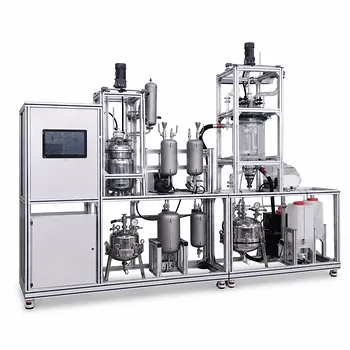
ASE pilot plants demand precise control over four interconnected parameters. Temperature, pressure, solvent polarity, and static cycle time form the core of every successful extraction. Without rigorous monitoring and control of each, reproducibility and efficiency collapse.
Mastering Accelerated Solvent Extraction at pilot scale isn't about choosing the right solvent alone—it's about orchestrating temperature, pressure, polarity, and dwell time to keep the solvent liquid, mobile, and chemically active, all while maintaining safe operating boundaries.
The Four Critical Pillars of ASE Control
Temperature: The Kinetic Accelerator
Temperature is the primary lever for extraction speed. By heating solvents between 75°C and 125°C, you reduce their viscosity and surface tension. This allows the solvent to penetrate solid matrices faster and dissolve target compounds more effectively.
Higher temperatures disrupt intermolecular forces between analytes and the matrix. However, the upper limit isn't arbitrary—it must stay below the thermal degradation point of your target compounds. A common sweet spot for many environmental applications is 100°C, balancing speed with compound integrity.
Pressure: The Phase Enforcer
Pressure’s sole purpose is to keep the solvent liquid above its atmospheric boiling point. ASE deliberately pushes solvents like acetone, dichloromethane, or water well past their normal boiling points. Without sufficient back-pressure, they would vaporize, destroying the liquid-solid extraction process.
Maintain the system at approximately 1,500 psi. This value is non-negotiable for most methods; it ensures the solvent molecules remain in a dense, liquid state that can effectively solvate analytes. Monitoring the pressure transducer and checking for leaks are critical safety and performance checks before every run.
Solvent Polarity: The Selectivity Switch
The solvent’s polarity must match the target compound’s chemistry. A non-polar solvent will never effectively pull a polar alkaloid from plant tissue, and vice versa. This parameter is often "configured" more than actively "controlled" in real time, but its selection dictates the entire extraction mechanism.
Pilot plants often use a single solvent or a pre-mixed binary system. The choice is guided by the target’s polarity index—moving from non-polar solvents like hexane toward polar ones like methanol. The goal is to maximize solubility for the analyte while leaving unwanted bulk matrix components behind.
Static Cycle Time: The Equilibrium Manager
Extraction isn’t infinite; it’s driven by concentration gradients. As analytes dissolve into the solvent, the gradient flattens and extraction slows. Static cycle time describes how long the cell holds the solvent at target temperature and pressure before flushing it out and introducing fresh solvent.
By reducing the static time and increasing the number of cycles, you repeatedly reset the concentration gradient. This is especially critical for samples with high analyte loads or complex, tightly bound matrices. Typical pilot-scale extractions of 1–100 g samples complete safely within 15 to 25 minutes total, using multiple short static cycles.
Understanding the Trade-offs
The Speed vs. Selectivity Balance
Pushing temperature and static time to extremes always involves trade-offs. A very high temperature can co-extract unwanted matrix components, causing messy chromatograms later. Long static times can saturate the solvent, leading to diminishing returns and wasted time. The optimal method finds the lowest temperature and fewest cycles that still achieve quantitative recovery.
Thermal Degradation Risk
Not all compounds tolerate the recommended 75–125°C range. Thermally labile analytes, like certain vitamins or volatile fragrances, can decompose. In these cases, you must sacrifice extraction speed for gentler conditions, potentially operating at the lower end of the temperature range while extending static time or increasing cycle counts to compensate.
Pressure Limits and Safety
1,500 psi is a standard, not an absolute safety limit. The pilot plant's tubing, seals, and extraction cells are rated for far higher pressures, but 1,500 psi keeps most common solvents safely above their boiling points at 125°C. Always verify that your system’s pressure relief valves and rupture disks are rated appropriately. Exceeding the solvent’s critical point accidentally can trigger phase changes that damage inline detectors.
The Solvent Recovery Penalty
The easiest extraction solvent at the cell level can become a nightmare to recover. ASE methods often favor solvents with low boiling points for easy evaporation post-extraction. However, very volatile solvents present high vapor pressure at 100°C and require robust condensation systems. Selecting a solvent that is both an effective extractant and easy to recover via integrated distillation is key for economic pilot operations.
Making the Right Choice for Your Extraction Goal
Once you understand these four levers, you can tune the pilot plant for specific outcomes. The same instrument can tackle hardened polymers, fragile biota, or environmental soils by adjusting the hierarchy of control.
- If your primary focus is thermal sample integrity: Clamp temperature at the lower end (75°C) and compensate with additional static cycles. Monitor pressure only for safety, not performance.
- If your primary focus is maximum throughput: Push temperature to 125°C and use the shortest static cycle time that still maintains equilibrium. Validate that no analyte degradation occurs at that thermal limit.
- If your primary focus is method transfer from a textbook SOP: Lock temperature and pressure to exactly the published values (commonly 100°C and 1,500 psi). Only alter static time and number of cycles to adapt to your specific sample mass.
- If your primary focus is fractionating complex mixtures: Start with a low-polarity solvent for a set of static cycles, then switch to a higher-polarity solvent in subsequent cycles to strip more tightly held compounds. Monitor pressure to ensure the new solvent remains liquid.
The art of ASE configuration is learning when to hold a parameter rigidly fixed and when to use it as a tunable dial. By treating temperature, pressure, polarity, and time as an integrated system rather than isolated settings, you turn the pilot plant from a brute-force extractor into a precision analytical tool.
Summary Table:
| Parameter | Target Range / Setting | Primary Role & Purpose |
|---|---|---|
| Temperature | 75°C – 125°C | Decreases solvent viscosity to accelerate extraction speed. |
| Pressure | ~1,500 psi | Keeps the solvent in a dense liquid state above its boiling point. |
| Solvent Polarity | Selected based on analyte | Determines chemical selectivity and matches target compounds. |
| Static Cycle Time | 15 – 25 minutes (total) | Resets concentration gradients to maintain extraction equilibrium. |
Scale Up Your Extraction Processes with LABPARK
Achieving precise control over critical extraction parameters requires robust and reliable equipment. LABPARK provides premium Educational and Vocational Unit Operations Pilot Plants in chemical engineering, bioprocess & biotech, and environmental & water treatment.
Whether you are equipping a university lab, a research institute, or an industrial R&D facility, our pilot plants deliver the scalability, safety, and precision control you need to bridge the gap between lab-scale chemistry and industrial production.
Contact LABPARK today to discuss your pilot plant requirements with our technical experts!
Related Products
- Comprehensive Liquid-Liquid Extraction Pilot Plant for Engineering Education
- Carbon Dioxide Absorption and Desorption Educational Pilot Plant for Carbon Capture Studies
- Educational Rotary Disc Liquid-Liquid Extraction Pilot Plant
- Supercritical High-Gravity Flash Evaporation Educational Unit Operations Pilot Plant
- Gallium and Indium Selective Extraction Educational Pilot Plant
People Also Ask
- How do pilot plants differentiate physical vs chemical extraction? Enhance Chemical Engineering Training
- How to Estimate KD for Liquid-Liquid Extraction Pilot Plants Using Henry's Law when Lab Data is Limited
- Why is the plait point a critical limit in liquid-liquid extraction pilot plants? Safe LLE Operation
- In a liquid-liquid extraction pilot plant, how is a ternary-phase diagram utilized to determine solvent feed requirements?
- How to resolve emulsion in liquid-liquid extraction? 5 ways to ensure efficient phase separation