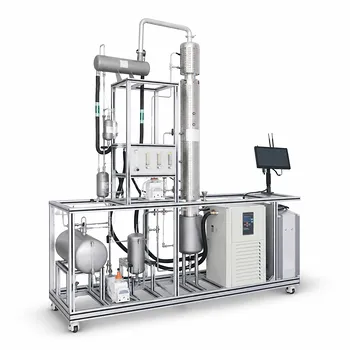
The path to a dense underflow and a crystal-clear overflow hinges on manipulating two fundamental phenomena: particle aggregation and water release. In continuous thickeners, this is achieved by introducing chemical flocculants to dramatically accelerate sedimentation and by employing a slow-turning rake to compact the settled sludge into a dense, pumpable slurry. Environmental pilot plants faithfully replicate these mechanisms using transparent continuous sedimentation columns, variable-speed rakes, and precision chemical dosing systems, allowing researchers to optimize underflow concentration and overflow clarity under fully observable conditions.
The true art of thickener operation lies not in speed, but in balance. Pilot plant simulation demonstrates that optimal performance comes from matching the correct flocculant dosage and rake speed to a specific slurry, creating escaping micro-channels for trapped water without resuspending the solids.
The Science of Accelerated Sedimentation: Chemical Conditioning
Flocculants: Bridging Particles for Quicker Settling
The primary method to accelerate sedimentation is the addition of flocculants. These are typically electrolytes or surfactants that neutralize surface charges on fine suspended particles.
Once the repulsive forces are eliminated, particles collide and bind together into larger flocs. This aggregation dramatically increases their effective size and weight, causing them to settle far more quickly than the original fine particles ever could on their own.
Temperature: Controlling the Medium's Resistance
A secondary, physical lever is the adjustment of temperature. The goal here is to lower the viscosity of the liquid, which is the internal friction resisting a particle's fall.
Warmer water is less viscous, allowing flocs to descend through it with significantly less resistance. While effective, this method demands a clear understanding of the energy cost versus the settling rate improvement for a given slurry.
Mechanical Compaction: How Rakes Turn Sludge into Dense Underflow
The Gentle Stirring Principle
Once the solids have settled to the bottom, the challenge shifts from speed to density. A slowly rotating rake mechanism is the key tool for compaction.
Operating at approximately 1 rpm in small-scale units, the rake does not aggressively mix the sediment. Instead, its gentle stirring creates a network of micro-channels within the sludge bed. These pathways provide an escape route for water trapped between the particles, allowing it to migrate upwards while the thickened solids are guided toward a central discharge port.
The Role of Feed Well Design
The journey to compaction begins even before the sediment reaches the floor. A well-designed feed well in the center of the thickener dissipates the incoming slurry's kinetic energy and distributes it evenly and gently into the settling zone.
This calm introduction prevents turbulence that would otherwise re-entrain particles, giving the flocculated solids the best possible start for a uniform, undisturbed descent towards the rake. In pilot plants, a bridge support—standard for these smaller-diameter units—provides a stable platform for both the feed well and the drive mechanism.
Simulating the Process in a Pilot Plant
The Transparent Column: A Window into the Process
Environmental and water treatment pilot plants simulate these operations using transparent continuous sedimentation columns. This visibility is the simulation’s superpower.
A glass or clear plastic column allows students and researchers to visually track the dynamic formation of the sludge blanket, measure settling rates in real time, and see exactly how clear the overflow becomes. It turns an opaque industrial process into an observable, teachable science experiment.
Variable Drives and Dosing: The Knobs of Optimization
The simulation hardware is designed for experimentation. A variable-speed rake drive lets users directly observe the impact of different rotation speeds on solids compaction and potential resuspension.
Simultaneously, a precise chemical dosing system is used to trial different flocculant concentrations. By systematically adjusting these variables along with the feed slurry's density, a pilot plant operator can map the complete operational envelope to find the exact settings that jointly optimize underflow concentration and overflow clarity.
Understanding the Trade-offs and Pitfalls
When Flocculation Becomes a Liability
The relationship with flocculants is a delicate balance. Over-dosing does not simply improve performance; it can create a bulky, voluminous floc that settles quickly but compacts poorly, resulting in a dilute underflow and higher chemical costs.
Under-dosing, on the other hand, leaves fine particles un-bridged, causing a cloudy overflow and inefficient solids capture. The optimal point is often surprisingly narrow.
The Danger of Over-Raking
A rake's gentle stirring is essential, but pushing the speed beyond its optimum is destructive. An over-speeded rake no longer creates micro-channels; it resuspends settled solids back into the liquid column.
This shears the floc, un-doing the work of the chemical conditioning and completely defeating the purpose of the thickener. The pilot plant's transparent column makes this catastrophic failure mode immediately visible.
The Energy Cost of Thermal Control
While heating a slurry to lower viscosity is technically effective, it is almost always energy-intensive. For pilot plant studies, this method is explored primarily to understand the fundamental physics or for very specific high-value applications where heating is otherwise free, such as utilizing waste process heat. It is rarely a primary optimization strategy for a standard municipal or industrial treatment line.
Optimizing Your Pilot Plant Simulations
- If your primary focus is maximizing overflow clarity: Begin with pinpointing the minimum effective flocculant dose through a series of jar tests adapted to the column, then fine-tune the feed well flow to ensure the gentlest possible introduction of the chemically conditioned slurry.
- If your primary focus is achieving the highest underflow density: Keep the flocculant dose precisely at its optimal, but invest your experimentation time in varying the rake's rotation speed and observing the bed-level response to find the sweet spot that creates maximum water-release channels without any particle resuspension.
- If your primary focus is understanding a new slurry and minimizing operational cost: Use the transparent column to visually map the "failure boundaries"—the dose at which floc becomes overly bulky and the rake speed at which the bed begins to cloud—and then dial back to a safe, efficient operating setpoint well within those limits.
Ultimately, the pilot plant and its simulated processes are a risk-free sandbox, turning the invisible dynamics of particle settling into a clear, controllable, and optimizable system.
Summary Table:
| Method / Component | Primary Function | Key Optimization Parameter |
|---|---|---|
| Chemical Flocculants | Aggregates fine particles into larger, faster-settling flocs | Precise dosage to avoid bulky flocs or cloudy overflow |
| Slow-Turning Rake | Compacts settled sludge by creating water escape channels | Rake speed (keep at ~1 rpm to prevent particle resuspension) |
| Temperature Adjustment | Reduces liquid viscosity to lower resistance | Balance energy cost vs. settling rate improvement |
| Transparent Column | Permits real-time visualization of sludge blanket dynamics | Ideal for tracking settling rates and verifying overflow clarity |
Optimize Your Environmental Engineering Curriculums and Research
To successfully master sedimentation and sludge compaction dynamics, having the right experimental setup is essential. LABPARK provides state-of-the-art Educational and Vocational Unit Operations Pilot Plants in chemical engineering, bioprocess & biotech, and environmental & water treatment.
Designed specifically for universities, research institutes, and enterprises, our pilot plants feature transparent continuous columns and high-precision controls to turn complex chemical and mechanical processes into clear, observable science.
Ready to elevate your laboratory capabilities? Contact LABPARK today to find the perfect pilot plant solution for your institution!
Related Products
- Continuous Batch Extractive Distillation Educational Pilot Plant
- Continuous Sieve-Plate Distillation Pilot Plant for Unit Operations Laboratory Education
- Multi-Functional Special Distillation Educational Pilot Plant
- 100L Continuous Loop Hydrogenation Educational Unit Operations Pilot Plant
- Constant Pressure Filtration Educational Unit Operations Pilot Plant
People Also Ask
- Wilson vs. UNIQUAC: How to Choose the Right Thermodynamic Model for Your Pilot Plant
- How to Configure a Distillation Pilot Plant? Key Steps for Multi-Mode Setup
- Why use non-ideal VLE calculations in distillation pilot plants? Ensure accurate scale-up & purity
- How does the feed thermal state influence distillation pilot plant design and utility consumption?
- How to Integrate Spectroscopy in Distillation Pilot Plants for Advanced Process Control