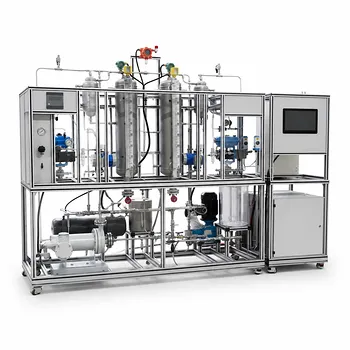
Achieving unshakeable reliability in a noisy bioprocess training plant is not a single fix—it's a two-front battle fought simultaneously on the physical and the digital plane. You must combine meticulous physical engineering to prevent noise at its source with intelligent software strategies that mathematically filter out what remains. Only this layered defense can turn a chaotic sensor stream into the trustworthy, high-fidelity data required for precise automated control and meaningful learning.
A robust control system for a training bioprocess plant must be engineered as a holistic entity. The ultimate goal is data you can stake a decision on. This demands a strategy where aggressive physical fortification of the signal path is non-negotiable, and where the automation software itself becomes an active partner in identifying, excluding, and correcting unreliable data points in real time.
The Two Layers of Signal Reliability
The core challenge in a noisy environment is that a control system is only as good as its sensor data. A single corrupted reading can trigger a cascade of erroneous control actions, ruining an experiment and teaching a dangerously flawed lesson about process behavior. The solution is a layered defense, starting where the signal is born.
Physical Fortification: Stopping Noise at the Source
Before any software algorithm can work, you must prevent as much noise as possible from ever entering the system. This involves treating the sensor and its immediate environment as a protected zone.
Eliminate physical interference in optical measurements. For sensors like polarimeters, which measure crucial parameters like sucrose concentration, even microscopic intruders are catastrophic. Bubbles in the measurement tube cause light scattering, generating erratic, unusable noise. A rigorous protocol of tilting the flow cell to guide all bubbles into a trap is not just best practice; it is essential for signal existence.
Prevent self-inflicted mechanical stress. The sensor assembly itself can be a source of noise if handled incorrectly. Over-tightening a polarimeter tube cap, for example, can induce stress birefringence in the optical glass. This creates a false optical rotation signal, a phantom reading that mimics a real change in the process but is purely a mechanical artifact. The fix is simple precision: secure the tube just enough to prevent leaks, no more.
Manage the sensor's lifecycle. The reliability of a signal starts with the health of its source. A light source in an optical sensor, like a sodium lamp, is not a simple lightbulb; frequent on-off cycling drastically shortens its lifespan and can cause unstable intensity output before it fails. For stable, long-term signals, the lamp should be left on for the duration of a campaign and only powered down when truly necessary, treating it as a precision instrument, not a room light.
Software-Level Signal Fidelity: Engineering Trust Through Math
Even the best physical setup will encounter electromagnetic interference (EMI) from pumps, motors, and other lab equipment. The job of the control and data acquisition software is to be inherently skeptical of raw data and to transform it into a validated, trustworthy signal.
Move beyond single-point readings to statistical sampling. The most powerful weapon against random electronic noise is multiplicity. A control system should not act on a single measurement. Instead, software must be programmed to take rapid, triplicate sample measurements and automatically calculate the average. This simple act of averaging smooths out transient spikes that are not representative of the true process state.
Implement real-time data validation. Averaging is only a first step. The software should also perform online statistical tests to qualify the data. For instance, calculating the standard deviation of the triplicate measurements is critical. If the deviation exceeds a pre-set threshold, the software knows the signal is too noisy to be trusted at that moment. Instead of passing faulty data to a PID controller, it can hold the last valid value, trigger an alarm for the student operator, or flag the data point for review. This turns the automation platform into a standalone measurement device with self-diagnosing accuracy.
Leverage computational models for signal stability. To further stabilize the data, the software should actively integrate and apply corrective models. This includes tasks like integrating chromatographic peak areas with sophisticated noise-filtering algorithms or applying a regression model to a sensor's non-linear response. By embedding this intelligence, the system doesn't just display a raw voltage; it computes a validated, high-level process value like "substrate concentration," actively ignoring the noise floor.
Understanding the Trade-offs
A perfectly powerful filter has the potential to create a perfectly blind system. Over-processing data carries its own significant risks that must be managed.
The danger of overdamping the signal. Aggressive averaging and filtering create a lag in the control response. If your statistical sampling window is too long for a fast-changing variable like dissolved oxygen after a stirrer speed change, the "clean" signal will be an old signal. The control loop will constantly be chasing a process event that already happened, leading to oscillation and instability that the filtering was meant to prevent.
The complexity-maintenance trade-off. The most sophisticated noise-rejection system is worthless if it becomes a "black box" for the trainees. In a teaching environment, an overly complex, automated signal validation system can obscure fundamental principles. If the software silently corrects bad data, students may never learn to recognize physical problems like a fouled sensor or a bubble in the line. The system must provide transparency by flagging interventions, not invisibly papering over them.
Physical robustness vs. accessibility. A completely hard-piped, electro-polished, and permanently sealed system is physically robust against noise and corrosion but is a nightmare for a training plant where students need to reconfigure lines, swap sensors, and understand each component. The design must balance the need for clean, interference-free connections with the educational need for flexible, tactile, and visible hardware.
How to Engineer a Reliable Training System
The optimal architecture depends on which outcome you value most for your trainees and your process.
- If your primary focus is impeccable data quality for kinetic modeling: Prioritize heavy software-side signal processing. Implement triplicate measurement protocols, invest in software with built-in peak integration and regression tools, and accept the slight process lag in exchange for laboratory-grade data precision.
- If your primary focus is teaching sensor diagnostics and the reality of industrial noise: Prioritize transparency over automated correction. Build the physical robustness (bubble traps, stress-free mounting) but configure the software to alarm on high standard deviations rather than silently withholding a value. Force the student to diagnose the cause of the noise, making them a better process engineer.
- If your primary focus is the performance of feedback control loops: Speed is your metric. Optimize the sampling and averaging window to be fast enough for your critical loops, like dissolved oxygen control. Tune your PID controllers with the inherent lag of your validated signal in mind, and accept that you'll define "reliability" as an acceptable band of minor jitter rather than a dead-flat line.
The path to a reliable signal in a noisy world is not to demand silence but to architect a system that is physically disciplined and mathematically savvy enough to know the difference between a process event and an insult.
Summary Table:
| Layer | Key Measure | Target / Benefit |
|---|---|---|
| Physical | Eliminate bubbles & limit mechanical stress | Prevents light scattering and false optical readings |
| Physical | Manage sensor lamp lifecycles | Ensures stable light intensity and long-term signal output |
| Software | Implement triplicate sample averaging | Smooths out transient electronic noise and random spikes |
| Software | Validate real-time standard deviation | Flags faulty data and prevents corrupted control loops |
Optimize Your Training Environment with LABPARK
Building a reliable bioprocess training setup requires the perfect balance of robust hardware and smart software integration. LABPARK provides state-of-the-art Educational and Vocational Unit Operations Pilot Plants in chemical engineering, bioprocess & biotech, and environmental & water treatment.
We help universities, research institutes, and enterprises bridge the gap between theory and industrial reality with systems engineered to withstand noisy environments.
Ready to elevate your hands-on engineering programs? Contact our expert team today to discuss the ideal pilot plant solution for your lab!
Related Products
- Bio-fermentation Ethanol Production Practical Training Unit Operations Pilot Plant
- Natural Product Extraction Unit Operations Training Pilot Plant
- Ethyl Acetate Synthesis Unit Operations Pilot Plant for Practical Training
- Multimodal Absorption and Desorption Pilot Plant for Unit Operations Training
- Multi Pump Fluid Transport Process Piping Unit Operations Training Pilot Plant
People Also Ask
- Why Use PTFE & Hastelloy in Chemical Pilot Plants? Prevent Corrosion & Ensure Safety
- Why Compare Predicted and Experimental Excess Enthalpy? Key to Accurate Pilot Plant Scale-up
- Why is the chemical plant startup schedule crucial? De-risk scale-up with pilot plants.
- When to transition from PID to adaptive control in pilot plants? Key process indicators.
- Why must batch and fed-batch fermentation pilot plants be designed to accommodate changing rheological conditions?