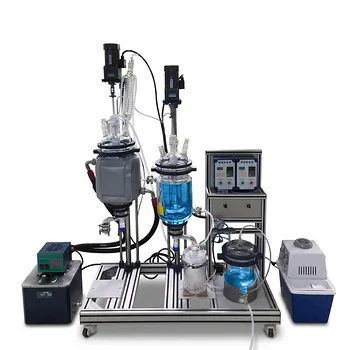
Choosing between a classifying and a mixed-suspension crystallizer for unit operations training is fundamentally a choice between crystal perfection and process practicality. A classifying crystallizer (like the Oslo type) can produce large, exceptionally uniform crystals by selectively withdrawing only particles that have reached a target size, but this precision comes at the cost of lower throughput, larger equipment footprint, and shorter continuous runtimes. Mixed-suspension designs (DTB, DP, Messo) forsake that razor-sharp size control in favor of robust, uninterrupted operation and simpler, more compact hardware—making them the pragmatic workhorses of many pilot plants. Teaching both architectures illuminates the critical engineering balance between product quality attributes and the capital and operational constraints that govern real industrial crystallization.
The core trade-off that students must grasp is that producing large, monodisperse crystals through size classification inevitably sacrifices productivity, floor space, and long-run stability. The choice of crystallizer becomes a study in compromise—a lesson that replicates the exact tension between ideal separation and economic viability they will face in professional practice.
The Two Archetypes of Crystallizer Design
To understand the trade-offs, it is essential to recognize how each crystallizer type handles the crystal population. The key differentiator is whether the equipment deliberately grades crystals by size before product removal.
Classifying Crystallizers: Prioritizing Crystal Quality
Classifying crystallizers, exemplified by the Oslo fluidized‑bed design, intentionally separate the growing crystals so that only those that have reached a desired size are extracted as product.
A mother liquor circulation loop moves supersaturated solution upward through a bed of crystals. This fluidization sorts particles hydrodynamically: small crystals remain higher in the bed to grow, while large, dense crystals settle to a classified withdrawal zone.
The result is a product with a narrow size distribution and large mean particle size. For training, this vividly demonstrates how residence time distribution can be manipulated to engineer a specific crystal quality attribute.
Mixed‑Suspension Crystallizers: Prioritizing Operational Robustness
In a mixed‑suspension, mixed‑product‑removal (MSMPR) crystallizer, such as a DTB, DP, or Messo unit, the vessel is intensely mixed so that the crystal size distribution is uniform throughout the slurry and the product withdrawal stream represents the average population.
A draft tube and internal circulation (in the DTB example) provide gentle agitation without the external loops that create fouling risks. Because there is no size classification, the product inherently contains a broad particle size distribution.
This design trade‑off yields exceptional continuous‑run capability, stable steady‑state operation, and a smaller mechanical footprint. In a teaching laboratory, the MSMPR crystallizer serves as a reliable platform for studying population balances, nucleation‑growth kinetics, and long‑term process control without frequent shutdowns for cleaning.
Key Design Trade‑offs for Training Environments
When selecting equipment for a unit operations lab, educators must weigh several interrelated factors that mirror the decisions faced in industry. Each choice highlights a different aspect of the crystallization curriculum.
Crystal Size Uniformity vs. Productivity
A classifying crystallizer can deliver crystals with a coefficient of variation well below 20% and large mean sizes suitable for applications demanding high purity and flowability.
However, that size control is bought with lower production rates per unit volume. The necessary internal classification and the careful control of supersaturation in the fluidized bed inherently limit the mass of crystal that can be harvested per hour.
In a teaching lab, this trade‑off forces students to ask: Does the product’s value justify the slower throughput? The answer becomes a concrete example of how crystal quality and capacity are interdependent.
Equipment Footprint and Capital Cost
Classifying units typically require a tall column, an external circulation loop with a pump, and often a larger heat exchanger. The Oslo crystallizer, in particular, has a substantial vertical profile that demands elevated headroom and expensive support structures.
Mixed‑suspension crystallizers like the DTB are considerably more compact. Internal baffles and draft tubes replace the external piping and settling zones, lowering both the equipment cost and the physical space needed.
For a pilot plant with limited floor space and a tight budget, the smaller footprint of a mixed‑suspension design is a decisive advantage. The cost savings can be redirected to instrumentation or additional experiments, reinforcing the curriculum on economic evaluation.
Operational Continuity and Maintenance
The mother liquor circulation loop of a classifying crystallizer is notoriously vulnerable to fouling. Supersaturated solution contacts cold heat exchanger walls and piping, where crystal scale rapidly builds up. This scaling not only reduces heat transfer efficiency but also forces unscheduled shutdowns for cleaning, shortening the continuous run times that are so valuable for student experimentation.
Mixed‑suspension designs, especially those with internal cooling jackets or gentle draft‑tube mixing, expose far less cold surface area to the saturated slurry. The result is a dramatic improvement in runtime: a DTB unit can often operate continuously for days, allowing students to collect steady‑state data and study transient responses without interruption.
This operational contrast teaches a profound lesson: the reliability of a crystallization process is as much about managing fouling as it is about chemistry.
Versatility in Teaching Multiple Modes
Mixed‑suspension crystallizers offer a distinct advantage for a multi‑purpose teaching lab. Because they are inherently flexible, the same DTB vessel can be re‑configured to run cooling, evaporative, or even antisolvent crystallization with minimal hardware changes.
Classifying crystallizers, by contrast, are optimized for specific hydrodynamic conditions that are harder to adapt across different solute‑solvent systems. For a curriculum that aims to cover several crystallization modes in a single semester, the platform versatility of a mixed‑suspension unit maximizes the number of experiments possible with a single piece of equipment.
Deeper Lessons Hidden in the Hardware
Beyond the obvious technical specifications, the choice of crystallizer teaches subtle but critical principles about scale‑up and process control.
The Fouling–Classification Link
In the classifying crystallizer, the very mechanism that grades crystals—external circulation and heat removal—creates the conditions for uncontrolled nucleation and surface scaling. As scale builds on the exchanger, the heat transfer coefficient drops, and operators must increase the temperature driving force, which in turn can cause further nucleation bursts that upset the classification.
Students who witness this firsthand internalize why crystallizer design must consider the interaction between thermal duty and crystal size control. The mixed‑suspension unit, with its internal recirculation, decouples heat transfer from classification, demonstrating a more thermally stable configuration.
Population Balance and Residence Time
A mixed‑suspension crystallizer operating at a true steady state provides the cleanest possible data for a crystal population balance analysis. Because the product withdrawal is a representative sample of the well‑mixed slurry, the derived nucleation and growth kinetics are directly applicable to scale‑up models.
The classifying crystallizer, while excellent for producing a narrow size cut, confounds the simple MSMPR assumption because the product stream is no longer representative. This makes kinetic modeling more complex but gives advanced students a chance to study the effects of classification on residence time distribution and the resulting particle size control.
Understanding the Trade‑offs That Drive Your Decision
Selecting a crystallizer is never about finding a “best” design in absolute terms; it is about matching the hardware to the educational objectives and the practical constraints of the laboratory.
Crystal specification is a luxury with a cost. If your educational goal is to illustrate how to achieve high‑purity, free‑flowing crystals for pharmaceutical or high‑value fine‑chemical applications, the classifying crystallizer provides a tangible demonstration of the techniques and the associated operational penalties.
Process reliability is an undervalued commodity. For a curriculum centered on process dynamics, control, and continuous operation, the mixed‑suspension crystallizer is unrivaled. Its ability to run for extended periods allows for statistically meaningful kinetic studies and avoids the frustration of equipment downtime that can derail a tightly scheduled lab course.
Fouling control is a lesson in itself. The indirect cooling required by most classifying crystallizers highlights a universal crystallizer headache: scaling on cold surfaces. Teaching students how to mitigate this fouling—through surface polishing, periodic heating, or direct cooling alternatives—is a valuable exercise in practical plant trouble‑shooting.
Making the Right Choice for Your Unit Operations Lab
The decision between classifying and mixed‑suspension crystallizers should be guided by the specific learning outcomes you aim to reinforce. Use the following priorities to align your equipment selection with your educational goals.
- If your primary focus is demonstrating particle engineering and narrow size distribution: Choose an Oslo‑type classifying crystallizer. The visual spectacle of fluidized‑bed classification and the precise product cut will make the concept of design for crystal size unforgettable.
- If your primary focus is process control, population balance modeling, and long‑duration experiments: Opt for a DTB or similar mixed‑suspension unit. Its operational stability, smaller footprint, and lower maintenance burden will maximize the return on your lab’s time and equipment investment.
- If your primary focus is tight budget and multi‑mode flexibility within a single semester: A mixed‑suspension crystallizer is the more economical and versatile choice, allowing you to cover cooling, evaporation, and antisolvent methods without multiple dedicated pilots.
- If your primary focus is preparing students for both worlds: Integrate a short‑course module on the classifying crystallizer using a rented skid or virtual simulation, while anchoring the routine lab work on a reliable mixed‑suspension platform. This hybrid approach exposes students to the trade‑offs without shouldering the full operational cost of a classifying unit.
Ultimately, the best crystallizer for training is the one that forces students to confront the unavoidable tension between ideal crystal quality and practical realizability—a balancing act they will carry with them into every future process design.
Summary Table:
| Feature | Classifying Crystallizer (Oslo) | Mixed-Suspension (DTB/MSMPR) |
|---|---|---|
| Crystal Uniformity | High (narrow size distribution) | Moderate (broad size distribution) |
| Productivity | Lower output per unit volume | Higher, stable production rates |
| Footprint & Cost | Large profile, higher capital cost | Compact design, lower cost |
| Fouling Risk | High (frequent scale cleanup) | Low (stable, continuous runs) |
| Best Teaching Use | Particle engineering & sizing | Process control & kinetics |
Bring Industrial-Scale Learning to Your Lab with LABPARK
Are you looking to equip your lab with advanced chemical engineering tools? LABPARK designs and manufactures premium Educational and Vocational Unit Operations Pilot Plants in chemical engineering, bioprocess & biotech, and environmental & water treatment. We help universities, research institutes, and enterprises deliver hands-on training with reliable crystallizers and process systems.
Contact our team today to find the perfect pilot plant solution for your curriculum!
Related Products
- Multi Functional Membrane Crystallization Educational Unit Operations Pilot Plant
- Potassium Salt Thermal Dissolution and Crystallization Separation Educational Unit Operations Pilot Plant
People Also Ask
- Control Crystallization Pilot Plant Secondary Nucleation: 4 Key Adjustments
- Why is precise temperature control critical in crystallization pilot plants? Key to Scale-Up Success
- What key factors should be considered when configuring a crystallization unit operations pilot plant?
- What are the benefits of integrating online PAT tools like ATR-FTIR into crystallization unit operations pilot plants?
- How to use crystallization pilot plant agitation speed to identify diffusion vs reaction growth?