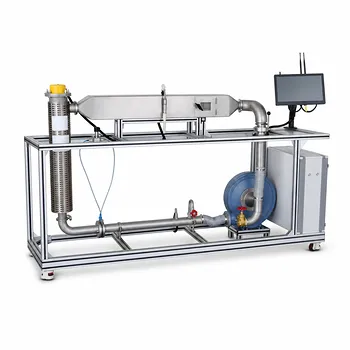
Rapid drying in a vertical tube: a pneumatic (flash) dryer uses a high-velocity hot gas stream to instantly suspend and dry free-flowing particulate solids, completing the process in just seconds. As a demonstration of drying unit operations, its standout advantages are ultra-short residence time, high thermal efficiency, and the ability to successfully dry moderately heat-sensitive materials due to cooling from rapid surface evaporation.
At its core, a flash dryer minimizes material thermal degradation by combining maximum gas–solid contact with a residence time measured in seconds. This makes it an ideal teaching tool for illustrating simultaneous heat and mass transfer, but its practical use is strictly limited to free-flowing, non-fragile feeds that can survive high-velocity collisions.
Core Operational Principles
High-Velocity Gas Conveying
Wet material is fed into a vertical drying pipe where hot gas flows at 20 to 40 m/s. The gas velocity is high enough to fully suspend the particles, turning the pipe into a pneumatic transport line that eliminates any need for mechanical agitation.
Because the particles are carried along by the gas, drying occurs during concurrent upward movement. The slip velocity between gas and solids helps drive convective heat transfer, and the continuous motion ensures fresh gas contacts the particle surface at every instant.
The Role of Particle Dispersion
Feed introduction is designed to disperse the material into individual particles immediately. This dispersion maximizes the surface area exposed to the hot gas, setting the stage for exceptionally rapid evaporation.
The process only works for free-flowing granular, powdery, or even slightly cake-like solids that can be entrained and separated in the gas stream. Clumpy or sticky feeds would fail to disperse and would not dry uniformly.
Extremely Short Residence Time
The entire drying process happens in a vertical column that the gas–solid mixture transits in 0.5 to 5 seconds. This brief contact time is the defining characteristic that differentiates flash dryers from rotary or tray dryers.
During those few seconds, surface moisture is removed almost instantly. The internal moisture must then migrate to the surface, but for the small particles typically processed, this diffusion path is short enough for the entire particle to dry to the target moisture content.
Key Advantages in a Demonstration Setting
Ultra-Rapid Drying as a Clear Visual
An operator sees wet powder enter the bottom and dry powder exit the top in a matter of seconds. That dramatic time scale makes it easy to teach the concepts of rapid mass transfer and the effect of increasing the driving force (temperature difference) on drying rate.
This is a direct demonstration of the falling rate period being compressed because surface moisture evaporates so quickly, leaving only a brief diffusion-controlled phase.
High Thermal Efficiency
Flash dryers recover heat through the short gas residence time and the immediate contact design. Thermal efficiencies can be high because the gas at the outlet is not far below the inlet temperature—the heat goes primarily into evaporating water from the particle surface.
In a lab, you can monitor inlet and outlet gas temperatures to show how efficiently the energy is used, reinforcing the link between residence time, heat transfer area, and fuel economy.
Protection of Heat-Sensitive Materials
Rapid surface evaporation cools the particle significantly, keeping the product temperature well below the gas inlet temperature. This allows the processing of moderately heat-sensitive grains, cereals, or active pharmaceutical ingredients without thermal damage.
In a demonstration, comparing the dryer’s gas temperature versus the actual powder outlet temperature provides a clear lesson in evaporative cooling and its practical benefit for product quality.
Understanding the Limitations
Unsuitable for Fragile or Abrasive Solids
High gas velocities cause particle–wall collisions and inter-particle friction. Fragile materials break down into fine dust, altering the product size distribution and potentially creating an explosive atmosphere. This limitation is a critical safety teaching point.
High Pressure Drop and Tall Installations
The system requires significant fan power to maintain the 20–40 m/s gas velocity through a vertical pipe that can be several meters high. This makes a flash dryer space- and energy-intensive for a lab setup, which is an important practical consideration when specifying equipment.
Narrow Range of Acceptable Feeds
Particles that are too large (> a few mm) or too fine (< ~20 μm) cause problems. Large particles cannot be entrained, while extremely fine particles risk channeling and re-entrainment issues. The demonstration will only succeed with a carefully selected, free-flowing feed within the ideal size range.
Making the Right Choice for Your Demonstration
Whether you select a pneumatic dryer or another unit operation depends entirely on what learning outcome you want to emphasize.
- If your primary focus is demonstrating instantaneous mass transfer and evaporative cooling: Choose the flash dryer. The visual of material traveling upward while rapidly losing moisture is unmatched for teaching short-contact-time drying and thermal protection mechanisms.
- If your primary focus is illustrating uniform drying of a broad particle size range or demonstrating gentle handling: A fluidized bed dryer is more appropriate. It offers longer, more controllable residence times and lower mechanical stress, making it easier to show steady-state moisture profiles without feed damage.
- If your primary focus is handling pasty, sticky, or non-free-flowing feeds: Neither pneumatic nor conventional fluidized bed drying is ideal; you would need to pre-form or consider other dryer types entirely.
The pneumatic dryer excels when you need a compact, high-speed demonstration of how maximizing surface area and shortening contact time can drastically improve drying efficiency and product quality in a single, visually compelling step.
Summary Table:
| Feature | Description | Key Advantage / Limitation |
|---|---|---|
| Residence Time | 0.5 to 5 seconds | Protects heat-sensitive materials from thermal degradation |
| Gas Velocity | 20 to 40 m/s | Instantly suspends particles without mechanical agitation |
| Thermal Efficiency | High convective heat transfer | Optimizes energy use through rapid surface evaporation |
| Feed Suitability | Free-flowing granules/powders | Limited to non-sticky materials within a narrow size range |
Are you looking to enhance your laboratory training or research capabilities? LABPARK provides premium Educational and Vocational Unit Operations Pilot Plants in chemical engineering, bioprocess & biotech, and environmental & water treatment. Designed specifically for universities, research institutes, and enterprises, our systems deliver hands-on learning for complex processes like pneumatic drying.
Contact us today to find the perfect pilot plant solution for your institution!
Related Products
- Supercritical High-Gravity Flash Evaporation Educational Unit Operations Pilot Plant
- Circulating Wind Tunnel Drying and Convective Heat Transfer Coefficient Determination Educational Pilot Plant
- Multi-Functional Drying Educational Unit Operations Pilot Plant
People Also Ask
- How is the heat transfer area calculated for an evaporation unit operations pilot plant during experimental design? Guide
- How to select educational evaporator pilot plants for thermal & scaling solutions? Complete Guide
- How are Dühring plots applied in evaporation pilot plants? Practical guide to boiling point prediction
- What is the practical significance of Kb in pilot plant evaporation? Master process design.
- How to Connect Benchtop Evaporation to Pilot Plants in Chemical Engineering Education