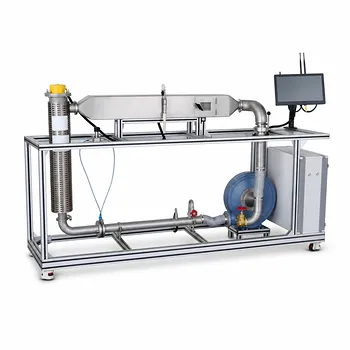
When safety and operational realism are non-negotiable in training, a unit that automates the most hazardous manual steps changes everything.
An agitated filter dryer trainer directly eliminates the messy, high-risk cake manipulation found in non-agitated designs. The built-in agitator automatically mixes, smooths, and washes the filter cake, preventing solvent channeling and cutting down the manual handling that exposes trainees to potent materials. This single closed unit mirrors modern pharmaceutical production, making it the definitive choice for research labs and vocational programs that must teach containment and efficiency—not just basic chemistry.
The decisive advantage of an agitated filter dryer trainer is its ability to convert a high-exposure manual operation into a closed, automated process. This not only protects operators-in-training from hazardous compounds but also ingrains the safety protocols and hands-free techniques required in today’s regulated industries.
The Operational Advantages: From Manual to Automated Precision
Agitation fundamentally shifts the educational value of a filter dryer from a standalone piece of glassware to an integrated processing system. It turns a series of risky, error-prone manual tasks into a single, press-button demonstration.
Eliminating Manual Cake Manipulation
In a non-agitated unit, the filter cake must be manually broken up, smoothened, and rewetted during washing. This hands-on intervention is the root cause of most exposure risks. An agitated trainer’s motorized blades perform these actions mechanically, inside the sealed vessel, demonstrating how industry prevents solvent channeling and achieves uniform wash efficiency. Trainees learn the critical process parameter of cake uniformity without ever touching the product.
Seamless Unit Operation Integration
An agitated filter dryer trainer demonstrates the complete workflow of filtration, cake washing, reslurrying, thermal drying, and mechanical discharge in one contained system. Non-agitated designs fragment this training into disconnected steps, often leaving drying and discharge to separate, open apparatus. The agitated unit shows students how a single, closed process step reduces transfer losses and cycle times—a core concept for any researcher moving to pilot scale.
Enhanced Process Control and Reproducibility
The agitator’s adjustable height and speed allow instructors to precisely control cake thickness and drying rates, turning a visual demonstration into a reproducible experiment. Because it smooths out surface cracks, solvent flows uniformly through the cake bed, giving consistent drying profiles. Trainees see firsthand how automation removes operator-to-operator variability, a vital lesson for Good Manufacturing Practices.
The Safety Imperative: Minimizing Exposure in the Learning Environment
For any program handling solvents, fine powders, or active pharmaceutical ingredients, the safety profile of the trainer isn’t a bonus—it’s the core curriculum. An agitated design teaches safety by design, not by adding layers of protective gear.
A Closed System for High-Containment Training
The entire agitated filter dryer operates as a sealed vessel, from the moment slurry enters until the dried cake is discharged. This closed-loop containment is non-optional when handling potent or respiratory-sensitizing compounds. Students learn to work within a controlled environment, understanding that the equipment—not a full protective suit—is the primary barrier. Non-agitated systems often require breaking containment for mixing or scraping, a practice considered unacceptable in modern high-potency facilities.
Drastically Reduced Personal Protective Equipment (PPE) Requirements
Manual smoothing and discharge in a static Nutsche filter demand extensive PPE: full suits, powered air-purifying respirators, and gloves. An agitated trainer reduces the reliance on this train-of-thoughtless gear because operators remain outside the closed vessel. For vocational training, this means less time spent on donning/doffing drills and more time focused on the process itself, while still embedding the principle that engineering controls come first.
Ingraining a Safety-First Culture
When a trainee sees that a clever piece of mechanical design eliminates an entire exposure pathway, they internalize the hierarchy of controls. An agitated filter dryer trainer makes the concept of “inherently safer design” tangible. It shifts the conversation from “how do I protect myself from the process?” to “how can the process protect me?”—a mindset invaluable for future operators and scale-up engineers.
Understanding the Trade-offs: When a Non-Agitated Trainer Might Be Considered
No training design is perfect for every goal. A completely agitated approach does have its limitations, and a non-agitated unit still holds a specific place in certain curricula.
The Simplicity and Lower Cost of Static Nutsche Filters
Non-agitated filter dryers are mechanically simpler and come with a lower upfront capital cost. For a program focused exclusively on aqueous filtrations of benign salts or teaching the raw physics of cake formation, a static Nutsche filter offers a transparent, uncluttered view of the filtration mechanism itself. Its maintenance and operation require less electro-mechanical know-how.
The Risk of Overlooking Foundational Principles
Automation can hide the physical reality. If an agitator automatically heals cracks in the cake, a student might never visually witness the detrimental effects of channeling or understand why smoothness matters. A manual, non-agitated run—performed safely with simulated, non-hazardous materials—can vividly demonstrate the failure modes that the agitated unit is designed to solve. This side-by-side comparison creates the deepest understanding.
Application Limitations (The Real-Word Cutoff)
The critical limitation is one of chemical hazard. Non-agitated designs are effectively restricted to non-toxic, non-volatile materials in a teaching lab. For any substance rated as potent, sensitizing, or requiring containment, an agitated unit isn’t an upgrade—it’s the only choice. If your training even remotely touches Active Pharmaceutical Ingredients (APIs), a non-agitated trainer teaches poor and unsafe habits by replicating an obsolete open-handling workflow.
Making the Right Choice for Your Program’s Goals
The decision hinges on whether your curriculum prioritizes basic filtration theory or modern, work-ready process skills. Match the equipment to the primary occupational outcome.
- If your primary focus is preparing students for pharmaceutical or fine chemical careers: Choose the agitated filter dryer trainer. It teaches the integration of containment and automation that is the current industrial gold standard.
- If your primary focus is illustrating the failure modes of cake washing and the need for containment: Use a non-agitated unit only alongside an agitated one, and restrict the non-agitated exercise to completely harmless simulant materials. The lesson is in the contrast.
- If your primary focus is fundamental chemistry research with only low-hazard materials: A simple, non-agitated jacketed filter can serve to demonstrate filtration and drying principles cost-effectively, provided the inherent safety limits are rigorously respected.
Investing in an agitated filter dryer trainer is ultimately an investment in teaching the right safety reflex: let the equipment contain the hazard so the person never has to.
Summary Table:
| Feature | Agitated Filter Dryer Trainer | Non-Agitated (Static) Trainer |
|---|---|---|
| Cake Manipulation | Automated & sealed within the vessel | Manual intervention & cake breaking required |
| Safety & Containment | Closed-loop, ideal for potent/toxic compounds | Open-process steps, higher exposure risk |
| Process Control | High reproducibility (adjustable speed & height) | Variable (highly dependent on operator skill) |
| PPE Requirements | Reduced (prioritizes engineering controls) | High (due to direct handling during discharge) |
| Best Suited For | Industry-ready vocational & pharmaceutical training | Basic filtration physics & low-hazard training |
Elevate Your Training & Research Standards
Equip your laboratory or training facility with the safety, containment, and automation demanded by modern industry. LABPARK provides state-of-the-art Educational and Vocational Unit Operations Pilot Plants in chemical engineering, bioprocess & biotech, and environmental & water treatment.
Designed specifically for universities, research institutes, and enterprises, our pilot plants bridge the gap between classroom theory and industrial reality.
Ready to upgrade your curriculum? Contact us today to find the perfect pilot plant solution for your program!
Related Products
- Circulating Wind Tunnel Drying and Convective Heat Transfer Coefficient Determination Educational Pilot Plant
- Multi-Functional Drying Educational Unit Operations Pilot Plant
People Also Ask
- Why transition from laminar to turbulent flow is critical in convective heat transfer pilot plants?
- How does a unit operations pilot plant demonstrate fluid velocity vs heat transfer coefficient?
- How do tube arrangement & orientation affect condensation heat transfer? Optimize pilot plant performance.
- Why Are Thermal Properties Critical in Pilot Plants? Key Material Selection Factors
- What characterizes the transition to the falling rate drying period? Key scale-up insights.