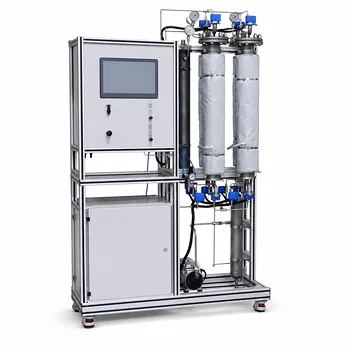
The core choice hinges on where condensation occurs and how gravity interacts with the vapor-liquid flow. Horizontal shell-side condensation is the industrial workhorse—offering high heat transfer coefficients—while vertical configurations introduce a changing liquid film thickness that lets students explore film condensation theory and vapor shear effects. For a unit operations training plant, the optimal configuration is rarely a single best answer but a deliberate pedagogical trade-off between replicating common industrial practice, demonstrating fundamental heat transfer principles, and ensuring safe, observable operation at pilot scale.
The greatest training value comes from intentionally including both a horizontal and a vertical condenser in the plant layout. This side-by-side comparison enables students to measure the real-world impact of orientation on heat transfer coefficients, pressure drop, and condensate drainage—turning a static piece of equipment into a dynamic, data-rich teaching tool.
The Two Axes of Condenser Geometry
Choosing a condenser for a training plant means deciding not only the equipment’s orientation but also which side of the heat exchange surface the condensing vapor occupies. These two variables create the four configuration families described in the primary reference.
Horizontal Shell-Side Condensation: The Industrial Baseline
This is the most common configuration in production plants. The vapor flows through the shell, condensing on the outside of horizontal tube bundles.
Heat transfer coefficients are naturally high because the condensate drains quickly off the tubes, maintaining a thin liquid film. Students immediately see why this arrangement dominates refining and bulk chemical processes.
It also provides a direct, practical lesson in pressure drop engineering, especially when baffles are present to redirect shell-side flow.
Horizontal Tube-Side Condensation: The Specialist’s Niche
Condensing vapor inside horizontal tubes is rare for process streams. The primary industrial exception is vapor-heated reboilers, where steam condenses inside the tubes to drive distillation.
Including this configuration in a training plant can be valuable if your curriculum covers reboiler design or steam-side heat transfer. However, it offers less universal pedagogical insight for standard condensation pathways.
Vertical Tube-Side Condensation: The Classroom Workhorse
Here, vapor enters at the top and condenses inside vertical tubes, with the liquid film falling downward under gravity. This setup is extremely common in educational and pilot-scale columns as a reflux condenser.
The key physical phenomenon is a continuously thickening liquid film. As the condensate travels down the tube, the film layer grows, progressively reducing the local heat transfer coefficient.
This gradual change allows students to directly observe the transition from laminar film condensation to wavy or turbulent behavior—an abstract textbook concept that becomes concrete with temperature and pressure measurements along the tube length.
Vertical Shell-Side Condensation: A Rarer Configuration
Vapor condensing on the outside of vertical tubes presents gravitational drainage similar to the tube-side case, but with added complexity in managing shell-side distribution.
It is less frequently built into training plants unless the goal is to showcase reflux condensers in a different pressure drop regime or to study the impact of vapor shear on a falling film on the outside of the tubes.
What This Choice Teaches—and What It Hides
The decision is not purely technical; it is a curriculum design choice. Each configuration amplifies certain learning objectives at the expense of others.
Bringing Film Condensation Theory to Life
Textbooks present Nusselt’s theory of laminar film condensation on a vertical surface, then extend it to turbulent films and horizontal tubes. A vertical tube-side condenser is the ideal experimental apparatus to validate the vertical laminar model and observe the point where the film becomes wavy.
A horizontal shell-side setup, by contrast, dramatically shortens the drainage path, keeping the film thin and the heat transfer coefficient high. It demonstrates why horizontal orientation is preferred industrially, but it provides less insight into film development along a length.
Demonstrating the Role of Vapor Shear
When vapor velocity is high, it exerts a drag on the condensate film. This shear can thin the film (increasing heat transfer) or hold up liquid (increasing pressure drop).
A vertical downflow condenser naturally integrates vapor shear in the same direction as gravity, while a horizontal unit sees complex shear patterns across tube rows. Running experiments with variable vapor rates helps students correlate Nusselt numbers with the vapor Reynolds number—an essential skill for troubleshooting poorly performing exchangers.
Pressure Drop and System Hydraulics
Horizontal shell-side condensation often involves cross-flow and baffles, which give a higher pressure drop than a simple vertical downflow design. Measuring this pressure drop teaches students to balance heat transfer performance against column operating pressure and compressor sizing, a critical real-world trade-off.
A vertical tube-side condenser can serve as a low-pressure-drop reflux condenser, keeping the column top pressure stable—a design choice worth demonstrating explicitly.
Safety and Practical Constraints at Pilot Scale
While the primary reference focuses on fundamentals, the supplementary references emphasize a concrete operational boundary: the boiling point of the liquid being distilled.
Material Compatibility and Thermal Shock
For liquids with boiling points above approximately 130 °C, direct water cooling creates dangerous thermal gradients that can crack glass equipment. Training plants using borosilicate glass components should therefore pair high-temperature distillations with an air condenser, irrespective of its horizontal or vertical orientation.
When selecting a vertical or horizontal shell-and-tube exchanger in metal (stainless steel), this constraint relaxes, but the lesson about thermal stress and material limits remains essential. It is a perfect moment to discuss why industrial condensers use metal and gradual cooling loops.
Managing Highly Volatile and Flammable Solvents
Distilling low-boiling, flammable solvents demands specialized receiving adapters and vapor containment, as the supplementary reference notes. The condenser configuration itself does not directly mitigate flammability risk, but a vertical reflux condenser that returns liquid directly to the column can reduce the volume of exposed liquid and simplify safety interlocking.
Incorporating this scenario into a plant setup teaches students to view condenser selection as part of a broader process safety management system, not an isolated equipment choice.
Understanding the Trade-offs
No single condenser style excels on every axis. An honest assessment of limitations builds student confidence and instructor credibility.
Pedigree versus Pedagogy
A horizontal shell-side unit mirrors industry, but if it is installed as a single pass with few baffles, students may see only a black-box high performance without the chance to dissect the film dynamics. A vertical tube-side unit is easier to instrument and model from first principles, but it may feel “academic” and less directly connected to field equipment.
Complexity and Cost
A training plant that attempts to include all four configurations becomes expensive and physically large. The most practical compromise is to offer two contrasted setups—for example, a horizontal shell-side condenser on a continuously operated distillation column and a vertical tube-side condenser on a batch still. This gives the desired comparison without duplicating every support system.
Observation and Instrumentation Limits
Condensation phenomena are visual by nature, but inside metal tube bundles they are invisible. Glass-shell vertical condensers allow direct observation of the falling film, which is a powerful teaching tool. Horizontal shell-side condensation in a metal shell requires reliance on thermocouples and pressure transducers alone, demanding more abstract reasoning from students.
Making the Right Choice for Your Goal
Prioritize your condensers based on what you need students to carry into their professional careers. Use the following goal-driven recommendations to shape your final layout.
- If your primary focus is replicating industrial design practice: Choose a horizontal shell-side condenser as your core demonstration unit. Supplement it with shell-side pressure drop experiments to teach the real cost of baffle selection.
- If your primary focus is teaching fundamental condensation heat transfer: Build around a well-instrumented vertical tube-side condenser. Let students map local heat transfer coefficients along the tube and observe the wave onset as vapor rate changes.
- If your primary focus is safe pilot-scale operation across diverse chemicals: Install a vertical air condenser for high-boiling fluids and a vertical water-jacketed reflux condenser for low-boiling distillations, embedding material selection and thermal stress discussions into every experiment.
- If your primary focus is a compromise between depth and breadth: Pair one horizontal shell-side unit with one vertical tube-side unit in adjacent distillation skids. This enables direct data comparison without overwhelming the budget, and it frames configuration choice as a deliberate engineering decision.
A well-considered condenser selection transforms the equipment from a simple heat exchanger into a narrative device that guides students from textbook theory to the practical, messy reality of chemical process design.
Summary Table:
| Configuration | Primary Industrial Use | Pedagogical Value | Key Advantage |
|---|---|---|---|
| Horizontal Shell-Side | Refining & bulk chemical processes | Replicating industrial baseline & pressure drop | High heat transfer due to rapid liquid drainage |
| Vertical Tube-Side | Reflux condensers in columns/stills | Demonstrating film condensation & vapor shear | Clear observation of film thickness transition |
Build the Perfect Unit Operations Lab with LABPARK
Selecting the right condenser configuration is critical to bridging the gap between textbook theory and industrial reality. LABPARK provides premium Educational and Vocational Unit Operations Pilot Plants in chemical engineering, bioprocess & biotech, and environmental & water treatment tailored for universities, research institutes, and enterprises.
Whether you need customized glass reflux condensers for visual learning or robust metal shell-and-tube systems for industrial simulation, our engineering team will help you configure the ideal setup.
Contact LABPARK today to design your pilot plant!
Related Products
- Three-Tube Heat Transfer Educational Pilot Plant for Unit Operations Training
- Carbon Dioxide Absorption and Desorption Educational Pilot Plant for Carbon Capture Studies
- Low Concentration Carbon Dioxide Capture Pressure Swing Adsorption Educational Pilot Plant
People Also Ask
- When is ε-NTU preferred over LMTD in pilot plants? Predict heat exchanger performance without iteration.
- Why is the study of thermal boundary layers and Prandtl numbers critical in heat transfer unit operations pilot plants?
- How to configure heat transfer pilot plants for pinch analysis? Teach energy recovery.
- How does regular perturbation analysis aid in predicting nonlinear temperature distributions? Pilot plant insights
- How does thermal conductivity affect pilot plant performance? Optimize heat transfer & accuracy