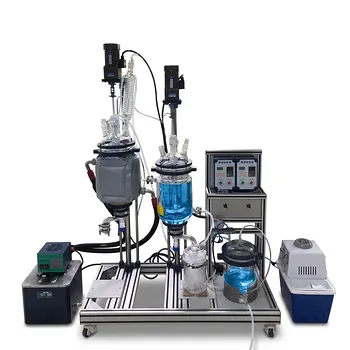
Direct cooling eliminates the cold surface where scaling occurs, but introduces a new layer of complexity around coolant management.
In a unit operations laboratory, a direct cooling crystallizer mixes an immiscible, often volatile coolant directly into the solution, removing heat through latent heat of vaporization without any intervening wall. An indirect cooling crystallizer, by contrast, separates the coolant from the process fluid with a jacket or an external heat exchanger, making coolant handling trivial but making the heat-transfer surface highly prone to fouling. This fundamental difference creates a direct trade-off: you sacrifice thermal efficiency over time due to scaling, or you gain long-term stability at the cost of introducing a foreign phase that must be separated and managed safely.
The core choice is between managing a fouling solid surface (indirect) and managing a second liquid phase (direct). Indirect systems offer simplicity of coolant handling but degrade in performance as crystals deposit on the cold wall; direct systems preserve heat transfer but demand rigorous coolant selection, separation, and safety protocols.
Design Differences Between Direct and Indirect Cooling Crystallizers
Both methods remove heat to drive supersaturation, but the way they bring the heat-sink into contact with the crystallizing liquor creates entirely different mechanical and process demands.
The Indirect Route: Heat Transfer Through a Solid Wall
In an indirect cooling crystallizer, the coolant never touches the process solution.
Heat moves across a metal wall, typically through a jacketed vessel or an external circulation loop with a shell-and-tube or plate heat exchanger. This physical barrier makes coolant selection trivial—water, brine, or glycol are all common—and eliminates any risk of product contamination from the coolant. However, it also creates a cold surface that is perfectly positioned for crystal nucleation and growth, a phenomenon known as fouling or scaling.
Internal and external circulation designs further differentiate indirect systems. A draft-tube crystallizer with internal circulation uses an agitator to move slurry past a submerged cooling surface, offering compact layout but limited heat exchange area. An external circulation crystallizer pumps the slurry through an external exchanger, providing larger surface area, higher heat transfer coefficients, and easier cleaning, but at the risk of crystal breakage and the need for careful pump selection to avoid crushing the product.
The Direct Route: Mixing Coolant and Mother Liquor
A direct cooling crystallizer abolishes the heat transfer wall entirely.
Instead, an immiscible, volatile coolant (such as a light hydrocarbon or liquefied gas like butane) is injected directly into the crystallizing slurry. Cooling is achieved mainly through the latent heat of vaporization of the coolant, which evaporates and is then recompressed or vented. Because there is no solid surface colder than the bulk liquid, the scaling problem disappears—crystals have no place to adhere and build an insulating layer.
The design shifts the challenge from heat exchanger surface area to phase contacting and separation. The vessel must provide adequate dispersion, and the process must include downstream equipment to separate the coolant from the mother liquor and the product. This makes the direct method ideal for systems that foul aggressively, such as lubricant dewaxing or certain inorganic salt crystallizations, but it turns the pilot plant into a multi-phase separation unit.
Operational Trade-offs in a Unit Operations Laboratory
When you run these two configurations side by side, the trade-offs reveal themselves in heat transfer consistency, maintenance, and safety.
Heat Transfer Stability vs. Efficiency Decay
An indirect crystallizer starts with a clean, predictable heat transfer coefficient, but its performance degrades over time as the crystalline scale builds.
This scaling forces periodic shutdowns for cleaning, making continuous long runs difficult and complicating mass balances. In a laboratory, this decay is actually a valuable teaching point—it forces students to observe how fouling resistance changes the overall heat transfer coefficient and influences nucleation rates. A direct cooling crystallizer, by contrast, maintains a steady heat duty for the entire run because there is no solid surface to foul. The trade-off is that you must now monitor the coolant dispersion and evaporation rate, which introduces operational variability that is not present in a clean single-phase jacket.
Coolant Management and Product Contamination Risk
Indirect systems are forgiving: the coolant never touches the product, so any standard heat transfer fluid works.
Direct cooling demands a coolant that is immiscible with the solvent, easily separable, and chemically inert toward the product. Separation is rarely perfect, and traces of coolant can remain in the crystals, raising concerns about product purity and requiring a solvent washing or stripping step. In a pilot plant, this also means you must design for phase separation—settling chambers, coalescers, or distillation columns—adding complexity to what might otherwise be a simple batch crystallizer.
Laboratory Safety and Logistics
Direct cooling crystallizers introduce a volatile and often flammable fluid into a warm process stream.
The resulting vapor must be contained, re-liquefied, or safely vented, demanding explosion-proof equipment and reliable pressure relief. Indirect systems, using water or glycol, avoid these hazards completely. For a unit operations laboratory, this means direct cooling units require a much higher level of infrastructure and safety oversight. The benefit is the opportunity to teach students how to handle hazardous refrigerants under controlled conditions and to study the pressure-temperature- composition relationships that govern evaporative cooling.
Scale-Up and Footprint Considerations
Indirect crystallizers, especially external circulation types, tend to have a larger equipment footprint due to the pump, heat exchanger, and associated piping.
Direct cooling crystallizers can be more compact because they do not require a separate heat exchanger, but they often demand additional separation and vapor-handling equipment, canceling out some of that space savings. In an educational setting, the indirect external loop provides a clear, visual demonstration of pumping and heat exchange principles, while direct cooling illustrates intensified heat transfer within a single vessel.
Understanding the Trade-offs: Common Pitfalls
Overlooking these pitfalls turns a learning exercise into a troubleshooting session.
- Indirect systems foul more rapidly than expected: Even mildly fouling solutions can cut heat transfer coefficients in half during a single lab period if the temperature differential is too large. Always start with a modest ΔT.
- Pump selection in external circulation loops is critical: An incorrectly chosen centrifugal pump can destroy crystal size distribution through excessive shear or, conversely, allow crystals to settle and plug the exchanger. Use a low-shear, gentle-duty pump.
- Direct coolant loss can skew mass balances: If the evaporated coolant is not fully recovered and quantified, the apparent yield and enthalpy balance become unreliable. A closed-loop condensation system is essential for meaningful data.
- Contamination risk is not just about purity: Even an inert coolant can alter crystal morphology or agglomeration if it partitions into the liquid layer around growing crystals. Test compatibility on a small scale before committing to a full run.
Making the Right Choice for Your Lab or Pilot Plant
Your selection depends entirely on the learning objectives and the material system you are running.
- If your primary focus is studying heat transfer fouling dynamics: Choose an indirect cooling crystallizer with an external circulation loop. Its transparent decay in performance provides rich data for modeling fouling resistance and its effect on supersaturation profiles.
- If your primary focus is running a severely scaling system without interruptions: Use a direct cooling crystallizer. The elimination of a cold wall allows long, stable runs that let you study steady-state crystal size distribution without the confounding effect of declining heat duty.
- If your primary focus is teaching process safety and multi-phase handling: Direct cooling offers an unmatched platform for discussing coolant selection, vapor handling, liquid-liquid separation, and hazardous area classification.
- If your primary focus is a simple, low-maintenance setup for basic crystallization demonstrations: An indirect jacketed vessel is sufficient and far easier to clean between experiments.
Every design you compare in the unit operations lab is a trade-off between the elegance of simplicity and the power of specialization—choose the one that transforms your biggest process headache into your most valuable teaching moment.
Summary Table:
| Feature | Direct Cooling Crystallizers | Indirect Cooling Crystallizers |
|---|---|---|
| Heat Transfer Method | Direct contact / Latent heat of vaporization | Across a physical barrier (jacket or external loop) |
| Fouling & Scaling | Minimal to none (no cold solid surface) | High risk (requires periodic shutdown for cleaning) |
| Coolant Management | Complex; requires volatile, immiscible, separable fluid | Simple; uses standard fluids (water, glycol, brine) |
| Product Purity | Potential contamination; requires separation steps | No contact, zero coolant contamination risk |
| Safety & Infrastructure | High; demands vapor recovery and explosion protection | Low; standard non-hazardous fluid loops |
| Ideal Educational Use | Teaching multi-phase flow and safety protocols | Studying heat transfer decay and fouling dynamics |
Equip Your Laboratory with Advanced Unit Operations Pilot Plants
Choosing the right crystallization setup is crucial for delivering accurate experimental data and realistic industrial training. LABPARK provides state-of-the-art Educational and Vocational Unit Operations Pilot Plants in chemical engineering, bioprocess & biotech, and environmental & water treatment.
Specifically engineered for universities, research institutes, and enterprises, our pilot plants bridge the gap between theory and industrial practice.
Looking to upgrade your laboratory capabilities? Contact our technical experts today to find the ideal pilot scale solution for your curriculum or research goals.
Related Products
- Multi Functional Membrane Crystallization Educational Unit Operations Pilot Plant
- Potassium Salt Thermal Dissolution and Crystallization Separation Educational Unit Operations Pilot Plant
People Also Ask
- Control Crystallization Pilot Plant Secondary Nucleation: 4 Key Adjustments
- Why is precise temperature control critical in crystallization pilot plants? Key to Scale-Up Success
- How Crystal vs Amorphous Solids Guide Crystallization Pilot Plant Objectives
- What key factors should be considered when configuring a crystallization unit operations pilot plant?
- What are the benefits of integrating online PAT tools like ATR-FTIR into crystallization unit operations pilot plants?