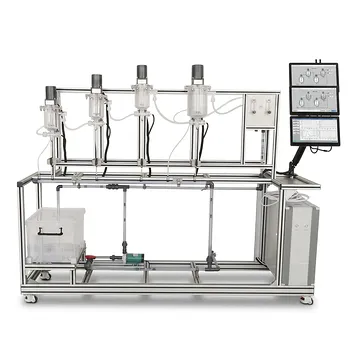
The primary advantage is clear: resilience. A Distributed Control System (DCS) prevents a single computer failure from bringing your entire pilot plant to a halt. While a centralized architecture funnels all control decisions through one computer—creating a catastrophic single point of failure—a DCS splits the workload across multiple localized controllers. This means a fault in one unit operation, like a distillation column, won't cascade to your reactor or absorption tower. For an educational setting where safety and continuous operation are paramount, the DCS architecture directly maps to industrial best practices, giving students hands-on experience with the systems they will encounter in the field.
The real question isn't just about technology choice; it's about balancing operational risk, pedagogical value, and lab scalability. A DCS answers that question by trading central simplicity for distributed fault tolerance, turning a dangerous single-point-of-failure into a manageable, localized incident that keeps the rest of the plant—and the learning process—running.
Why a Single Controller Is a High-Stakes Gamble for Teaching Labs
The appeal of a centralized system is easy to understand: one computer, one program, one place to manage everything. But chemical processes are inherently hazardous, and student operators are, by definition, learning. This combination makes a centralized architecture a high-risk proposition.
The Single Point of Failure Problem
If the central process computer fails—due to a hardware fault, a software crash, or even a network disconnect—every control loop freezes simultaneously. Valves stay open, heaters remain energized, and pumps keep running without regulation. In a complex pilot plant, that can quickly escalate from a ruined experiment to a serious safety incident. The primary reference correctly identifies this as the core flaw, and it’s magnified when inexperienced operators are at the helm.
The Educational Cost of a Total Shutdown
Beyond safety, a total plant shutdown derails curriculum. Restarting a multi-unit pilot plant often takes hours of purging, heating, and stabilizing material balance. In a typical laboratory period, a single failure can wipe out an entire session’s worth of learning objectives. That wasted time represents a tangible cost to the program and a frustrating experience for students.
How a DCS Redefines Reliability and Safety
A DCS sidesteps this problem by distributing control functions to dedicated, localized controllers—often called field control stations. The operator stations become purely monitoring and supervisory interfaces, not the brains executing every loop.
Localized Fault Containment
When a controller managing a specific unit operation fails, the blast radius is contained to that section. Your reactor loop might hold its last good state and alarm, while the downstream absorption column continues to run normally. This compartmentalized failure mode is not just a theoretical benefit; it’s the foundation of industrial safety system design. Students learn, firsthand, that complex processes demand fault isolation, not total reliance.
Industrial-Grade Rich Control Functionality
A DCS isn’t just about splitting hardware. It brings a library of pre-built, industrially proven control algorithms—PID, cascade, feedforward, ratio control, and more. A centralized system built from scratch might offer basic PID, but a DCS provides these algorithms as configurable function blocks, tested and hardened over decades. This means students are not just learning the theory; they are configuring and tuning the same control strategies used in real chemical plants, accelerating their transition to industry.
Modular Scalability for Growing Curricula
Pilot plants evolve. A unit operations course might start with a heat exchanger and a reactor, then add a distillation train next year. A centralized system often forces a major software rewrite with each addition. A DCS, built for modular expansion, lets you add new controllers and I/O nodes without touching existing logic. This protects the lab’s capital investment and lets the curriculum expand organically rather than in disruptive leaps.
Standardized HMI and Data Historians
The operator interface on a DCS is not a custom screen; it’s a standardized, industrial-grade HMI with trending, alarming, and data logging. Students learn how to navigate real plant graphics, interpret alarm floods, and pull historical data to analyze process upsets. These are skills that transfer directly to DeltaV, Foxboro, or any other major platform. A centralized system might offer graphical displays, but rarely with the same rigorous alarm management and audit trail capabilities that regulatory environments demand.
Understanding the Trade-offs
Objectivity demands that we acknowledge where DCS isn’t the perfect solution for every educational setting. The fit depends on your lab’s size and goals.
Increased Initial Complexity and Cost
A DCS requires multiple controllers, a dedicated communication network, and engineering workstations to configure them. For a very small bench-top setup with only one or two loops, this can feel like over-engineering. The hardware cost and the learning curve for configuring a distributed architecture are higher upfront than a single PLC or a simple PC-based control board.
Configuration Management Overhead
In a single-computer system, there’s only one program to manage. In a DCS, you have multiple controllers, each with its own configuration database. Change management becomes critical: you must ensure that an update to a control strategy in one controller doesn’t inadvertently break inter-controller communication links. This requires disciplined engineering practices, which is a good lesson for students but adds administrative work for lab managers.
Communication Latency and Bandwidth
Distributing control loops across a network introduces communication latency that doesn’t exist in a single-computer system. For process control loops with fast dynamics—pressure control on a compressor surge line, for example—this latency must be carefully managed. Peer-to-peer communication between controllers for cascade or feedforward signals needs deterministic protocols. When configured correctly, this latency is negligible for most unit operations, but it is a design consideration that centralized systems avoid entirely.
Making the Right Choice for Your Educational Pilot Plant
The decision between centralized and distributed control hinges on your primary objectives for the lab. Consider what you’re optimizing for.
- If your primary focus is maximizing student safety and mirroring industrial reality: Choose a DCS. The fault-tolerant architecture and industrial HMI are non-negotiable for teaching process safety and operational discipline.
- If your primary focus is long-term flexibility and phased curriculum growth: Choose a DCS. Its modularity allows you to expand the plant without re-engineering the entire control system, protecting your investment over multiple academic years.
- If your primary focus is minimizing upfront cost for a simple, single-unit demonstration: A centralized PLC or PC-based control system may suffice. Its single-point-of-failure is manageable if the system is small and strictly supervised, and the lower cost and simplicity can be appropriate for a focused, single-experiment course.
- If your primary focus is teaching advanced control strategies like cascade and feedforward at scale: A DCS is the clear winner. Its rich native algorithm library and block-oriented configuration environment turn complex loop design into a drag-and-drop exercise, aligning student experience with industry practice.
The goal of an educational pilot plant is to produce capable engineers, not just valid data. A DCS does more than control a process—it teaches the resilience, modular thinking, and industrial fluency that define the profession.
Summary Table:
| Key Aspect | Distributed Control System (DCS) | Centralized Control System |
|---|---|---|
| System Failure Risk | Low (Faults are isolated to specific unit operations) | High (Single computer failure halts the entire plant) |
| Scalability | High (Modular expansion via new controller nodes) | Low (Requires complex software rewrites for additions) |
| Pedagogical Value | High (Mimics real-world industrial plant environments) | Low (Simpler interface, less relevant to career prep) |
| Upfront Cost & Setup | Higher initial hardware and configuration complexity | Lower initial cost and simple programming |
Build a Safer, Industry-Ready Lab with LABPARK
Equip your students and researchers with hands-on experience using realistic industrial control systems. LABPARK designs and delivers premier Educational and Vocational Unit Operations Pilot Plants in chemical engineering, bioprocess & biotech, and environmental & water treatment.
We help universities, research institutes, and enterprises implement advanced, DCS-equipped pilot plants that guarantee maximum safety, process resilience, and pedagogical value.
Ready to upgrade your training facilities? Contact our experts today to get started!
Related Products
People Also Ask
- How does MRF model impeller rotation in CFD? Key Boundary Conditions Explained
- How can a CSTR pilot plant demonstrate reactor staging? Visualize volume savings.
- How does steady-state multiplicity affect the operation and safety of exothermic reactions within a CSTR pilot plant? - Guide
- What parameters to monitor transitioning from Batch to CSTR? Master Pilot Plant Setup
- Why is temperature regulation via a cooling jacket a critical feature in CSTR pilot plants used for laboratory training?