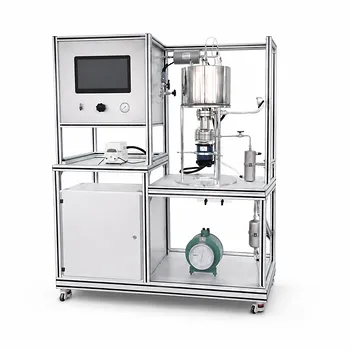
Micro-reactor modules in pilot plants fundamentally eliminate the need for cryogenic cooling.
By integrating these modules into unit operations pilot plants for traditionally cryogenic reactions, you replace extreme low-temperature dependency with precise thermal control at ambient conditions. The core advantages are drastically lower energy costs, simplified plant utility infrastructure, higher product yield and purity, and a safer, more scalable experimental platform.
Traditional batch processing forces reactions to rely on energy-intensive cryogenic cooling (-60°C or lower) just to manage heat and selectivity. Micro-reactors solve this at the root by shrinking heat and mass transfer distances by orders of magnitude, enabling safe, high-performance operation at ordinary temperatures while turning the pilot plant into a powerful, resource-efficient teaching tool.
Why Cryogenic Conditions Were Once Unavoidable
Many highly exothermic or temperature-sensitive reactions—like certain organometallic syntheses or nitrations—run away uncontrollably if heat is not removed at an extreme rate. In a conventional stirred batch reactor, the only practical lever is to chill the entire vessel and contents to cryogenic temperatures.
The Hidden Cost of Cold
This approach masks poor heat transfer with brute-force cooling. It demands expensive low-temperature chillers, special materials, and enormous energy consumption. Even then, localized hot spots can degrade selectivity and yield.
A Problem of Geometry
The fundamental bottleneck is the vessel’s low surface-area-to-volume ratio (often around 5.3 m⁻¹). Heat generated deep inside the bulk liquid must travel a long, slow path to the cooling jacket, making true isothermal control impossible without deep refrigeration.
The Micro-Reactor Breakthrough: Ambient Operation Through Process Intensification
Integrating a micro-reactor module rewrites the rules. The technology shrinks channel dimensions below 1 mm, collapsing the distance heat and mass must travel. This single change eliminates the need for cryogenic cooling.
Heat Transfer Coefficients That Beat Cryogenics
Micro-channel heat transfer coefficients soar to 10,000–35,000 W/m²K—roughly a 100-fold improvement over the 100–700 W/m²K typical of batch vessels. Every watt of reaction heat is whisked away instantly, so the fluid never builds up dangerous temperature gradients.
Raising the Surface-Area-to-Volume Ratio
The ratio jumps from single digits in a batch tank to 150 m⁻¹ or more in an intensified micro-system. This geometric advantage is what makes ambient operation possible: the entire reacting volume is in intimate contact with the temperature-controlled wall, achieving thermal uniformity that even cryogenic jackets cannot match.
From -60°C to Room Temperature
Because heat removal is so efficient and immediate, reactions that once required -60°C can now run safely at 20–25°C. The cooling duty is handled by simple tempered water loops rather than complex, hazardous cryogenic utilities. This is the direct, primary advantage highlighted in the core reference.
Pilot Plant Advantages That Extend Beyond Cooling
The shift to ambient operation cascades into a series of practical wins for any unit operations pilot plant, especially those dedicated to education and research.
Radical Energy and Utility Simplification
Eliminating cryogenic chillers cuts capital expense, maintenance, and electricity consumption. The pilot plant becomes more sustainable and far easier to operate, removing the need for specialized safety training around cryogenic fluids.
Enhanced Safety with Minimal Hold-up
Micro-reactors typically process extremely small material volumes—often under 150 ml. This drastically reduces the inventory of hazardous chemicals. A thermal runaway becomes a manageable event rather than a plant disaster, making it an ideal learning environment for students studying high-risk chemistry.
Superior Yield, Selectivity, and Purity
Precise thermal control eliminates hot and cold spots. Residence time distribution tightens down to a few seconds or milliseconds, preventing side reactions. The result: higher conversion, higher selectivity, and a purer product stream, all achieved at ambient temperatures.
Scalable Demonstration Through Numbering Up
Unlike batch scaling, continuous micro-reactors scale by “numbering up”—running hundreds of identical parallel microchannels. This preserves the exact fluid dynamics and heat transfer characteristics from lab to pilot scale, allowing meaningful data collection on a small footprint.
A Powerful Educational Platform
Micro-reactor pilot plants give students hands-on exposure to continuous flow chemistry, process intensification, and advanced control. They can safely study fast, exothermic reactions, observe laminar flow, and characterize residence time distribution—skills directly aligned with modern pharmaceutical and fine chemical manufacturing.
Understanding the Trade-offs and Practical Constraints
No technology is a universal fix. Objective evaluation requires acknowledging where micro-reactors stumble, especially in a teaching-pilot-plant context.
Solid Handling is an Achilles’ Heel
Channel dimensions of 1 mm or less make micro-reactors exquisitely sensitive to particles. Any solid precipitation, catalyst slurry, or un-dissolved reagent can immediately clog the system. This limits their use for many real-world crystallization or heterogeneous catalytic reactions unless gas-phase or perfectly clean liquid feeds are guaranteed.
Corrosion Sensitivity in Thin Channels
Micro-reactors are often fabricated from etched metal plates or glass. The thin walls and high surface-to-volume ratio mean that corrosion—even at a minor rate—can quickly compromise integrity. This restricts the palette of viable reaction fluids, particularly highly acidic or halide-containing mixtures.
Catalyst Coating and Fouling
While sol-gel coatings can create excellent catalyst supports, the confined geometry makes catalyst deactivation or fouling a terminal event for that module. Regeneration is difficult, and plug-and-play replacement may be needed, which adds consumable cost in a pilot setting.
Making the Right Choice for Your Pilot Plant Goals
Your decision to integrate a micro-reactor module should pivot on your primary objective. The technology is transformative, but it must align with the specific chemistry and teaching goals.
- If your primary focus is replacing cryogenic batch reactions: Prioritize a micro-reactor system with high heat transfer capacity and simple ambient tempering loops. This will deliver immediate energy savings and safety gains for exothermic liquid-phase reactions.
- If your primary focus is student training on process intensification: Opt for a modular, sensor-rich platform. The transparent, bench-scale setup excels at visualising flow, controlling residence time, and demonstrating the batch-to-continuous transition.
- If your primary focus is scaling up a clean, exothermic reaction: Use the numbering-up approach. Prove the kinetics at a single channel, then replicate, keeping material hold-up low and safety high while generating representative pilot data.
- If your primary focus involves solids or highly corrosive media: Reconsider a micro-reactor as your sole tool. A hybrid approach—using the micro-module for a clean, downstream step after bulk filtration—may offer the best synthesis of advantages without the clogging risk.
By grounding your choice in the fundamental physics of heat transfer rather than the engineering band-aid of cryogenic cooling, you turn the pilot plant into a true platform for safer, cheaper, and more insightful chemical process development.
Summary Table:
| Feature | Traditional Batch Reactor | Micro-Reactor Module |
|---|---|---|
| Operating Temperature | Cryogenic (-60°C or lower) | Ambient (20–25°C) |
| Heat Transfer Coefficient | 100–700 W/m²K | 10,000–35,000 W/m²K |
| Surface-Area-to-Volume Ratio | ~5.3 m⁻¹ | 150+ m⁻¹ |
| Safety & Chemical Hold-up | High volume (high runaway risk) | Low volume (<150 ml, high safety) |
| Scaling Method | Volumetric scale-up | Numbering up (parallel channels) |
Modernize Your Laboratory with LABPARK
Are you looking to upgrade your chemical engineering curriculum or research capabilities? LABPARK provides premium Educational and Vocational Unit Operations Pilot Plants in chemical engineering, bioprocess & biotech, and environmental & water treatment designed specifically for universities, research institutes, and enterprises.
Integrating micro-reactor modules into your setup allows you to:
- Eliminate Cryogenic Costs: Replace expensive cooling systems with safe, ambient-temperature operations.
- Enhance Safety: Minimize hazardous chemical hold-up to protect students and researchers.
- Teach Cutting-Edge Tech: Deliver hands-on experience in continuous flow chemistry and process intensification.
Ready to transform your laboratory? Contact our engineering experts today to find the perfect pilot plant configuration for your institution.
Related Products
- Micro-Scale Gas-Solid Catalytic Reaction Educational Pilot Plant
- Multi-Reactor Educational Pilot Plant for Reaction Engineering Unit Operations
- Internal Circulation Gradient Free Catalytic Reaction Educational Pilot Plant
- Fixed-Bed Chemical Reaction and Gas Dust Tar Removal Unit Operations Pilot Plant
- Educational Unit Operations Pilot Plant for Intraparticle Diffusion Effective Factor Measurement
People Also Ask
- Why is a multibed configuration necessary for exothermic reactions? Optimize your pilot plant trajectory.
- Fluidized vs. Fixed Bed Reactors: Comparing Heat & Complexity in Pilot Plants
- Why is thermal management a major challenge in methane oxidative coupling? Reactor Solutions for Pilot Plants
- How does the Mears criterion evaluate transport resistance? Key Guide to Intrinsic Kinetics
- How do reactor pilot plants safely study gas-solid reactions? Master kinetics with thermal & flow control.