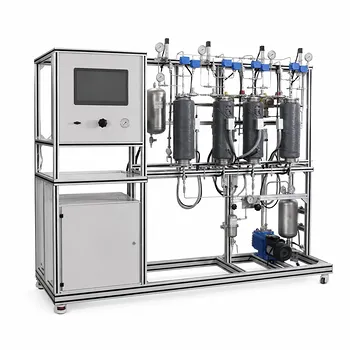
The true power of a pilot-plant dryer isn’t just in removing water—it’s in understanding the invisible transformations happening inside.
In-line spectroscopic monitoring, using techniques like near-infrared (NIR), Raman, and tunable diode laser absorption spectroscopy (TDLAS), instantly captures both moisture loss and solid-state changes without ever interrupting the process. This real‑time, non‑destructive view eliminates hazardous manual sampling, enables precise drying‑endpoint control, and teaches advanced process analytical technology (PAT) principles that are essential for successful scale‑up.
Incorporating in‑line spectroscopy into drying pilot plants transforms a black‑box unit operation into a data‑rich process. It simultaneously reveals water removal kinetics and critical solid‑state alterations—such as hydrate formation or polymorphic conversions—making it the cornerstone of robust quality assurance, operator safety, and effective PAT education.
Seeing the Full Picture: Simultaneous Moisture and Solid‑State Monitoring
The primary reason in‑line spectroscopy is so valuable is that it tracks two overlapping phenomena that define product quality: loss of water and changes in molecular structure. A single off‑line sample cannot show how these two factors dance together in real time.
NIR Spectroscopy: The Water Watchdog
NIR is exquisitely sensitive to O–H bonds, making it the go‑to tool for real‑time moisture quantification.
It can distinguish between loosely held surface water and more tightly bound water, revealing the true drying profile.
When coupled with PLS regression, NIR provides a continuous, quantitative moisture value that mirrors what a Karl Fischer titration would measure—without the delay.
Raman Spectroscopy: The Structure Detective
Raman excels at detecting subtle changes in crystal lattice energies, hydration states, and pseudopolymorphic conversions.
If a product is at risk of converting to an undesired lower hydrate or an amorphous form during drying, Raman will signal that transformation as it happens.
This ability to correlate process variables (humidity, temperature, solvent vapor) directly with solid‑state fate is what makes PAT education and robust process development possible.
Safety First: Eliminating Hazardous Manual Sampling
Traditional drying pilot plants rely on operator “thieving”—manually extracting powder from a hot dryer or a freeze‑dryer shelf.
For toxic, potent, or highly hygroscopic materials, this creates immediate exposure risks and sampling artifacts.
In‑line spectroscopic probes create a fully closed‑system measurement loop, protecting operators and upholding green‑chemistry principles by eliminating solvents and chemical waste from assay preparation.
Precision End‑Point Control: Stopping at the Exact Right Moment
Without real‑time data, drying cycles are often terminated by a fixed timer or an infrequent off‑line assay.
Over‑drying degrades the product (e.g., amorphization, collapse), while under‑drying leaves residual moisture that compromises stability.
In‑line spectroscopy, combined with multivariate models, delivers a continuous “residual moisture” signal. This enables a true end‑point criterion—stop when the target is reached, not before and not after.
In freeze‑drying, TDLAS takes this further by measuring the mass flow rate of water vapor between chamber and condenser, giving an unambiguous end‑point that is independent of the dryer’s size and configuration.
How It Works in Key Drying Technologies
Fluidized Bed Drying and Granulation
In‑line NIR and microwave resonance sensors capture spectral signatures of the fluidizing particles, instantly correlating them to moisture content.
This generates precise drying curves under varying air temperatures and velocities, making thermodynamic effects directly visible to researchers.
Students can watch the process “line out” and thus optimize cycle times while preventing attrition from over‑drying.
Freeze‑Drying (Lyophilization)
For heat‑sensitive biologics, Raman and NIR probes placed inside sample vials track physical phase changes—freezing, sublimation, and desorption—as they occur.
Simultaneously, TDLAS interfaces between the drying chamber and condenser measure real‑time water vapor concentration, gas velocity, and mass flow.
This combination gives two independent end‑point signals: one solid‑state (Raman) and one vapor‑flow (TDLAS), building a redundant, highly reliable control strategy that translates directly from pilot to production scale.
Understanding the Trade‑Offs and Challenges
No technique is perfect. Recognizing the limitations of in‑line spectroscopy ensures you apply it where it excels and supplement it where it falls short.
Model‑Development Effort
Spectroscopic sensors output spectra, not concentrations. They require robust chemometric models (PLS, PCR) trained on representative lab‑reference data.
Building these models takes time, expertise, and a library of samples spanning the expected moisture and solid‑state ranges.
Harsh‑Environment Durability
Probes inserted into agitated filter dryers or fluid beds must withstand temperature extremes, mechanical vibration, and corrosive solvents.
Window fouling or fiber‑optic damage can degrade the signal, necessitating careful probe design and occasional recalibration.
Data Interpretation Gaps
While spectroscopy is excellent for chemical and physical state monitoring, it may not quantify a low‑level impurity or provide absolute purity without complementary off‑line validation.
It is best viewed as a powerful PAT tool that augments, rather than completely replaces, reference methods for regulatory filings.
Making the Right Choice for Your Pilot Plant
Your specific goal should dictate which spectroscopic approach you integrate first.
- If your primary focus is teaching advanced PAT concepts: Combine NIR for moisture dynamics and Raman for solid‑state transformations. This dual‑sensor setup demonstrates multivariate process understanding and real‑time‑release principles in a single pilot‑plant exercise.
- If your primary focus is eliminating operator exposure during toxic processing: Prioritize a closed‑system NIR or Raman probe installation, validated against a minimal number of safe off‑line checks, to achieve a walk‑away safe sampling strategy.
- If your primary focus is ensuring freeze‑drying endpoint fidelity: Deploy in‑vial Raman alongside TDLAS mass‑flow monitoring. This dual‑verification approach removes scale‑up uncertainty because the TDLAS reading is inherently independent of dryer geometry.
- If your primary focus is rapid process development and scale‑up: Use in‑line spectroscopy to generate dense kinetic datasets early on, enabling mechanistic modeling and sharply reducing the number of time‑consuming pilot batches required.
By moving from sporadic manual checks to continuous spectroscopic insight, you transform your pilot‑plant dryer from a risky black box into a high‑fidelity scale‑up engine that protects both product quality and operator safety.
Summary Table:
| Technique | Primary Measurement | Main Benefit | Best Application |
|---|---|---|---|
| NIR | Moisture content & water removal kinetics | Highly sensitive to O-H bonds; replaces Karl Fischer delays | Fluidized bed drying & granulation |
| Raman | Crystal structure & hydration states | Identifies polymorphic conversions & phase changes in real-time | Lyophilization (in-vial monitoring) |
| TDLAS | Water vapor concentration & mass flow rate | Provides size-independent, highly precise endpoint detection | Lyophilization (chamber-to-condenser) |
Optimize Your Scale-Up and Training with LABPARK
At LABPARK, we design and supply state-of-the-art Educational and Vocational Unit Operations Pilot Plants across chemical engineering, bioprocess & biotech, and environmental & water treatment. Tailored for universities, research institutes, and enterprises, our pilot plants can be integrated with advanced inline monitoring technologies to secure operator safety, guarantee product quality, and deliver real-world PAT training.
Ready to transform your laboratory or training facility? Contact us today to discuss your project requirements.
Related Products
- Multi-Functional Drying Educational Unit Operations Pilot Plant
- Continuous Batch Extractive Distillation Educational Pilot Plant
- Green Anhydrous Ethanol Refining Practical Training Pilot Plant
- Multi-Functional Special Distillation Educational Pilot Plant
- Dual-Mode Rectification Pilot Plant for Practical Training Unit Operations
People Also Ask
- Vacuum vs. Atmospheric Drying: How to Choose the Right Pilot Plant Configuration for Your Lab
- How do seasonal changes affect drying pilot plant blower requirements? Key sizing tips.
- Why is dry-basis moisture content preferred over wet-basis? Simplify your drying pilot plant balances.
- How can pilot plants demonstrate a control strategy in a design space? Practical QbD implementation.
- Why is the chemical plant startup schedule crucial? De-risk scale-up with pilot plants.