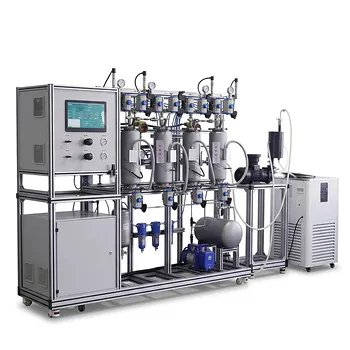
Quickly assessing your gas cleaning pilot plant, the fundamental difference is clear. A cyclone separator is your rugged, low-cost workhorse for capturing the coarse, heavy dust that plumes out first. An electrostatic precipitator (ESP) is the precision instrument you switch on when the highest removal efficiency—even for microscopic, sub-micron particles—is non-negotiable, and you can accept a higher complexity and electrical demand.
While a cyclone gives you immediate, reliable bulk dust knockdown with almost no energy penalty, an ESP delivers near-perfect fine particle capture (>99.9%) with an exceptionally low pressure drop. In most realistic pilot plant research scenarios, they aren't competitors but complementary stages in a multi-barrier dust removal strategy.
Understanding the Fundamentals: Cyclone Separators
Cyclone separators rely on brute mechanical force, not fragile media or high-voltage electrics. This simplicity makes them indispensable for initial dust removal in educational and R&D pilot plants.
How Centrifugal Force Separates Dust
A cyclone works by injecting the particle-laden gas tangentially into a conical chamber.
The gas spins into a powerful vortex, and centrifugal force flings the heavier dust particles outward toward the wall. The particles slide down into a collection hopper, while the cleaned gas reverses direction and exits through a central vortex finder. The entire process has no moving parts, no filters to change, and can handle heavy dust loads continuously.
Performance Limitations for Fine Particles
The Achilles' heel of a cyclone is its physical dependence on particle inertia.
Collection efficiency plummets for particles smaller than roughly 10 µm. Sub-micron dust is too light to be thrown to the wall effectively; it simply follows the gas stream out. In a pilot plant, this means a cyclone alone will never meet modern fine particulate emission targets, but it is the perfect pre-cleaner to protect sensitive downstream devices.
Understanding Electrostatic Precipitators (ESPs)
An ESP replaces mechanical force with electrostatic attraction, targeting dust on a microscopic level. This transforms it into a high-precision instrument for advanced emission control research.
The Role of High-Voltage Charging
ESP operation hinges on a corona discharge from high-voltage discharge electrodes.
As the gas flows between these electrodes and grounded collection plates, the intense electric field ionizes the gas, charging every airborne particle. These charged particles are then driven by the electric field to migrate and stick to the collection surfaces. Periodic rapping or washing dislodges the accumulated dust cake into hoppers, keeping the unit clean.
Exceptional Efficiency Across a Wide Particle Spectrum
The key performance advantage is that an ESP’s charging force acts on mass and surface area, not just gross inertia.
This allows ESPs to capture fine dust with breathtaking efficiency, often exceeding 99.9%, for particles ranging from 0.01 to 100 µm. Even the sub-2 µm respiratory fraction is easily removed. Moreover, the device achieves this with an extremely low pressure drop, because the gas path is essentially an open channel with no torturous filter media.
Head-to-Head: Performance and Application in a Pilot Plant
When designing a gas cleaning module, you must decide where each unit plays a role. The choice hinges on efficiency targets, particle size, and operational constraints.
Efficiency and Particle Size Range
The divergence is stark and defines their roles.
- Cyclone: High efficiency for particles >10 µm, but efficiency collapses to near zero for anything under 2 µm. It’s a coarse bulk separator.
- ESP: Efficiency stays >99% across the entire size range, even into the sub-micron and fume region. It’s a final polishing and fine dust catcher.
Pressure Drop and Energy Consumption
These devices consume energy in fundamentally different ways, a critical insight for pilot plant documentation.
A cyclone imposes a moderate but constant pressure drop (typically 5–15 mbar) as you drive through the vortex. The fan power required scales directly with this pressure loss. An ESP operates with an almost negligible gas-side pressure drop, often less than 1 mbar. However, it trades that for a high-voltage DC power supply, which consumes energy to maintain the corona discharge. In pilot plant reports, you compare pumping energy (cyclone) versus electrical charging energy (ESP).
Maintenance and Operational Complexity
Cyclones are famously “fit and forget” devices with no internals to clog, blind, or replace. The only routine task is emptying the hopper.
ESPs demand more attention. High-voltage safety interlocks, rapping mechanisms (mechanical or electromagnetic), and the need to maintain clean insulators and electrode alignment introduce a steep learning curve. For a training pilot plant, this complexity is precisely the educational value, as it teaches advanced process control and troubleshooting.
Durability in Harsh Gas Streams
Supplementary details often overlooked in basic guides reveal ESPs’ hidden strength.
Because an ESP has no tight porous media to clog, it can handle sticky, high-temperature, or corrosive gases that would rapidly destroy a bag filter or foul a sensitive sensor. Cyclones can also handle high temperatures, but their fine-fraction bypass limits their use as a final control device. An ESP downstream of scrubbers or as a standalone hot-gas unit is often the only viable high-efficiency option for demanding research scenarios.
Understanding the Trade-offs
Objective advice requires acknowledging where each technology falls short or introduces risk.
- Cyclone’s Efficiency Ceiling: No amount of optimization will make a standard cyclone efficient for fine PM2.5. Relying on it alone for modern emission limits is a guaranteed failure.
- ESP’s Capital and Space Footprint: ESPs are considerably larger, more expensive to fabricate, and require a secure high-voltage infrastructure. In a compact pilot skid, the sheer volume of the collector plates can be a constraint.
- Back-Corona and Dust Resistivity: A hidden trap with ESPs is that certain highly resistive dusts (like dry silica) can cause “back-corona,” a sparking inversion that kills efficiency. Cyclones are immune to this electrical phenomenon. This is a key experimental variable your pilot plant can explore.
- The Synergy Argument: The most common design flaw is using either technology in isolation. A cyclone first to knock out the heavy, abrasive load, followed by an ESP to capture the fines, gives you both protection for the ESP’s internals and the highest overall system efficiency at a much smaller ESP size.
Making the Right Choice for Your Pilot Plant Goal
Your selection depends entirely on the learning or research outcome you need to demonstrate. Here is how to align the technology with your objective.
- If your primary focus is demonstrating simple, robust bulk dust control: Use a standalone cyclone separator. It’s the most cost-effective way to show fundamental separation physics and is virtually maintenance-free.
- If your primary focus is achieving the highest possible emission control for fine respirable dust: Deploy an electrostatic precipitator. It will give you >99% capture and the data to explore advanced topics like current-voltage curves and particle resistivity.
- If your primary focus is modeling a realistic industrial emission control train: Combine the two. Install a cyclone as the pre-separator and an ESP as the final polisher. This layout teaches process integration, protects the ESP, and delivers true near-zero emission results.
Ultimately, in a well-designed environmental engineering pilot plant, the question isn’t cyclone or ESP—but how to stage them together to turn a dust-laden challenge into a clean research result.
Summary Table:
| Feature | Cyclone Separator | Electrostatic Precipitator (ESP) |
|---|---|---|
| Primary Mechanism | Centrifugal force / inertia | Electrostatic attraction |
| Target Particle Size | Coarse dust (>10 µm) | Fine & sub-micron dust (0.01 to 100 µm) |
| Removal Efficiency | Low for fine dust; high for bulk load | Exceptionally high (>99.9% even for fines) |
| Pressure Drop | Moderate (5–15 mbar) | Extremely low (<1 mbar) |
| Energy Consumption | Pumping/fan energy (to overcome pressure) | Electrical energy (to maintain corona discharge) |
| Complexity & Maintenance | Low (no moving parts, "fit and forget") | High (requires electrode cleaning, safety interlocks) |
| Best Application | Pre-cleaning, protecting downstream equipment | Final polishing, high-efficiency emission control |
Optimize Your Gas Cleaning Research with LABPARK
Are you looking to enhance hands-on learning or advance your environmental engineering research? LABPARK provides premium Educational and Vocational Unit Operations Pilot Plants across chemical engineering, bioprocess & biotech, and environmental & water treatment sectors.
We help universities, research institutes, and enterprises design and implement versatile, safe, and highly accurate pilot systems—including custom gas cleaning setups featuring integrated cyclone separators and ESPs.
Ready to elevate your laboratory capabilities? Contact LABPARK today to discuss your project requirements and receive a tailored solution!
Related Products
- Gas-Solid Heterogeneous Separation Demonstration Educational Unit Operations Pilot Plant
- Bench Scale Dual Column Gas Separation and Capture Educational Pilot Plant
- Multi-Component Gas Pressure Swing Adsorption Pilot Plant for Unit Operations Education
People Also Ask
- Why is pressure drop characterization critical in separation pilot plants? Key operational insights.
- What are the key thermodynamic considerations for gas mixture modeling? Expert Guide
- What are the primary operational objectives and physical requirements when running heterogeneous separation pilot plants?
- What are the material limitations of gas separation pilot plants? Key factors to consider.
- What are the trade-offs in olefin-paraffin separation? Optimize Pilot Plant Performance