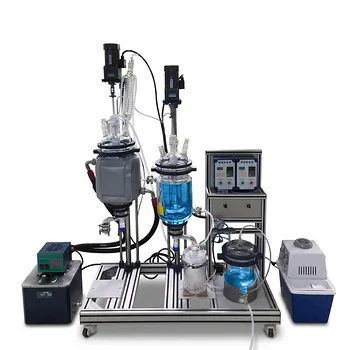
The core difference between an internal and an external circulation cooling crystallizer lies in where the driving force for slurry movement is located.
Internal circulation designs use a submerged draft tube and an internal agitator to create a controlled upward flow of the crystal slurry inside the vessel. External circulation designs, by contrast, rely on an external pump and a recirculation loop to move the slurry through a separate heat exchanger and back into the tank. In a pilot plant, these structural choices directly influence mixing uniformity, crystal residence time, and the location of the cooling interface.
While internal circulation provides a gentle, well-defined mixing pattern ideal for studying nucleation and growth kinetics, external circulation decouples pumping from the vessel, offering higher throughput and flexible heat exchange at the cost of added complexity and crystal breakage risk. In educational settings, the choice between them determines which fundamental engineering phenomena students can observe.
Structural Differences: How the Crystals Are Moved
The Internal Circulation Arrangement
An internal circulation crystallizer features a draft tube mounted concentrically inside the vessel. A bottom-mounted agitator, typically a marine propeller, pulls slurry up through the tube and discharges it radially at the top, creating a continuous internal loop.
This design eliminates external piping, keeping all crystal-handling components within the tank.
The External Circulation Loop
An external circulation crystallizer replaces the internal draft tube with an external pump and a recirculation pipe. The pump draws slurry from the vessel, pushes it through a shell-and-tube or plate heat exchanger, and returns cooled suspension back to the tank.
The flow can be co-current or counter-current to the coolant, and the loop is often equipped with flow meters and control valves for precise adjustment.
Impact on Dead Zones and Settling
Internal draft tubes are engineered to minimize dead zones by controlling fluid motion vertically, directly addressing settling at the bottom.
External loops can also prevent settling if discharge nozzles are placed low and create sufficient turbulence, but improper design may leave stagnant corners where crystals accumulate.
Operational Features and Performance Implications
Circulation Rate Control and Turn-Down
In an internal design, circulation rate is a direct function of agitator speed, which also influences tip speed and shear. This couples mixing intensity with particle suspension, limiting independent adjustment.
External loops separate these functions: the pump speed controls circulation independently of any in-vessel agitation, providing a wider turn-down range and the ability to fine-tune residence time in the heat exchanger.
Heat Exchange and Supersaturation Management
With external circulation, the entire cooling load is concentrated in the external heat exchanger, generating a sharp localized drop in temperature. This can produce high local supersaturation, which is useful for promoting nucleation but risks scale formation on the exchanger surfaces.
Internal circulation relies on cooling through a jacket or internal coils, distributing the heat removal more gently across the vessel wall. This often results in a more uniform temperature profile and less intense wall supersaturation.
Crystal Breakage and Attrition
The external pump is a well-known source of crystal attrition. The mechanical action of the impeller can fracture crystals, generating secondary nucleation and broadening the size distribution.
Internal designs, with their low-speed, high-flow agitators, are deliberately gentle. The draft tube guides flow without directing crystals through high‑shear zones, making them preferable when large, uniform crystals are the goal.
Common Pitfalls and the Fouling Trade-off
The Scaling Problem in Indirect Cooling
Both internal and external circulation crystallizers are indirect cooling systems—heat transfers through a solid wall. As the primary reference implies, one key comparison is how each handles the inevitable crystal scaling (fouling) on cold surfaces.
Supplementary observations from pilot plant experience confirm that any indirect cooling method is highly susceptible to scaling because crystals nucleate and adhere directly to the chilled metal, progressively reducing heat transfer.
Cleaning and Maintenance
External exchangers are often designed as removable bundles or can be isolated and cleaned with chemical solvents without draining the main vessel. This accessibility is a practical advantage during long experimental runs.
Internal cooling jackets or coils, while less compact, become a maintenance headache. They cannot be easily removed for mechanical cleaning, and scaling inside the tank may go unnoticed until performance drops significantly. In a pilot plant, this teaches students to weigh thermal efficiency against operational simplicity.
Direct Cooling as a Benchmark
Although not part of the internal/external dichotomy, it is worth noting that direct cooling crystallizers eliminate the solid wall entirely by injecting an immiscible coolant. This avoids scaling but introduces challenges in coolant selection, separation, and safety.
Viewing internal and external designs as indirect methods highlights why fouling is a central topic when students operate pilot crystallizers.
Making the Right Choice for Your Educational Pilot Plant
The configuration you choose should align with the specific learning objectives and operational constraints of your unit operations lab.
- If your primary focus is fluid dynamics and mixing uniformity: Start with the internal draft-tube crystallizer. It makes the flow path visible and lets students relate agitator power number to circulation rate directly, without the confounding variable of an external loop.
- If your primary focus is heat transfer and supersaturation control: The external circulation design is superior. It allows students to measure the log-mean temperature difference across a dedicated exchanger, calculate a unique overall heat transfer coefficient, and observe fouling build-up over time.
- If your primary focus is crystal size distribution and attrition: Run both systems with the same chemistry and cooling profile. The resulting distributions will clearly show the broadening effect of the external pump, providing a powerful lesson in secondary nucleation.
- If your primary focus is maintenance and long-run operability: The external design, with its accessible heat exchanger, teaches the value of designing for cleanability. However, the simpler internal arrangement demonstrates that fewer components often means fewer failure points.
By understanding the structural origins of circulation and heat transfer, you equip yourself to design experiments that isolate exactly the crystallization phenomenon you need to study.
Summary Table:
| Feature | Internal Circulation | External Circulation |
|---|---|---|
| Driving Force | Internal agitator & draft tube | External pump & recirculation loop |
| Heat Exchange | Cooling jacket or internal coils | External shell-and-tube or plate exchanger |
| Crystal Attrition | Low (gentle mixing, uniform size) | High (pump impeller shears & breaks crystals) |
| Flow & Shear Control | Coupled (speed controls both suspension & shear) | Decoupled (pump speed controls flow independently) |
| Fouling & Maintenance | Harder to clean (requires tank shutdown/draining) | Easier to isolate, clean, and maintain |
Optimize Your Chemical Engineering Lab with LABPARK
Choosing the right crystallization setup is critical for both research accuracy and student learning. LABPARK provides state-of-the-art Educational and Vocational Unit Operations Pilot Plants in chemical engineering, bioprocess & biotech, and environmental & water treatment.
Designed specifically for universities, research institutes, and enterprises, our pilot plants allow users to safely study heat transfer, crystallization kinetics, and fluid dynamics in a hands-on environment.
Ready to upgrade your laboratory capabilities? Contact LABPARK today to discuss your custom pilot plant requirements!
Related Products
- Multi Functional Membrane Crystallization Educational Unit Operations Pilot Plant
- Potassium Salt Thermal Dissolution and Crystallization Separation Educational Unit Operations Pilot Plant
People Also Ask
- Control Crystallization Pilot Plant Secondary Nucleation: 4 Key Adjustments
- Why is precise temperature control critical in crystallization pilot plants? Key to Scale-Up Success
- What key factors should be considered when configuring a crystallization unit operations pilot plant?
- What are the benefits of integrating online PAT tools like ATR-FTIR into crystallization unit operations pilot plants?
- How to use crystallization pilot plant agitation speed to identify diffusion vs reaction growth?