The silent workhorse of any chemical engineering unit ops lab—the centrifugal pump—owes its reliability to a subtle but critical design detail: backward-curved blades.
While blades that sweep away from the direction of rotation might appear counterintuitive, they directly generate a higher proportion of static pressure (the usable head) and less wasteful kinetic energy. This drastically reduces hydraulic losses inside the pump casing, delivering the high efficiency and stable flow characteristics essential for precise, repeatable lab demonstrations.
The choice between backward-curved, forward-curved, and radial blades is fundamentally a choice between prioritizing energy conversion efficiency and operational stability (backward-curved) or maximum theoretical head at the cost of severe turbulence and energy loss (forward-curved). In a teaching lab where consistent, efficient fluid transport is paramount, backward-curved blades are the only logical option.
Decoding the Blade Angles: A Primer on Pump Geometry
What Do Blade Angles Actually Mean?
The impeller blade’s outlet angle ((\beta_2)) is measured relative to the tangent of the impeller’s circumference.
Backward-curved blades have (\beta_2 < 90^\circ), radial blades sit at (90^\circ), and forward-curved blades use (\beta_2 > 90^\circ).
Forward-curved blades lean into the direction of rotation, scooping fluid aggressively and throwing it out at a higher velocity.
Backward-curved blades angle away, releasing the fluid with a much smaller tangential velocity component.
According to the Euler turbomachinery equation, theoretical head depends on how much the impeller can increase the fluid’s tangential momentum.
Forward-curved blades achieve a higher absolute exit velocity ((v_2)), yielding a larger ideal head—but at a hidden cost.
The Efficiency Trap: When More Head Means Less Performance
The Hidden Cost of High Theoretical Head
Forward-curved blades impart an extraordinary amount of kinetic energy to the fluid.
That high velocity represents dynamic head, not the static head needed to overcome system resistance.
A pump’s volute casing must then convert that velocity into pressure.
This conversion process is inherently lossy—eddy currents, flow separation, and turbulent recirculation turn a significant fraction of the energy into heat, not usable pressure.
The Role of Static Head in Real-World Pumping
Static head is the pressure rise delivered directly at the impeller outlet—the head you can actually “use.”
Backward-curved blades produce a far larger fraction of their total head as static head right at the impeller.
This bypasses most of the high-loss velocity-to-pressure conversion, dramatically improving overall hydraulic efficiency.
In a lab setting, that translates into less power consumption and more stable, controllable flows.
Why Unit Operations Labs Demand Backward-Curved Blades
Reproducible Results Depend on Operational Stability
Lab experiments require consistent, predictable flow that won’t oscillate unexpectedly.
Pumps with backward-curved blades exhibit a steep, stable head-capacity curve—as flow changes, the head changes in a well-behaved manner, preventing surging and hunting.
Forward-curved blades, by contrast, often produce a flatter or even drooping curve.
That can lead to flow instability, making it extremely difficult to collect accurate data or convincingly demonstrate fundamental transport phenomena to students.
Energy Efficiency as a Teaching Principle
Chemical engineering curricula emphasize designing processes that respect energy and resource constraints.
A backward-curved pump operating at 80%+ efficiency reinforces that lesson every time it runs, while a forward-curved counterpart might struggle to reach 50–60%.
Moreover, unit ops equipment often runs for extended periods.
An efficient pump slashes electrical consumption and teaches students that sound component selection directly impacts process economics.
Long-Term Reliability in a Demanding Environment
Lab pumps cycle on and off frequently, encounter varying fluid properties, and sometimes suffer from well-meaning student mishandling.
The lower discharge velocities and reduced radial thrust of backward-curved blades subject seals, bearings, and casings to less hydraulic stress.
This minimizes vibration and internal wear, extending the equipment’s service life.
Forward-curved blades, with their aggressive jet-like discharge, accelerate erosion and mechanical fatigue, leading to more frequent maintenance and replacement.
Understanding the Trade-offs
When Forward-Curved Blades Might Make Sense (And Why Not in a Liquid Lab)
Forward-curved blades are not useless—they simply excel in a different domain.
You’ll often find them in high-volume, low-pressure gas fans where moving a lot of air cheaply (small impeller, high speed) takes precedence over peak efficiency.
However, for incompressible liquids, the density magnifies conversion losses dramatically.
What might be an acceptable efficiency penalty in a ventilation fan becomes a prohibitive energy waste and instability risk in a liquid pump, particularly in an educational environment that demands precision.
The Forgotten Radial Blade
Radial blades ((\beta_2 = 90^\circ)) offer a middle ground with moderate efficiency and simpler construction.
Some slurry or solids-handling pumps use them because the straight, open channels resist clogging.
Yet in clean‑fluid lab service, they still leave a significant portion of head as dynamic head.
Backward-curved designs deliver clearly superior efficiency and flow stability, making them the default choice for unit operations pilot plants.
Making the Right Choice for Your Lab Goal
The final decision on pump blade design must align with your educational and operational priorities.
Consider these actionable scenarios:
- If your primary focus is demonstrating chemical engineering principles with maximum clarity and repeatability: Insist on a pump with backward-curved blades; its stable flow and high static head generation provide the most accurate, interpretable data.
- If your goal is to highlight the critical difference between theoretical ideal and real-world performance: Compare a backward‑curved pump’s efficiency curve directly with Euler‑predicted values—this starkly illustrates the penalty of kinetic‑energy conversion losses.
- If you are sizing a pump for a pilot‑plant scale reaction or separation unit: Prioritize backward-curved blades to ensure the system operates near its Best Efficiency Point (BEP) while minimizing energy consumption and maintenance headaches for years of student use.
Ultimately, the backward-curved blade isn’t a default compromise—it’s a deliberate optimization that transforms a simple machine into a precise, durable, and instructive instrument for chemical engineering education.
Summary Table:
| Blade Type | Outlet Angle | Primary Head Type | Hydraulic Efficiency | Flow Stability | Primary Application |
|---|---|---|---|---|---|
| Backward-Curved | < 90° | Static Head (Usable Pressure) | High (80%+) | High (Steep, stable curve) | Liquid pumping, unit ops labs |
| Radial | = 90° | Mixed | Moderate | Moderate | Slurry and solid-handling pumps |
| Forward-Curved | > 90° | Dynamic Head (High Velocity) | Low (due to conversion losses) | Low (Flatter/drooping curve) | High-volume, low-pressure gas fans |
Build a High-Performance Lab with LABPARK
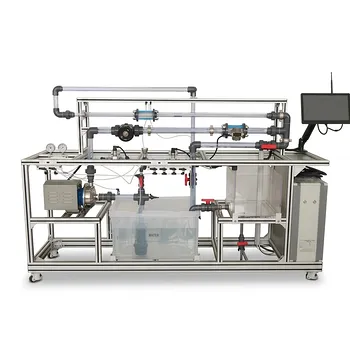
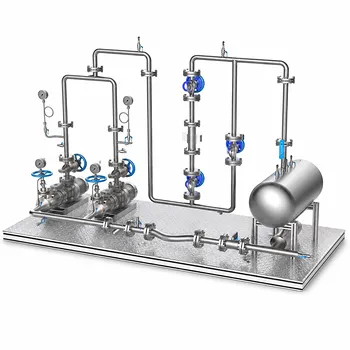
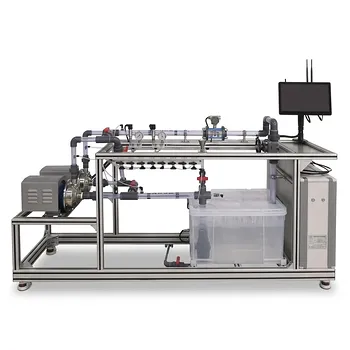
Looking to equip your facility with reliable, highly efficient, and pedagogically sound equipment? LABPARK provides state-of-the-art Educational and Vocational Unit Operations Pilot Plants in chemical engineering, bioprocess & biotech, and environmental & water treatment.
Designed specifically for universities, research institutes, and enterprises, our pilot plants feature optimized components—like high-efficiency backward-curved impeller pumps—to ensure stable data collection, minimal maintenance, and maximum learning value for your students.
Ready to elevate your engineering lab? Contact our technical experts today to find the perfect pilot plant solution for your institution!
Related Products
- Centrifugal Pump Performance and Orifice Flowmeter Calibration Educational Pilot Plant
- Chemical Pipeline Assembly and Fluid Transport Practical Training Unit Operations Pilot Plant
- Centrifugal Pump Performance Determination Educational Unit Operations Pilot Plant
People Also Ask
- What features should instructors look for in pump & flowmeter pilot plants? Key Selection Guide
- Why start a centrifugal pump with a closed outlet valve? Protect your pilot plant motors.
- How to update chemometric calibration models in pilot plants? Best practices for process engineers.
- How can cavitation and slurry erosion be studied and mitigated using fluid transport and centrifugal pump pilot plants?
- How do pilot plants demonstrate siphon pressure variations? Visualizing Bernoulli's Energy Balance