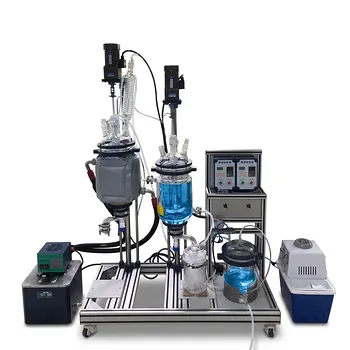
The production of boric acid from borax hinges on a simple double displacement reaction, driven by a strong mineral acid. This reaction transforms sodium tetraborate into boric acid and a sodium salt byproduct. However, the key to controlling the subsequent crystallization lies not in the synthesis itself, but in the paradoxical acid behavior of the H3BO3 molecule—a weak, monobasic species in water that defies its triprotic formula.
Producing boric acid is chemically straightforward: react borax with excess HCl. The real process control challenge emerges from boric acid's identity as a weak Lewis acid, not a proton donor. This means the working solution is only mildly acidic, requiring a nuanced approach to pH management, yield optimization, and wastewater neutralization during pilot-scale crystallization.
The Chemical Reaction: From Borax to Boric Acid
The synthesis is a textbook metathesis reaction. A hot, concentrated borax solution is acidified to drive the precipitation.
The Core Stoichiometry
The primary reaction proceeds as follows: Na₂B₄O₇ + 2HCl + 5H₂O → 2NaCl + 4H₃BO₃
Mixing aqueous sodium tetraborate with excess hydrochloric acid yields a hot solution containing soluble sodium chloride and boric acid. Upon slowly cooling this mixture, the lower solubility of boric acid forces it to crystallize out of the salt-laden mother liquor.
The Pilot Plant Workflow
In a typical pilot crystallizer, borax is dissolved in hot water. Concentrated HCl is then added incrementally to ensure complete conversion. The subsequent controlled cooling step is the heart of the unit operation, where crystal nucleation and growth occur.
The Weak Acid Behavior: A Lewis Acid in Disguise
Despite having three hydrogen atoms, boric acid does not behave like a typical proton donor. Its acidity stems from an entirely different mechanism.
Electron Acceptance, Not Proton Donation
In aqueous solution, H₃BO₃ acts as a weak monobasic Lewis acid. It does not donate a proton (H⁺) but instead accepts a hydroxyl ion (OH⁻) from a water molecule. This is a critical distinction for process chemists. The equilibrium is: H₃BO₃ + H₂O ⇌ B(OH)₄⁻ + H⁺
The acid dissociation constant, K = 5.4 × 10⁻¹⁰, confirms its exceptionally weak nature.
Implications for Solution Chemistry
Because the acid does not fully dissociate, the solution pH never drops drastically, even at high concentrations. The H⁺ ion is a consequence of the hydroxyl extraction from water, leaving a tiny concentration of free protons. This behavior must be modeled correctly in any process control software.
Process Implications for Pilot Crystallizers
The weak acidity directly impacts how engineers control the unit operation, from reaction yield to effluent handling.
Impact on pH Control and Supersaturation
The mild, buffered pH environment means that slight variations in HCl excess have a disproportionate effect on the final proton concentration. Operators cannot rely on a simple strong-acid titration curve. To drive crystallization, the solution must be cooled, not pH-shifted, because boric acid's solubility is highly temperature-dependent, not pH-dependent in this mildly acidic range.
Wastewater Neutralization Requirements
The mother liquor will contain residual weak acid and NaCl. Neutralizing this stream requires a base like NaOH, but the weak nature of boric acid means the titration curve plateaus. Careful monitoring and a controlled dosing strategy are essential to avoid overshooting the neutral pH target during pilot plant runs.
The Hidden Variable: How pH Influences Crystal Morphology
The weak acid behavior is not just a titration challenge; it also interacts with the physical outcome of the crystallization.
Sensitivity of Crystal Shape
Crystal morphology is rarely a fixed property. As the supplementary reference shows with sodium chloride, the presence of different species in solution can dramatically alter habit from cubes to octahedrons. In boric acid crystallization, the concentration of the B(OH)₄⁻ ion, governed by the Lewis acid equilibrium, acts as an intrinsic additive that can influence platelet versus needle growth.
Downstream Processing Consequences
The shape of the crystals—whether they form thin, plate-like structures or more equant particles—directly impacts the efficiency of filtration, washing, and drying. A shift towards platy crystals, potentially influenced by the local pH micro-environment at the growth interface, can blind a centrifuge filter cloth much faster than a granular habit.
Understanding the Trade-offs
Using this reaction system presents a mix of engineering advantages and control complexities.
- The Mild pH Advantage: The weak acidity lowers corrosion risk for agitated crystallizers and piping compared to a strong mineral acid system. This can reduce capital expenditure for exotic alloys in a pilot plant.
- The Yield Limitation: Because the acid is weak, the reaction equilibrium with borax must be pushed by using an excess of HCl and removing boric acid from solution via cooling. A stochiometric amount of acid will not maximize yield.
- The Morphology Variable: While the weak acidity itself may seem predictable, its subtle influence on crystal habit can introduce poor reproducibility in downstream unit ops if not carefully characterized at scale-up.
Making the Right Choice for Your Pilot Operation
The success of your boric acid crystallization campaign hinges on which process variable you prioritize. Here’s how to align the chemistry with your goal:
- If your primary focus is maximizing yield: Use a significant but controlled excess of HCl, and rely on rapid cooling to exploit the steep solubility curve, not pH-driven precipitation.
- If your primary focus is crystal purity and morphology: Tightly control the cooling rate and mixing. Regularly analyze the mother liquor pH to ensure it stays within a narrow window, as this correlates with the B(OH)₄⁻ concentration that can act as a habit modifier.
- If your primary focus is waste reduction and process safety: Leverage the weak acid nature. Design a mild two-stage neutralization system for the effluent, and remember that the mild pH allows for simpler management of volatile HCl vapors.
Mastering this process means treating boric acid not as a simple product, but as a weak Lewis acid orchestrating the entire crystallization environment.
Summary Table:
| Parameter | Chemical Property / Reaction | Impact on Crystallization |
|---|---|---|
| Core Reaction | $Na_2B_4O_7 + 2HCl + 5H_2O \rightarrow 2NaCl + 4H_3BO_3$ | Requires cooling to drive precipitation due to temperature-dependent solubility. |
| Acid Behavior | Weak monobasic Lewis acid ($K_a = 5.4 \times 10^{-10}$) | Buffered pH; requires temperature control rather than pH shifts to trigger crystallization. |
| Morphology | Guided by $B(OH)_4^-$ ion concentration | Influences crystal shape (platelets vs. needles), affecting downstream filtration. |
| Process Safety | Mildly acidic working solution | Lowers corrosion risk for crystallizers and piping systems. |
Optimize Your Chemical Engineering Labs with LABPARK
Are you looking to enhance hands-on learning and research in crystallization and unit operations? LABPARK provides premium Educational and Vocational Unit Operations Pilot Plants in chemical engineering, bioprocess & biotech, and environmental & water treatment.
Designed specifically for universities, research institutes, and enterprises, our pilot plants deliver the precise process control and reliability needed to model complex chemical behaviors and crystallization kinetics.
Contact LABPARK today to find the perfect pilot-scale solution for your facility!
Related Products
People Also Ask
- How does solubility modeling assist crystallization pilot plants? Master the BETA parameter.
- What are the benefits of integrating online PAT tools like ATR-FTIR into crystallization unit operations pilot plants?
- How do crystallization pilot plants improve student learning? Shift from manual observation to process control.
- Control Crystallization Pilot Plant Secondary Nucleation: 4 Key Adjustments
- Why is precise temperature control critical in crystallization pilot plants? Key to Scale-Up Success