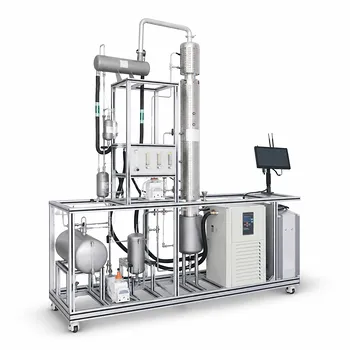
Process NMR provides real-time molecular fingerprints of flowing process streams, enabling immediate, automated control of critical unit operations like distillation and blending in pilot plants. By continuously measuring hydrocarbon types, octane/cetane numbers, acid strength, or polymer composition, the analyzer feeds compositional data directly into advanced control loops. This dynamic feedback allows operators—or an automated system—to adjust reflux ratios, feed tray locations, blend valve positions, and temperatures on the fly, maintaining target purity and yield even as feedstocks change.
Process NMR acts as a universal, linear online analyzer that delivers robust compositional data across wide ranges of process conditions. Its key advantage in pilot-plant control is the ability to provide multi-property feedback from a single instrument without frequent recalibration, making it ideal for optimizing distillation cuts and fuel blending in real time.
Applying Process NMR to Distillation Control
Distillation separates components based on boiling point, but achieving tight product specifications requires constant knowledge of the stream compositions. Process NMR gives that knowledge instantly.
Measuring Cut Points with Hydrocarbon Type Analysis
In refinery pilot plants, the value of a distillation cut depends on its chemical makeup, not just its boiling range. NMR directly quantifies aromatics, naphthenes, paraffins, and olefins in each sidestream.
A simple ¹H or ¹³C spectrum instantly reveals the ratio of these families. When the aromatic content of a kerosene cut drifts above specification, the control system can automatically increase the draw temperature or adjust the pumparound rate to shift that material back into the heavier product.
Closed-Loop Purity Monitoring
For chemical synthesis pilot plants, NMR measures the concentration of a target molecule—such as a monomer or an active pharmaceutical intermediate—in the distillate. If the product purity dips, the reflux ratio can be increased.
Because NMR responds linearly to concentration, even when the mixture deviates far from the design range, the feedback signal remains accurate. This avoids the non-linear bias that plague near-infrared (NIR) or Raman models during high‑severity runs, keeping the control loop stable.
Detecting Azeotropes and Reaction Byproducts
Many distillations involve azeotropic mixtures or reactive side products. NMR can identify the formation of a byproduct alcohol or ester in a reactive distillation column. Detecting this in real time allows the pilot plant to trigger a feed purge or adjust the catalyst concentration before the entire batch is compromised.
Precise Blending with Process NMR
Blending operations in pilot plants aim to hit a final product property—like a specific Research Octane Number (RON) or cetane number—by mixing several component streams. Process NMR transforms this from a predictive exercise into a directly measured, closed‑loop process.
Online Octane and Cetane Determination
NMR spectroscopy correlates directly with octane and cetane numbers through the molecular branching and aromatic content it sees. A single NMR spectrum of the blend header can predict RON more reliably than a conventional knock engine, and it does so in seconds.
The measured value is fed to the blender control system, which trims the flow rate of the high‑octane reformate or alkylate stream. This eliminates the need for frequent laboratory sampling and allows the pilot plant to maximize the use of lower‑cost blendstocks while still meeting specification.
Acid Strength and Additive Monitoring
In chemical synthesis pilot plants, NMR can monitor the strength of acid catalysts—like sulfuric acid alkylation—by directly tracking the acid concentration in a slipstream. Similarly, it can quantify polymer additive levels or polyol compositions during continuous blending.
The immediate feedback adjusts dosing pumps to keep the reaction chemistry balanced, preventing off‑spec product and reducing hazardous manual sampling.
Building the Integration for Real-Time Control
Getting NMR data into a control loop requires a robust sampling interface. The supplementary references detail the essential engineering requirements for pilot-plant integration.
The Continuous Sampling Loop
A fast loop (260–340 L/h) circulates the process stream from the distillation column or blend header directly past the NMR probe, then returns it to the process or to waste. This high flow rate ensures the measurement represents the current process condition with minimal lag.
From this fast loop, a slower split stream enters the NMR flow cell. This arrangement protects the sensitive magnet from pressure surges while delivering a fresh sample for each scan.
Critical Temperature and Phase Control
NMR spectral repeatability depends on magnetic field homogeneity, which drifts if the sample temperature fluctuates. The sampling system must hold the temperature variation to less than 3°C. For heavy or waxy streams, inline heating to about 80°C is required to ensure full solubility and prevent solids that would obliterate the signal.
All streams must be completely liquid; even microscopic solids cause spectral broadening and destroy quantitative accuracy. Filters and heat tracing are non‑negotiable for reliable process control.
Probe and Hardware Durability
The NMR probe must withstand process pressures typical of pilot plants—rated to at least 103.4 bar (1500 psi)—and feature stainless steel construction with standard Swagelok fittings. A vacuum‑jacketed Dewar around the probe prevents heat from the process fluid from reaching the magnet, preserving the instrument’s stability. The sample zone often uses robust ceramic welded to stainless steel to resist corrosion and thermal stress.
Understanding the Trade-offs and Pitfalls
While process NMR offers unique advantages for distillation and blending control, it comes with clear practical limits that the pilot‑plant engineer must manage.
High Capital and Infrastructure Cost
NMR magnets—whether superconducting or permanent—represent a significant upfront investment. The instrument requires a controlled environment (vibration‑free, temperature‑regulated) and, for superconducting systems, a steady supply of liquid cryogens. This cost must be weighed against the potential gains in product yield and reduced offline testing.
Chemometric Model Maintenance
Although NMR’s linear response simplifies models, complex mixtures still demand multivariate calibration (e.g., partial least squares). Building and validating these models requires initial lab work and periodic verification. However, the linearity means a single model often spans multiple feedstocks and process severities, greatly reducing the frequency of major recalibration compared to NIR or Raman.
Sampling System Complexity
The requirement for solids‑free, temperature‑controlled, high‑flow sampling adds complexity and potential failure points. Filters can plug, heaters can fail, and pressure drops can cause vaporization. Any interruption in sample flow makes the control loop blind, so redundancy and rigorous maintenance are essential.
Not a Universal Solution for All Processes
NMR cannot handle streams that contain paramagnetic impurities or are inherently multi‑phase (slurries, emulsions with free solids). In those cases, complementary technologies like Raman (for solids‑tolerant in‑situ analysis) or NIR may be necessary. The choice must be guided by the specific chemistry and physical state of the process streams.
Making the Right Choice for Your Pilot‑Plant Goal
Process NMR is a powerful tool, but its role depends on what you aim to achieve in your distillation or blending pilot plant. Use the following guide to focus your implementation.
- If your primary focus is maximizing product yield and quality in multi‑feedstock refinery pilots: Leverage NMR’s linear, universal hydrocarbon response to build a single robust model that controls cuts and blends across widely varying crudes without frequent recalibration.
- If your primary focus is training operators and students on dynamic process control: Integrate flow‑NMR with a clear display of real‑time compositional data, allowing manual or automated reflux, feed, and blend adjustments to demonstrate cause‑and‑effect in process optimization.
- If your primary focus is minimizing offline laboratory testing and cycle time: Use NMR for instant, multi‑parameter release of distillation fractions and blend recipes, cutting hours of wait time down to seconds and enabling high‑throughput pilot‑plant campaigns.
- If your primary focus is handling heavy, waxy, or temperature‑sensitive streams: Invest heavily in the sample conditioning system—heated fast loops, precise temperature control, and absolute filtration—to ensure NMR reliability without signal degradation.
The right implementation turns process NMR from an expensive spectrograph into the central nervous system of your pilot plant, delivering the compositional intelligence needed to make decisions that are both faster and smarter.
Summary Table:
| Application | Key Parameters Monitored | Process Control Action |
|---|---|---|
| Distillation | Hydrocarbon types (aromatics, paraffins), purity, byproducts | Adjusts reflux ratios and draw temperatures dynamically |
| Blending | Octane/cetane numbers, acid strength, chemical additives | Trims blendstock flow rates and dosing pumps instantly |
Are you looking to implement advanced process control in your training or research facility? LABPARK provides state-of-the-art Educational and Vocational Unit Operations Pilot Plants in chemical engineering, bioprocess & biotech, and environmental & water treatment. Designed specifically for universities, research institutes, and enterprises, our systems enable hands-on learning and advanced research in real-time process optimization, including distillation and blending control.
Contact LABPARK today to discover how we can help elevate your lab's capabilities!
Related Products
- Electrolyte Distillation Purification and Formulation Educational Pilot Plant
- Continuous Batch Extractive Distillation Educational Pilot Plant
- Continuous Sieve-Plate Distillation Pilot Plant for Unit Operations Laboratory Education
- Multi Functional Membrane Crystallization Educational Unit Operations Pilot Plant
- Multi-Modal Distillation Unit Operations Training Pilot Plant
People Also Ask
- Why does simple distillation yield higher efficiency than flash distillation? Key thermodynamic differences.
- How to Integrate Spectroscopy in Distillation Pilot Plants for Advanced Process Control
- How does double temperature difference control improve distillation pilot plants? Stabilize purity.
- How does the feed thermal state influence distillation pilot plant design and utility consumption?
- How to Estimate Distillation Pilot Plant Tray Efficiency? O'Connell's Correlation Guide