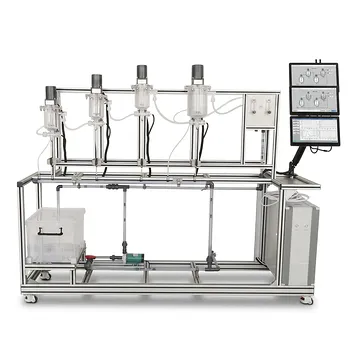
The residence time for a water knockout tank in a pilot plant is typically 30 to 60 minutes, while the final oil dehydration tank demands 16 hours or more. These two vessels form a staged separation train: the first knocks out free water quickly, but leaves a tight emulsion behind. The second, far slower tank breaks that emulsion with the help of a chemical, driving the water content in the treated oil down to 1% or less.
Pilot-plant designers treat the knockout tank as a fast bulk-separation step (30–60 min, removing 30–60% of the water) and the dehydration tank as a long-residence polishing step (≥16 h) to hit a target of ≤1% water by volume. Because lab beaker tests can mislead, only field pilot runs will confirm the exact times your specific crude and chemistry demand.
Understanding the Two-Stage Separation Logic
Why You Need Two Tanks, Not One
Free water settles quickly from an oil-continuous stream. However, once the easy-to-drop droplets are gone, you are left with a stable, chemically‑stabilized emulsion that would take days to resolve by gravity alone. A single tank either wastes space or fails.
The Knockout Tank’s Mission
The knockout (KO) tank aims to remove the bulk free water with minimal chemical cost and vessel volume. It accepts the raw mixture and lets gravity do the work while the emulsion layer is still loose. This step protects the downstream dehydration tank from being flooded with water that could be removed cheaply.
Water Knockout Tank Design and Residence Time
The 30‑to‑60‑Minute Window
Based on pilot-plant training data, the KO tank is sized for a residence time of 30 to 60 minutes. During this period, the tank strips out the water that separates under simple quiescent conditions, without strong chemical intervention.
Inherent Separation Limit
Even with a well‑designed inlet distributor, free‑water separation in this tank is typically limited to 30–60% of the total water content. The remaining water stays trapped as small droplets in the continuous oil, forming an emulsion that gravity alone cannot break. The KO tank’s job is not to solve the whole problem—it is to hand off a pre‑thickened emulsion to the next stage.
Oil Dehydration Tank Design and Residence Time
The 16‑Hour (or More) Rule
The dehydration tank receives the oil from the KO tank after it has been dosed with an emulsion breaker chemical. A minimum residence time of 16 hours is the standard starting point to allow that chemical to diffuse, rupture the interfacial films, and let droplets coalesce into a size that settles.
Hitting the 1% Water Specification
With the correct chemical dosage and enough time, the treated oil leaving the dehydration tank can achieve a water content of 1% by volume or less. This is often the contractual specification for crude or the feed limit for downstream units. The long residence time is the price you pay for that cleanliness.
The Critical Role of the Emulsion Breaker
The 16‑hour figure assumes the oil has been properly treated with an emulsion breaker before it enters the dehydration tank. Without the chemical, no reasonable residence time will break the emulsion. With the right product, the required time can sometimes be reduced, which is exactly what a pilot plant is meant to explore.
Trade-offs and Common Pitfalls
The Danger of Relying Solely on Lab Data
Laboratory beaker tests often give optimistic or inconsistent settling times. That’s why the primary reference insists you run actual field operating tests on your pilot plant to confirm the residence time. A 16‑hour design may be a safe starting point, but your specific crude, water chemistry, and mixing intensity can push the real requirement higher—or allow a shorter one.
Undersizing the Dehydration Tank
The single most expensive mistake is trying to shrink the dehydration vessel to cut costs. If your pilot data shows 20 hours are needed but you install a tank sized for only 16, you will never meet the outlet specification. The pilot plant gives you the real number; ignore it at your peril.
Knockout Tank Oversizing
An overgenerous KO tank can be tempting, but beyond 60 minutes you gain little extra water removal because the remaining droplets are too small to settle without chemical help. That extra volume only raises capital cost and heat‑loss surface area, without improving the subsequent dehydration step.
Mixing and Temperature Sensitivities
The separation performance in both tanks is heavily influenced by temperature and the upstream mixing shearing. A pilot plant that does not mimic field‑realistic shear and thermal conditions will produce optimistic residence‑time curves. Always replicate the plant’s upstream pumps, valves, and cool‑down path.
Making the Right Choice for Your Pilot Plant
The best design starts with the standard numbers but lets the pilot data fine‑tune the final vessel sizes. Use this goal‑based approach:
- If your primary focus is rapid bulk water removal: Prioritize a KO tank at the 30‑minute end of the range, with a robust inlet distributor, and accept that 40–60% water removal is the realistic ceiling.
- If your primary focus is reliably hitting the ≤1% water spec: Design the dehydration tank for at least 16 hours residence time, invest in a proper chemical injection and mixing skid, and run multi‑day pilot trials to determine if your crude needs even more.
- If your primary focus is optimizing chemical usage: Use the pilot plant to vary emulsion breaker dosage and type while measuring effluent water cut at different residence times, then size the tank to the minimum time that still meets the spec with the chosen chemical.
The pilot plant is not just a scale model—it is your negotiation with the actual fluid. Start with the textbook 30–60 minutes and 16+ hours, then let the data, not the beaker, have the final word.
Summary Table:
| Parameter | Water Knockout (KO) Tank | Final Oil Dehydration Tank |
|---|---|---|
| Residence Time | 30 to 60 minutes | 16 hours or more |
| Primary Goal | Bulk free water removal | Polishing & breaking tight emulsions |
| Separation Efficiency | 30% to 60% of total water removed | Achieves <= 1% water by volume |
| Chemical Addition | Not required for bulk separation | Essential (demulsifier/emulsion breaker) |
Optimize Your Separation Processes with LABPARK
Are you looking to scale up or refine your fluid separation processes? LABPARK provides state-of-the-art Educational and Vocational Unit Operations Pilot Plants in chemical engineering, bioprocess & biotech, and environmental & water treatment.
We help universities, research institutes, and enterprises determine accurate design parameters, validate residence times, and bridge the gap between laboratory tests and industrial performance. Contact us today to request a consultation and find the perfect pilot plant solution for your lab!
Related Products
People Also Ask
- How does MRF model impeller rotation in CFD? Key Boundary Conditions Explained
- How can a CSTR pilot plant demonstrate reactor staging? Visualize volume savings.
- How does steady-state multiplicity affect the operation and safety of exothermic reactions within a CSTR pilot plant? - Guide
- What parameters to monitor transitioning from Batch to CSTR? Master Pilot Plant Setup
- Why is temperature regulation via a cooling jacket a critical feature in CSTR pilot plants used for laboratory training?