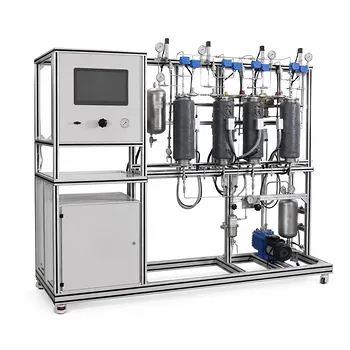
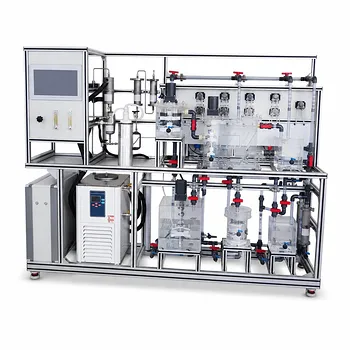
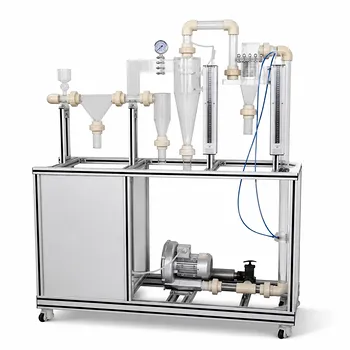
The direct, physical consequence is this: A moving bed gasifier will demand a far more elaborate and multi-stage downstream gas cleaning system in your training unit than a fluidized bed gasifier.
This is because a moving bed reactor, operating counter-currently, generates a raw syngas heavily loaded with condensable tars, oils, phenols, ammonia, and dust. The profound temperature gradient inside the reactor creates a “chemical soup” of by-products. In contrast, a fluidized bed reactor’s high, uniform temperature profile thermally cracks most of these condensable impurities at birth. For your unit operations training system, this means a fluidized bed setup will be markedly simpler and quicker to build, operate, and clean, while a moving bed setup will require you to build and demonstrate a complete, industrial-style gas conditioning train.
The core takeaway for a training system is not about one reactor being “better,” but about teaching the inseparable link between reaction conditions and separation requirements. A moving bed unit forces students to master tar removal, oil scrubbing, and ammonia stripping—complex but essential chemical engineering operations. A fluidized bed unit simplifies the gas cleaning to a standard particulate and sulfur removal loop, allowing training to focus intensely on the reactor’s fluid dynamics and heat management.
The Fundamental Difference in Syngas Quality
The choice of gasification reactor dictates the chemical cocktail your downstream equipment must handle. This isn’t a matter of one being cleaner across the board—it’s a shift in the type and quantity of contaminants.
The Moving Bed’s Messy Output
A moving bed (also called fixed-bed) gasifier produces a gas stream that is notoriously “dirty.”
This raw syngas contains a heavy load of condensable hydrocarbons, tars, naphtha, phenols, and ammonia, along with fine dust. These are not mere trace elements; they represent a significant fraction of the fuel’s mass that didn't fully decompose.
Consequently, the downstream cleaning system must be highly elaborate. It cannot simply be a filter. It must sequentially solve multiple phase-separation and absorption problems.
The Fluidized Bed’s Cleaner Syngas
A fluidized bed gasifier operates as a high-temperature chemical blender, fundamentally altering the output.
Its intense back-mixing and uniform temperature profile ensure that most long-chain hydrocarbons and tars are thermally cracked into permanent gases like hydrogen and carbon monoxide. This leaves a raw syngas with drastically lower levels of condensable impurities.
The downstream cleaning requirement, therefore, collapses primarily to removing particulates (fines and ash) and, in many training configurations, a standard sulfur removal step. The elaborate tar and oil removal train becomes unnecessary.
How Temperature Profiles Drive Impurity Formation
The disparity in gas cleaning complexity isn't an accident—it’s a direct, predictable result of each reactor’s internal thermal architecture.
Counter-Current Flow and Low Exit Temperatures in Moving Beds
In a moving bed, coal enters at the top and slowly descends against an upward stream of gasifying agents. This creates distinct temperature zones.
The gas exits from the relatively cool top zone (700–900 K), right after passing through the drying and pyrolysis regions. At these moderate temperatures, volatile matter in the coal escapes as a range of heavy hydrocarbons and tars rather than being broken down into simple gases. The gas effectively captures these high-molecular-weight compounds and carries them out of the reactor.
Because the exit gas is cool and saturated with condensables, your training system’s cleaning unit must immediately deal with phase-change challenges, preventing tars from solidifying and clogging lines.
Back-Mixing and Isothermal Conditions in Fluidized Beds
A fluidized bed suspends coal particles in a violently churning bed of sand or ash, heated uniformly to 1250–1400 K.
There are no cool zones. The entire bed acts as a single, hot isothermal unit. As fresh coal enters, it is instantly heated, and its volatile components are rapidly cracked at high temperatures.
The raw syngas leaving the bed is at a uniformly high temperature and contains very few of the complex organic molecules that plague a moving bed system. The contaminant profile shifts from a chemical separation problem to a more straightforward physical (particulate) removal problem.
Implications for Designing a Training Unit Operations System
For an educator or researcher, this difference translates directly into the physical footprint, operational safety, and pedagogical scope of your pilot plant.
Replicating Industrial Realities for Student Learning
A moving bed training system is, by necessity, a miniaturized chemical complex. It forces students to operate a sequential cleaning train involving cyclones, quench systems, oil scrubbers, and possibly steam stripping for ammonia.
This mirrors an old-world coal gasification plant and teaches unit operations that are critical in traditional chemical and petrochemical processing. The hands-on maintenance of tar-handling equipment is a profound, if messy, learning experience.
A fluidized bed training system, however, is a reactor-centric platform. The cleaning skid is simpler—often just a hot cyclone and a filter. This allows students to focus their entire attention on the reactor: measuring pressure drop, characterizing fluidization regimes, and studying heat transfer coefficients without being distracted by a complex separation train downstream.
Balancing Complexity and Educational Value
Your design objective is not to build the most complex machine, but to deliver the clearest pedagogical insight within your budget and safety envelope.
A moving bed requires heavier, more robust materials to handle corrosive condensates and the thermal cycling of tar-laden gas cooling. It demands more safety interlocks for combustible liquid handling.
A fluidized bed, while simpler downstream, shifts the operational complexity upstream to solid handling and gas distribution. You’ll need a reliable coal feeding system for fine particles and must manage catalyst or bed material attrition and entrainment, which itself becomes a lesson in particle technology.
Understanding the Trade-offs
A credible training system must demonstrate that every engineering choice involves compromise. Relying solely on a fluidized bed to simplify gas cleaning introduces its own set of critical lessons.
The Cost of Simplicity in Fluidized Beds
The cleaner syngas comes at a price. Catalyst or bed material attrition is a major operational reality in a fluidized unit.
The constant particle collisions generate a steady stream of fine dust that ends up in the gas stream. While this is a particulate matter problem—solved by cyclones or filters—it necessitates continuous bed replenishment and demonstrates the principle of elutriation.
Furthermore, the intense back-mixing that creates the uniform temperature can reduce carbon conversion efficiency and allow some particles to short-circuit the reactor, a critical teaching point when comparing idealized plug flow (in fixed beds) against continuous stirred-tank behavior.
The Lost Efficiency Narrative in Moving Beds
Choosing a fluidized bed to avoid a tar-handling unit means students miss a fundamental engineering lesson: energy integration with dirty gas.
The moving bed’s counter-current design is highly thermally efficient. The hot ash leaving the bottom heats the incoming gas, and the hot gas leaving the combustion zone pre-dries the coal. A training unit with an elaborate cleaning section can showcase how waste heat from tar condensation and scrubbing can be recovered, closing the energy loop—a lesson entirely absent from a simpler setup.
The choice, therefore, is not just about “how much cleaning” but “what story you want your unit to tell” about mass and energy balances.
Making the Right Choice for Your Training Goal
Your selection should be dictated by the specific chemical engineering principles you need your unit to demonstrate, not just the desire for a clean syngas.
- If your primary focus is teaching integrated process operations and advanced separation techniques: Build around a moving bed reactor. The inevitable tar and condensable hydrocarbon load will force students to design, operate, and troubleshoot a complete sequence of quench, scrubbing, and stripping unit operations, providing an unmatched education in industrial gas conditioning.
- If your primary focus is reactor dynamics, heat transfer, and fluidization mechanics: Select a fluidized bed reactor. The simplified downstream cleaning (primarily dust removal) frees up the student’s mental bandwidth and lab time to deeply investigate phenomena like minimum fluidization velocity, bed expansion, and isothermal temperature control without the safety and maintenance overhead of a tar-handling system.
- If your primary focus is a comparative research platform for fuels and conversion efficiency: Integrate both reactor types with modular, interchangeable cleaning skids. This allows direct, A/B comparison where students can quantify the exact trade-off between the moving bed's thermal efficiency (and high tar load) and the fluidized bed's carbon conversion uniformity (with its attrition challenges).
Ultimately, the reactor choice doesn't just set the cleaning requirements—it defines the entire curriculum of your training system.
Summary Table:
| Feature | Moving Bed Reactor | Fluidized Bed Reactor |
|---|---|---|
| Syngas Quality | Heavy load of condensable tars, oils, phenols & ammonia | Cleaner syngas with thermally cracked tars; high particulate dust |
| Cleaning Complexity | High (elaborate multi-stage quench, scrubbers & stripping) | Low (standard particulate cyclone & sulfur removal loop) |
| Temperature Profile | Distinct gradient (cool 700–900 K gas exit) | Isothermal (hot 1250–1400 K throughout) |
| Educational Focus | Complex separation, gas conditioning & heat integration | Reactor dynamics, fluidization mechanics & heat transfer |
Bring Industrial Reality to Your Chemical Engineering Lab
Choosing the right reactor configuration is crucial for aligning your training curriculum with real-world engineering outcomes. At LABPARK, we provide state-of-the-art Educational and Vocational Unit Operations Pilot Plants across chemical engineering, bioprocess & biotech, and environmental & water treatment. Designed specifically for universities, research institutes, and enterprises, our modular pilot plants offer the safety, durability, and flexibility needed to teach complex process control and reactor dynamics.
Ready to upgrade your laboratory? Contact LABPARK today to build the perfect custom training system for your students and researchers!
Related Products
- Fixed-Bed Chemical Reaction and Gas Dust Tar Removal Unit Operations Pilot Plant
- Bench Scale Carbon Dioxide Capture Educational Unit Operations Pilot Plant
- Thermal Desorption Exhaust Gas and Tail Water Treatment Educational Pilot Plant
- Dual-Mode Gas Absorption and Desorption Unit Operations Training Pilot Plant
- Gas-Solid Heterogeneous Separation Demonstration Educational Unit Operations Pilot Plant
People Also Ask
- When to transition from PID to adaptive control in pilot plants? Key process indicators.
- How do deviations in estimating latent heat impact pilot plant thermal systems? Avoid hardware mis-sizing.
- Why Compare Predicted and Experimental Excess Enthalpy? Key to Accurate Pilot Plant Scale-up
- How to study gasification in pilot plants? Compare exit gas composition & efficiency
- Why Use PTFE & Hastelloy in Chemical Pilot Plants? Prevent Corrosion & Ensure Safety