The key to effective liquid dehydration with molecular sieves lies not in a one-size-fits-all rule, but in a precise matching of pore size to the solvent system.
For the most common chemical engineering tasks, the selection boils down to two primary options: 3A molecular sieves (pore opening ≈0.3 nm) to dry ethanol or unsaturated hydrocarbons where larger molecules must be excluded, and 4A molecular sieves (pore opening ≈0.4 nm) for solvents like ether or many chlorinated compounds. The chosen sieves are then applied either by immersion in a batch tank or, far more commonly at pilot scale, by packing them into a column for continuous flow adsorption, followed by thermal regeneration.
While pore size is the entry point, successful liquid dehydration at the unit-operations scale demands a holistic view. The real task is to engineer a mechanical system that preserves bed integrity, prevents solvent co-adsorption, and supports repeatable regeneration cycles—all while delivering the required product purity.
The Science Behind Pore Size Selection
The molecular sieve’s power is its crystalline, sub‑nanometer cage that acts as a physical gate. Getting the gate size right is the first, non‑negotiable decision.
Why 3A Molecular Sieves Excel for Ethanol and Unsaturated Hydrocarbons
Water has an effective kinetic diameter of about 0.28 nm, enabling it to slip easily into a 3A pore.
Ethanol and many unsaturated hydrocarbons, however, are significantly larger (typically >0.40 nm). The 3A sieve therefore adsorbs water while completely excluding the product solvent. This prevents the loss of valuable product and avoids side reactions that could occur if the solvent were trapped inside the crystal.
For pilot plants handling alcohols, this selectivity is the difference between a clean teaching experiment and one plagued by unexplained yield drops.
Even a small amount of co‑adsorbed ethanol would complicate the mass balance and distort breakthrough data.
When 4A Molecular Sieves Are the Better Choice
Solvents such as diethyl ether, tetrahydrofuran, or larger chlorinated solvents have molecular diameters safely above the 4A pore window.
In these cases, the slightly larger opening provides faster water diffusion kinetics and a marginally higher adsorption capacity at high relative humidities.
A word of caution, however, is necessary: methanol (kinetic diameter ≈0.38 nm) can enter a 4A pore.
Although the original reference suggests 4A for methanol, deeper practical scrutiny shows that 3A sieves are nearly always preferred for any alcohol—including methanol—because they eliminate the risk of solvent co‑adsorption. While 4A may show faster initial drying, the long‑term cost of product loss and bed fouling often outweighs the slight kinetic advantage.
So treat the 4A/methanol recommendation as a deliberate, case‑by‑case design choice, not a rule.
Engineering Application: From Benchtop to Pilot Plant
Selecting the right powder or bead is only half the battle. The physical way the sieve is contacted with the liquid determines the operation’s stability and scalability.
Packed Bed Columns: The Standard for Continuous Drying
In a unit‑operations pilot plant, molecular sieves are loaded into a vertical column to form a fixed bed.
The wet liquid flows upward or downward through the bed, and water is progressively removed along a mass transfer zone that moves through the column over time. This setup allows users to measure breakthrough curves, study mass transfer rates, and scale the process directly to industrial dimensions.
A packed‑bed column also makes thermal regeneration straightforward.
After the bed reaches its capacity, the liquid flow is stopped, and a hot purge gas (typically at 200–300 °C) is passed through to drive off the water, restoring the sieves for the next cycle.
Immersion and Filtration: A Simple Batch Alternative
For small‑scale research or when a continuous setup is not yet justified, sieves can simply be immersed in the liquid.
After a set contact time, the slurry is filtered to separate the dried liquid from the spent sieves. This method is easy to implement but results in a one‑shot operation with no in‑situ regeneration.
Critical Physical Properties for Reliable Operation
A pore size that looks perfect on paper is useless if the sieve beads turn to dust under pressure.
For any pilot‑scale column, three physical properties must be balanced.
- High mechanical strength and attrition resistance prevent particle breakdown. Crushed fines clog distributors, increase pressure drop, and compromise the bed’s permeability.
- High specific surface area (typically 300–1200 m²/g for zeolites) ensures ample adsorption sites, but the binder that provides the strength can dilute this capacity. A trade‑off always exists.
- Consistent bead size is required to maintain uniform flow distribution and avoid channelling in the column.
Understanding the Adsorption Cycle: Breakthrough and Regeneration
The true value of a pilot‑plant study is in mapping the breakthrough curve—the plot of outlet water concentration over time.
When the effluent concentration starts to rise, the mass transfer zone has reached the bed’s exit, signaling the need for regeneration. By monitoring this curve, you validate the design, optimize bed depth, and determine regeneration frequency.
Understanding the Trade‑offs
No desiccant is universally superior, and overlooking the downsides turns a helpful tool into a process bottleneck.
Molecular Sieves vs. Other Desiccants
The supplementary references remind us that alternative drying agents exist, each with its own bias.
- Silica gel offers a higher weight‑based capacity (≈0.3 g/g vs. 0.25 g/g for sieves) and regenerates at a gentler 120–180 °C, but it cannot reach the ultra‑low water dew points that zeolites can.
- Anhydrous magnesium sulfate dries quickly but is slightly acidic, which can degrade sensitive products.
- Anhydrous sodium sulfate is neutral and economical but painfully slow and leaves more residual water.
Molecular sieves win when the goal is deep drying to ppm levels and when the solvent must not be altered.
The price is a higher regeneration temperature, which translates into more demanding energy and materials‑of‑construction requirements.
Common Pitfalls in Sieve Selection and Column Design
- Chemical complexation: Some desiccants (e.g., calcium chloride) react with alcohols or amines; molecular sieves are chemically inert, but the solvent must still be vetted for compatibility with the binder material.
- Thermal shock: Repeated high‑temperature regeneration can cause zeolite crystals to fracture if the bed is heated or cooled too quickly. A slow, controlled ramp is essential.
- Pressure drop creep: As inevitable attrition generates fines over many cycles, the bed’s pressure drop will climb. A regular sieve‑refresh protocol is part of sustainable pilot operations.
Making the Right Choice for Your Pilot Plant
Your specific experimental or training goal dictates which lever to pull.
- If your primary focus is achieving the lowest possible moisture content in the product: Commit to 3A or 4A molecular sieves in a packed bed and accept the high‑temperature regeneration, because silica gel cannot match their final dryness.
- If your primary focus is strict solvent purity and zero product loss: Use 3A sieves for all alcohols and any solvent with a kinetic diameter near or below 0.4 nm, even if the reference suggests 4A.
- If your primary focus is demonstrating an economic, low‑energy process: Start with silica gel, but note that the residual water content will be higher, and the dehydration ceiling is measurably lower.
- If your primary focus is teaching the dynamics of adsorption columns: Invest in sieves with top‑tier attrition resistance, because repeatability across student groups demands a bed that stays intact.
A thoughtful selection and a well‑engineered column turn a simple drying step into a transparent, repeatable unit operation that bridges textbook theory and industrial reality.
Summary Table:
| Sieve Type | Pore Size | Target Solvents | Key Benefit | Limit/Risk |
|---|---|---|---|---|
| 3A | ~0.3 nm | Ethanol, methanol, unsaturated hydrocarbons | Excludes solvent; no product loss | Marginally slower diffusion kinetics |
| 4A | ~0.4 nm | Diethyl ether, THF, chlorinated solvents | Faster diffusion kinetics | Co-adsorption risk with small alcohols |
Optimize Your Unit Operations with LABPARK
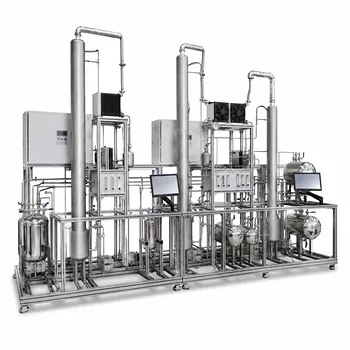
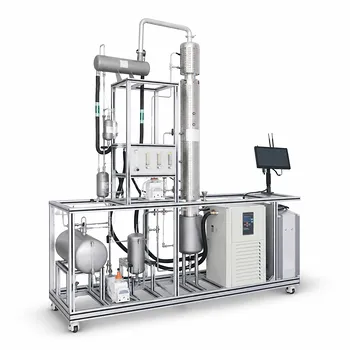
Are you looking to demonstrate advanced adsorption and liquid dehydration processes in your lab? LABPARK provides state-of-the-art Educational and Vocational Unit Operations Pilot Plants in chemical engineering, bioprocess & biotech, and environmental & water treatment.
Specifically engineered for universities, research institutes, and enterprises, our pilot systems empower students and researchers to master column breakthrough dynamics, mass transfer zones, and thermal regeneration cycle design.
Contact LABPARK today to find the ideal pilot plant solution for your educational or research facility!
Related Products
- Green Anhydrous Ethanol Purification Extractive Distillation Unit Operations Training Pilot Plant
- Continuous Sieve-Plate Distillation Pilot Plant for Unit Operations Laboratory Education
People Also Ask
- How can energy balance equations for condensers & reboilers be validated experimentally? Guide
- Fugacity vs Activity Coefficient: How to Choose VLE Models for Distillation Pilot Plants
- How can real-time carbon number prediction improve distillation pilot plants? Optimize control.
- Why is vacuum operation capability an essential feature for a distillation unit operations pilot plant? Unlock Efficiency
- How Reflux Ratio Affects Distillation Pilot Plant Separation Efficiency & Limits