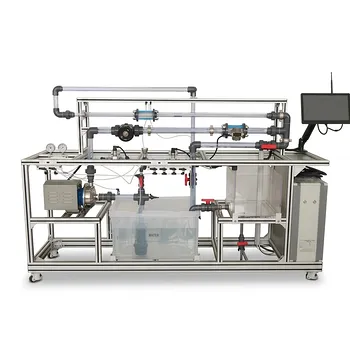
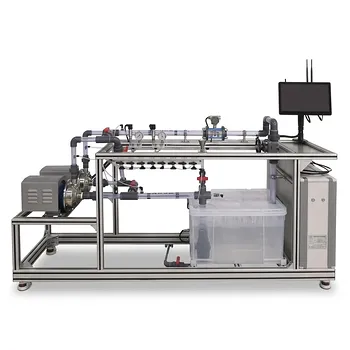
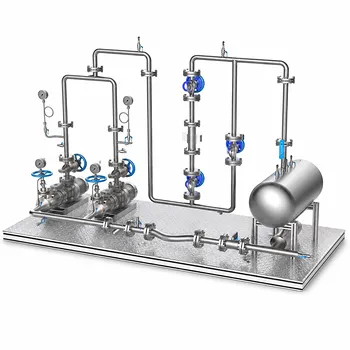
The instructor's selection is not about finding a single "correct" impeller, but about engineering a deliberate comparison. The primary rule is straightforward: select a closed impeller for clean, water-like fluids to demonstrate peak efficiency, and select a semi-open or open impeller for fluids containing suspended solids to demonstrate clogging resistance. The true educational value, however, comes from running the same fluid through both pumps to tangibly measure the resulting efficiency penalty and operational trade-offs.
Configuring a pilot plant with different impeller types is a strategic choice to transform a basic pump from a black box into a transparent system. The core lesson isn't just that "dirty water needs an open impeller," but that every pump design represents a compromise. The goal is to let students experimentally quantify this compromise—balancing the lower risk of clogging against a measurable drop in hydraulic efficiency.
The Pilot Plant as a Teaching System
The goal is not industrial production; it's demonstrable learning. Your pump selection must make abstract engineering trade-offs visible on a control panel.
Engineering a Direct Comparison
The primary reference highlights a critical pedagogical point: by configuring the plant with different impeller options, students can directly measure the performance gap.
A side-by-side test of a closed versus a semi-open impeller on a clear water loop makes an invisible fluid dynamic—recirculation loss—instantly tangible. Students see the lower discharge pressure and higher power consumption for the exact same flow rate. This turns a theoretical textbook fact into an observed physical reality.
Moving Beyond the Single Pump Standard
In many pilot plants, the pump is just a utility to move fluid from Tank A to Tank B. This approach ignores a core unit operations concept.
By making the pump itself the focus of the experiment, you teach that the machine and the fluid are a single, integrated system. The choice of impeller doesn't just affect the pump; it shifts the entire operating point of the piping network.
The Core Selection Principle: Fluid Compatibility
The very first question an engineer asks is: "What is in the fluid?" Your impeller selection must mirror this inquiry.
When to Choose a Closed Impeller
A closed impeller features both a front and back shroud, creating a tight seal against the pump volute. This design provides a singular, powerful advantage: high hydraulic efficiency.
It is the definitive choice for clean, low-viscosity fluids—the "clean water" standard. In a pilot plant, this represents baseline performance. Select this impeller for experiments involving distilled water, clear chemical solutions with no particulate, or heat transfer fluid loops where energy efficiency is a key performance indicator.
When to Choose a Semi-Open or Open Impeller
Open and semi-open impellers lack one or both shrouds, eliminating the internal cavities where solids can lodge and build up. Their advantage is clogging resistance, not flow perfection.
You must select these when the experimental fluid is a slurry, contains suspended solids, or is prone to fouling. This is critical for simulating bioprocess broths, wastewater treatment, or crystallization experiments where suspended crystals are the product. The sacrifice in efficiency is the price paid for operational continuity.
The Performance Principle: Efficiency and the Operating Point
Choosing an impeller is also a choice about the pump's characteristic curve. This directly dictates where the system will operate on the pump map.
Visualizing Recirculation Loss
The efficiency gap between closed and open designs is not a minor detail; it is a definable fluid mechanic. The clearance between an open impeller blade and the volute casing allows continuous recirculation.
Fluid slips backward from the high-pressure side of the blade to the low-pressure side without ever leaving the pump. Students must understand that the motor is still paying for this energy. By instrumenting a pilot plant with torque meters or calibrated motor drives, students can actually quantify this parasitic loss.
Defining the System's Intersection
As the supplementary references clarify, the pump's operational home is the intersection of its head-flow (H-Q) curve and the system resistance curve.
This is where the deep learning occurs. An open impeller possesses a lower-efficiency curve, dropping the entire intersection point to a lower flow rate and head for the same system. Assign students to derive the "B" coefficient in the system equation He = K + B*Q^2 with each impeller type. It forces a direct connection between a mechanical design choice (impeller geometry) and a fundamental mathematical model (Bernoulli’s equation).
Understanding the Trade-offs
Objectivity demands a hard look at the downsides. No impeller selection is exempt from compromise, and your students must learn to predict these failures.
The Hidden Cost of Open Designs
While open impellers solve the clogging problem, they introduce three significant failure points. First, the efficiency is not just low; it degrades rapidly with internal wear. As solids erode the blade edges, internal clearance increases, and performance drops further.
Second, they have a higher Net Positive Suction Head Required (NPSHr), making them more susceptible to cavitation. Third, the axial thrust loads are different, potentially impacting bearing life. A pilot plant experiment that runs a slurry should not just end with a clean pipe; it should include a post-run teardown inspection to measure this wear.
The Fragility of Peak Efficiency
The Achilles' heel of the closed impeller is its vulnerability. In an educational setting where students may make mistakes, a single valve misalignment causing a low-flow deadhead condition can quickly lead to overheating and seal failure if solids are present.
Even fine particles can erode the wear rings, destroying the tight clearances that give the closed impeller its efficiency advantage. The lesson here is that a high-performance component requires a high-integrity fluid.
Making the Right Choice for Your Educational Goal
You choose the impeller—and the fluid it pumps—to teach a specific chapter of fluid dynamics. Your lesson plan defines the pump configuration.
-
If your primary focus is pump theory and energy efficiency: The experiment must start with a closed impeller pumping clean water. Have students map the efficiency islands under varying flow rates, establishing this as the theoretical maximum against which all other designs are benchmarked.
-
If your primary focus is fluid handling and industrial processing: The experiment is incomplete without an open or semi-open impeller. Run a slurry of known particle size distribution and have students correlate the pressure drop across a test filter with the pump's declining performance curve.
-
If your primary focus is mathematical modeling and system design: You must include both impeller types on the same piping network. The exercise is to have students derive the distinct loss coefficients (B-factors) for each pump and predict, using the affinity laws, how the operating point will shift before they even turn the motor on.
Teaching pump selection is fundamentally about teaching students to balance the purity of efficiency against the robustness of clog-free operation.
Summary Table:
| Impeller Type | Recommended Fluid | Key Advantage | Main Trade-off |
|---|---|---|---|
| Closed | Clean, low-viscosity fluids (e.g., water) | Peak hydraulic efficiency | High risk of clogging and wear from solids |
| Semi-Open | Moderate slurries & suspended solids | Good clog resistance with moderate flow | Higher recirculation loss than closed designs |
| Open | High-solid slurries & fouling fluids | Maximum clog resistance; easy to clean | Lowest efficiency; higher NPSHr (cavitation risk) |
Upgrade Your Chemical Engineering Labs with LABPARK
Are you looking to give your students hands-on experience with real-world fluid dynamics? LABPARK provides state-of-the-art Educational and Vocational Unit Operations Pilot Plants in chemical engineering, bioprocess & biotech, and environmental & water treatment. Designed specifically for universities, research institutes, and enterprises, our systems enable students to compare pump performances, analyze impeller configurations, and master system hydraulics.
Contact LABPARK today to configure the perfect pilot plant for your academic or research needs!
Related Products
- Centrifugal Pump Performance and Orifice Flowmeter Calibration Educational Pilot Plant
- Centrifugal Pump Performance Determination Educational Unit Operations Pilot Plant
- Chemical Pipeline Assembly and Fluid Transport Practical Training Unit Operations Pilot Plant
People Also Ask
- What features should instructors look for in pump & flowmeter pilot plants? Key Selection Guide
- Why start a centrifugal pump with a closed outlet valve? Protect your pilot plant motors.
- How to update chemometric calibration models in pilot plants? Best practices for process engineers.
- How can cavitation and slurry erosion be studied and mitigated using fluid transport and centrifugal pump pilot plants?
- How do pilot plants demonstrate siphon pressure variations? Visualizing Bernoulli's Energy Balance