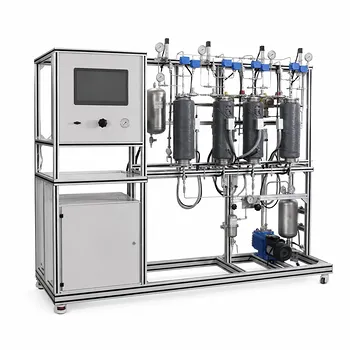
The selection isn’t about finding a single “best” dryer—it’s about aligning the pilot plant’s configuration with the physical state of your material and your throughput requirements.
Liquid and slurry feeds (yeast, resins, milk) call for spray dryers when you need large, continuous processing, or drum dryers for small, batch-scale operations. Paste-like or filter-cake materials (pigments, starches) are best matched with pneumatic (flash) or belt dryers at larger scales, while vacuum rotary drum dryers excel in small batches. For granular solids (0.01–20 µm particle size), fluidized bed dryers or rotary dryers are the workhorses. Stocking a teaching or research laboratory with pilot plants representing these different configurations allows users to systematically study how material characteristics dictate equipment selection and drying efficiency.
The physical form of the wet feed—liquid, paste, or granular—is the primary driver of dryer choice. Throughput demands then refine that choice into a specific batch or continuous system. A well-designed educational pilot plant mirrors these real-world dependencies, turning material properties and scale into hands-on learning opportunities.
Mapping Material States to Dryer Types
Understanding the starting point of your material is the first engineering decision. Every dryer family is built around a specific feed consistency.
Liquid Feeds and Slurries
Pumpable liquids and suspensions require a dryer that can atomize the feed into fine droplets or spread it into a thin film.
- For large, continuous throughput: Spray drying is the technology of choice. It disperses the liquid into a hot gas stream, producing a free-flowing powder in a single step. This is ideal for demonstrating industrial production of milk powder, detergents, or advanced ceramics.
- For small, batch-scale work or viscous pastes: Drum drying provides a gentler, conductive heat transfer. A thin layer of feed is dried on a rotating, steam-heated drum and scraped off as a solid flake, perfect for niche products like yeast or resins where the process simplicity and small footprint matter.
Pastes and Filter Cakes
These non-pumpable, high-viscosity masses need mechanical dispersal or extended surface contact.
- For larger, continuous operations: Pneumatic (flash) dryers disperse the paste into a high-velocity hot gas stream, drying it in seconds. They suit heat-sensitive fines. Belt dryers convey the paste through a temperature-controlled tunnel, offering gentle, uniform drying for fragile solids.
- For small batches and solvent recovery: Vacuum rotary drum dryers operate under reduced pressure, enabling low-temperature drying of thermally labile pastes. They are a staple in research settings where product degradation must be avoided.
Granular and Free-Flowing Solids
Crystalline or granular materials with inherent flowability thrive in systems that suspend or tumble the particles.
- Fluidized bed dryers lift and mix particles with a controlled gas stream, delivering high heat transfer and short drying times. They are optimal for particles between 0.03 and 6 mm, teaching fluidization principles alongside drying.
- Rotary dryers cascade solids through a rotating inclined cylinder. They handle high throughputs of free-flowing materials but introduce challenges like non-uniform residence times and dust generation—themselves valuable lessons in process engineering.
Beyond State: Critical Secondary Factors
While the physical form gives you a shortlist, a pilot plant that mimics real industrial decision-making must account for thermal sensitivity, mechanical fragility, and safety.
Thermal Sensitivity and Vacuum Drying
Materials that degrade or oxidize at high temperatures need low-temperature processing. Vacuum-compatible batch dryers (tray, rotary, or conical) remove moisture under reduced pressure, preserving activity. A comprehensive laboratory should contrast atmospheric and vacuum modes to demonstrate how operating pressure alters drying rates and final product quality.
Shear and Fragility
Abrasive or shear-sensitive materials require gentle handling. Tumble dryers or belt dryers avoid the high-shear contacts of agitated systems like filter or conical dryers. Selecting a pilot plant with this gentler motion allows researchers to study particle breakage and product uniformity directly.
Containment and Safety
When handling potent, toxic, or flammable compounds, closed systems like conical dryers, filter dryers, or fluid bed dryers prevent operator exposure and contain vapors. Open tray dryers, while excellent for kinetic demonstrations, are unsuitable for hazardous materials. Including at least one fully enclosed pilot unit teaches modern safety-by-design principles.
Batch vs. Continuous for Educational Goals
The mode of operation shapes your pedagogical flexibility.
- Batch dryers (tray, vacuum rotary) allow students to directly measure drying curves, monitor moisture content over time, and explore the fundamentals of mass transfer without the complexity of continuous feeding.
- Continuous dryers (spray, fluid bed, rotary) demonstrate industrial-scale realities: steady-state operation, energy integration, and automation. The choice often hinges on whether you aim to teach kinetics or process intensification.
Understanding the Trade-offs
No single pilot dryer can cover every scenario, and the selection is inherently a compromise. Recognizing these trade-offs builds critical engineering judgment.
- Spray dryers yield free-flowing powders but are energy-hungry and require careful atomization, often uneconomic for very small academic batches.
- Drum dryers handle viscous materials well but can thermally damage the product if the drum surface is too hot.
- Flash dryers offer short residence times for heat-sensitive pastes but are unsuitable for fragile particles that can fracture against the duct walls and require tall installations.
- Fluidized bed dryers deliver excellent mixing but fail with extremely fine particles (<20 µm) that cause gas channeling, or very large particles (>8 mm) that demand excessive gas velocities.
- Rotary dryers accept a wide particle size range but generate dust and have broad residence time distributions, complicating scale-up predictions.
These limitations are exactly why a thoughtfully assembled pilot plant suite—rather than a single unit—becomes a powerful teaching tool. It allows side-by-side energy consumption comparisons, product uniformity assessments, and an appreciation for the nuanced “fit” between material and machine.
Making the Right Investment for Your Laboratory
Align your dryer selection with the specific educational or research objectives of your institution. Use the following mappings to prioritize:
- If your primary focus is demonstrating drying kinetics and fundamental heat/mass transfer: Invest in a batch tray dryer or a vacuum rotary drum dryer. These allow precise data collection and interpretation of drying curves.
- If your primary focus is simulating industrial continuous production: Prioritize a spray dryer for liquid feeds, a fluidized bed dryer for granular solids, and a flash dryer for pastes, so students can evaluate throughput, residence time, and scale-up.
- If your primary focus is processing heat-sensitive biomolecules or pharmaceuticals: Select a vacuum dryer (tray, rotary, or conical) capable of low-temperature operation under reduced pressure, paired with a moisture trap system.
- If your primary focus is containment and operator safety with potent compounds: Opt for a fully closed conical or filter dryer system, which integrates filtration, washing, and drying in a single contained unit.
- If your primary focus is comparing energy efficiency across dryer types: Assemble a mini-pilot suite with a convection-based system (flash/fluid bed) and a conduction-based system (drum/rotary) to allow direct side-by-side techno-economic analysis.
The most impactful educational drying laboratory is never a single piece of equipment—it is a curated collection where the feed material’s physical state, throughput, and safety profile dictate the configuration, turning abstract selection principles into tangible engineering skill.
Summary Table:
| Feed State | Throughput / Scale | Recommended Dryer | Key Application |
|---|---|---|---|
| Liquids & Slurries | Large, Continuous | Spray Dryer | Milk powder, detergents, ceramics |
| Liquids & Slurries | Small, Batch | Drum Dryer | Yeast, resins, viscous pastes |
| Pastes & Filter Cakes | Large, Continuous | Pneumatic (Flash) / Belt Dryer | Pigments, starches, fragile solids |
| Pastes & Filter Cakes | Small, Batch | Vacuum Rotary Drum Dryer | Heat-sensitive pastes, solvent recovery |
| Granular Solids | Fast, Fluidized | Fluidized Bed Dryer | Crystalline materials (0.03–6 mm) |
| Granular Solids | High, Cascading | Rotary Dryer | Free-flowing bulk materials |
Equip Your Lab with LABPARK Pilot Plants
Enhance your hands-on training and research capabilities with LABPARK. We provide premium Educational and Vocational Unit Operations Pilot Plants in chemical engineering, bioprocess & biotech, and environmental & water treatment for universities, research institutes, and enterprises worldwide.
Whether you need to demonstrate drying kinetics or simulate continuous industrial processes, our customized systems offer the safety, containment, and operational flexibility your students and researchers deserve.
Contact us today to discuss your laboratory's requirements and get a tailored pilot plant solution!
Related Products
- Multi-Functional Drying Educational Unit Operations Pilot Plant
- Continuous Batch Extractive Distillation Educational Pilot Plant
- Green Anhydrous Ethanol Refining Practical Training Pilot Plant
- Multi-Functional Special Distillation Educational Pilot Plant
- Dual-Mode Rectification Pilot Plant for Practical Training Unit Operations
People Also Ask
- Vacuum vs. Atmospheric Drying: How to Choose the Right Pilot Plant Configuration for Your Lab
- How do seasonal changes affect drying pilot plant blower requirements? Key sizing tips.
- Why is dry-basis moisture content preferred over wet-basis? Simplify your drying pilot plant balances.
- Why Does a Pilot Plant Solver Return a Singular Matrix Error, and How Can You Resolve It?
- Why are particle density, bulk density & voidage critical in pilot plants? Master Bed Fluid Dynamics