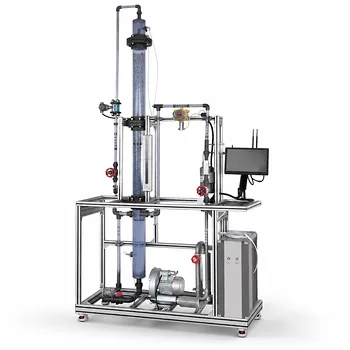
The two-phase pressure drop in packed bed columns is calculated primarily by correlating the two-phase energy loss to the single-phase energy losses that would occur if each fluid were flowing alone under identical conditions. This answer is the foundation: you don't solve a single complex two-phase equation; you build upon well-understood single-phase friction calculations. The dominant empirical model for co-current downflow—the workhorse of pilot plant trickle-bed reactors—is the Larkins et al. (1961) correlation, while a complementary approach uses dimensionless groups like Reynolds and Weber numbers to create generalized friction factor charts. Pilot plants validate these models by measuring differential pressure across the bed at varying gas and liquid rates, closing the loop between theory and the real-world design of industrial pumps, compressors, and separators.
Accurately modeling two-phase pressure drop in packed beds isn't about a single universal equation. It requires choosing between two empirical pathways: one that leverages the simplicity of single-phase pressure drop calculations (Larkins approach) and another that condenses variables into dimensionless group correlations. Your choice determines how you scale from a benchtop pilot plant to a full-scale industrial column.
Why Two-Phase Packed Bed Pressure Drop Matters in Pilot Plants
The surface need is a calculation method. The deep need is safe, scalable process design. In a pilot plant, you’re not just taking data—you’re building the confidence to multiply flow rates, change packing sizes, and select the right downstream equipment without causing catastrophic flooding or excessive energy consumption.
The Role of Pressure Drop in Column Performance
Pressure drop is the energy lost by the fluids as they fight through the tortuous void spaces between packing particles. In a two-phase system, the liquid and gas interact, dramatically altering the resistance compared to single-phase flow.
Too high a pressure drop risks flooding, where liquid backs up and chokes the column. Too low might signal poor distribution or channelling.
From Pilot Data to Industrial Sizing
Pilot plants equipped with differential pressure transmitters let you directly measure this loss across the packed height. By doing so at multiple liquid and gas throughputs, you generate the data needed to fit empirical constants for your specific catalyst shape, bed voidage, and fluid properties. This validated model then directly informs the sizing of industrial blowers (to overcome gas-side resistance) and pumps (to recycle liquids), ensuring you never exceed the maximum allowable pressure drop of the system.
The Two Dominant Modeling Paradigms
There are two fundamentally different ways to solve this problem. Both are empirical, but they differ in what they treat as the starting point.
Approach 1: Correlating Two-Phase Friction to Single-Phase Losses (The Larkins Method)
This is the most common approach for co-current downflow packed beds, exactly the configuration found in many pilot-scale trickle-bed reactors.
It works by first calculating the single-phase pressure drops (ΔPL for liquid flowing alone, ΔPG for gas flowing alone) through the exact same bed using standard single-phase equations like the Ergun equation. The Ergun equation itself accounts for viscous and inertial losses based on particle diameter, bed voidage, and superficial velocity.
A two-phase parameter, often denoted Χ (Chi), is then formed as the square root of the ratio of these single-phase losses: Χ = √(ΔPL / ΔPG).
The final two-phase pressure drop (ΔPTP) is found using an empirical multiplier, where the multiplier is a function of Χ. For example, the classic Larkins correlation plots the square root of (ΔPTP / ΔPL) against Χ, collapsing data for air-water and other systems into a single curve. This method directly answers: “Given what the bed does with each fluid alone, how much worse is it when they flow together?”
Approach 2: Dimensional Analysis and Friction Factor Correlations
A more generalized method lumps variables into dimensionless groups to define a two-phase friction factor (fTP). Correlations such as those by Ford or Saada are examples of this strategy.
The groups typically include a modified Reynolds number (using mixture properties or individual phase properties), a Weber number to capture surface tension effects, and ratios that describe the relative flow rates and densities.
The two-phase pressure drop is then expressed using a friction factor equation analogous to the single-phase Darcy-Weisbach relation, but the friction factor is read from a dimensionless correlation graph specific to the packing type. This high-level view is powerful when the goal is a generalized model that can handle a wide range of fluid systems without re-determining single-phase baselines, but it often requires iterative solutions for mixture properties.
Understanding the Trade-offs
No single model is universally perfect. Trust is built by acknowledging these limitations.
The Empirical Foundation Is a Cage
Every correlation, from Larkins to Ford, was derived from specific data sets. Extrapolating to high-pressure systems, non-Newtonian fluids, or packings with drastically different shapes (like structured packing instead of random spheres) can introduce large errors. The dimensionless group approach is especially sensitive to the specific way mixture viscosity and density are defined.
Flow Regime Dependence
The Larkins correlation is well-established for the trickle (low-interaction) regime in co-current downflow. At high gas rates, where the flow transitions to a pulse or spray regime, the energy loss mechanism changes, and the correlation loses accuracy. A pilot plant experiment is essential precisely because it reveals if your industrial column will operate in a regime where your model breaks down.
Complexity of the Single-Phase Baseline
The accuracy of the Larkins method hinges entirely on the reliability of the single-phase pressure drop equation you use, such as the Ergun equation. The Ergun equation requires an accurate bed voidage (ε) and effective particle diameter (dp), which can be difficult to determine for oddly shaped industrial catalysts. A small error in voidage is amplified in the two-phase prediction.
Making the Right Choice for Your Pilot Plant Analysis
Your specific goal determines which pathway to prioritize.
- If your primary focus is rapidly scaling a co-current trickle-bed reactor: Use the Larkins method. First, dedicate experimental runs to measuring single-phase gas and liquid pressure drops across the exact bed. Then, use the two-phase data to generate your own Χ vs. multiplier curve, tailoring the model to your specific chemistry and packing.
- If your primary focus is developing a generalized correlation for a new packing geometry: Invest effort in the dimensionless group approach. Systematically vary fluid properties and flow rates to map the friction factor across a wide range of Reynolds and Weber numbers, creating a tool that has predictive power beyond your immediate pilot setup.
- If your primary focus is comparing the performance of different structured packings: Be cautious with standard random-packing correlations. You may need to consult manufacturer-specific two-phase pressure drop models, which often combine elements of both methods with proprietary geometric constants.
The power of the pilot plant is that it allows you to replace a general empirical correlation with a project-specific, physically validated model, giving you the confidence to design your columns and select your pumps for long-term, flood-free operation.
Summary Table:
| Parameter | Larkins Method | Dimensional Analysis |
|---|---|---|
| Primary Application | Co-current trickle-bed reactors | Generalized modeling & new packings |
| Key Input | Single-phase liquid/gas losses | Dimensionless groups (Re, We numbers) |
| Pros | Highly accurate for trickle flow | Great for varying fluid properties |
| Cons | Fails in pulse/spray regimes | Complex mixture property calculations |
Scale Up Your Chemical Engineering Processes with LABPARK
Accurate modeling of pressure drops and fluid dynamics is critical for reliable column scale-up. LABPARK provides premium Educational and Vocational Unit Operations Pilot Plants in chemical engineering, bioprocess & biotech, and environmental & water treatment designed specifically for universities, research institutes, and enterprises.
Our state-of-the-art pilot plants help you:
- Validate Mathematical Models: Easily bridge the gap between theoretical calculations (like the Larkins method) and real-world column operations with precise differential pressure transmitters.
- Train the Next Generation: Provide hands-on experience for students and researchers with industry-grade sensors and controls.
- Accelerate R&D: Test various packing geometries, flow regimes, and fluid systems with high-precision, customizable equipment.
Ready to enhance your lab's research and training capabilities? Contact LABPARK today to discover how our pilot plants can meet your exact engineering requirements!
Related Products
- Packed Bed Absorption Educational Unit Operations Pilot Plant
- Absorption and Desorption Educational Unit Operations Pilot Plant
- High-Gravity Emulsification and Mass Transfer Educational Pilot Plant
- Micro-Scale Gas-Solid Catalytic Reaction Educational Pilot Plant
People Also Ask
- How Do Flow Regimes Transition in Packed Bed Pilot Plants? Key Scale-up Insights
- How does reactant concentration determine absorption column control? Gas-film vs. dual-film.
- How is the packing height of an absorption column calculated? Master HTU & NTU Concepts
- How does static vs. operating holdup affect pilot plant calibration? Avoid Critical Scale-Up Errors
- Why is counter-current flow selected for gas absorption? Maximize Pilot Plant Efficiency