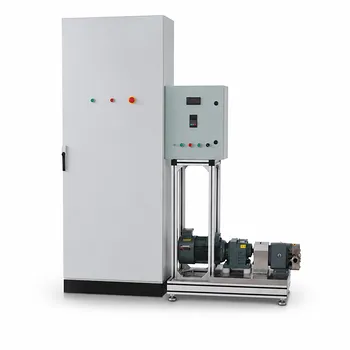
Manual dexterity gives way to automated precision. In a laboratory, you manually define a discrete volume using a pipette’s mechanical stop; in a pilot plant, you command an industrial pump or control valve to hit a volumetric flow rate setpoint. This shift is fundamentally about transitioning from a static, batch measurement mentality to a dynamic, continuous control strategy, where maintaining the stability of a flow rate over time replaces the act of drawing a single static volume.
Understanding the scale-up of liquid handling means recognizing that the core unit of measurement changes from volume (liters) to volumetric flow rate (liters per minute). The challenge shifts from the glassware’s physical geometry guaranteeing accuracy to an array of electronic sensors, actuators, and feedback control loops dynamically maintaining precision against shifting system pressures.
The Evolution of the Dosing Mechanism
Replacing the Piston Stroke with Continuous Pumping
On the benchtop, a piston-based pipette or bottle-top dispenser reliably delivers a single, fixed volume. In a pilot plant, that same function is industrialized through positive displacement pumps. Diaphragm or peristaltic pumps do not just move liquid; they become the central actuators in a control scheme. The manual act of depressing a plunger is replaced by a 4-20 mA signal from a Programmable Logic Controller (PLC) that instructs the pump to maintain a specific motor speed.
Refining Precision with Active, Not Passive, Adjustment
A graduated cylinder passively relies on a stable meniscus to communicate volume. An industrial system actively fights external factors like viscosity changes or varying discharge pressure. The system constantly adjusts the pump’s stroke frequency or a control valve’s position to lock onto a target flow rate. This introduces the concept of feedback control loops, where a flow sensor continuously reports actual performance back to the PLC, which in turn calculates an error correction signal for the pump.
From Visual Meniscus to Electronic Signal
Understanding the New "Measurement" Mindset
The superpower of lab glassware is its stability; it holds a fixed volume regardless of time. The superpower of a pilot plant is its ability to measure dynamic flow in real-time against a clock. Devices like Coriolis or magnetic flow sensors track mass or velocity, converting physical movement into an analog electronic signal. Students must learn to trust the sensor’s response time, zero-point stability, and how to interpret a jagged trendline on a SCADA screen just as they once trusted the glassware’s etched line.
Accounting for Environmental Compensation
Just as a chemistry student must correct for thermal expansion or meniscus parallax errors, a pilot plant operator deals with compensated measurements. The supplementary reference on gas volume measurement highlights a scale-up principle that applies equally to liquids: you must check that your sensor isn’t measuring a process variable distorted by temperature or pressure. A liquid mass flow measurement is only trustworthy if the system accounts for the specific density and temperature of your fluid, a manual step that is now embedded in the transmitter’s logic.
Automating the Logic of Level and Volume
From Manual Top-Up to Binary Control
Consider the simple act of keeping a solvent reservoir full. In the lab, you visually check the bottle and pour more in. In a pilot plant, a discrete level control loop takes over this cognitive task. As detailed in the process engineering reference, two level limit sensors and a solenoid valve define the strategy. This is often a student’s first encounter with translating human decision-making into ladder logic with self-holding instructions, automating the "watching" and "reacting" that a chemist does almost instinctively.
The Deep Need for System Stability
This seemingly simple fill control teaches a critical scale-up lesson: a pilot plant cannot tolerate an empty feed tank. A bubble in a lab pipette ruins a 10-microliter aliquot; a drained feed tank in a pilot plant can crash an entire continuous bioreactor campaign worth tens of thousands of dollars. The automatic fill logic therefore protects the process continuity, addressing the deep need for reliability that a single human operator cannot guarantee 24/7.
Understanding the Trade-offs
The Loss of Direct Tactile Feedback
When you pipette manually, you feel a clog or notice high viscosity by the resistance on the plunger. A pump lacks this instinct. It will blindly ramp up torque until a failure alarm triggers or a rupture disc bursts. You must program these mechanical safety limits explicitly, as the system will not intuitively react to subtle physical changes a human would catch immediately.
The Complexity Cost of Automation
While a manual pipette immediately delivers a fixed volume, an automated dosing system requires calibration curves, sensor zeroing routines, and loop tuning. A poorly tuned PID controller for a diaphragm pump can oscillate wildly, resulting in worse dosing accuracy than a technician with a graduated cylinder. The configuration time and the risk of logic errors introduce a layer of complexity that is absent from manual methods.
Making the Right Choice for Your Goal
Your approach to scaling up should align with the primary operational target of the pilot plant stage.
- If your primary focus is industrial vocational training: Simulate real-world failures by challenging students to program a PLC for high-low level control, ensuring they master self-holding circuit logic and understand how sensor placement prevents pump cavitation.
- If your primary focus is achieving exact stoichiometric dosing: Prioritize component selection for your continuous processes, qualifying mass flow sensors against your specific process fluid and implementing tight PID loop tuning to ensure variations in feedstock viscosity don’t alter the reaction ratio.
- If your primary focus is biological contamination control: Evaluate the cleanability of your automated components, selecting sanitary peristaltic or diaphragm pump heads that can be steam-sterilized, replicating the sterility of a single-use serological pipette in a high-volume reusable format.
Mastering pilot-plant fluid control means evolving from a volume measurer into a dynamic process manager who can program a machine to not just dose a liquid, but to guarantee that dose’s accuracy over time.
Summary Table:
| Parameter | Laboratory Concept | Pilot Plant Scale-Up |
|---|---|---|
| Primary Variable | Static Volume (L) | Dynamic Flow Rate (L/min or kg/h) |
| Control Mechanism | Manual Pipette / Visual Meniscus | Automated Pumps, Valves & PLC |
| Process Feedback | Direct tactile feeling by operator | Electronic sensor-driven PID loops |
| Operational Risk | Minor volume error in aliquot | Cavitation, run-dry, batch failure |
Evolve Your Lab to Pilot Scale with LABPARK
Transitioning from benchtop liquid handling to industrial fluid control requires hands-on training tools and robust, scalable systems. LABPARK provides industry-leading Educational and Vocational Unit Operations Pilot Plants in chemical engineering, bioprocess & biotech, and environmental & water treatment for universities, research institutes, and enterprises.
Whether you need to train future engineers on PLC loop tuning or design a scalable research process, our systems bridge the gap between theory and industrial practice.
Contact LABPARK today to discuss your project requirements with our engineering team!
Related Products
- Quantitative Dosing and Liquid Flow Control Educational Unit Operations Pilot Plant
- 100L Continuous Loop Hydrogenation Educational Unit Operations Pilot Plant
People Also Ask
- How do educational unit operations pilot plants bridge theory and design? Bridge the Engineering Gap
- How do educational unit operations pilot plants address safety and waste management when scaling up?
- Why is the attenuation path length (lA) critical when positioning pressure sensors in a fluid flow unit operations pilot plant?
- How do conservation equations guide fluid flow pilot plants? Key Scale-Up Principles
- What are the key differences in process analytics requirements from R&D to production?