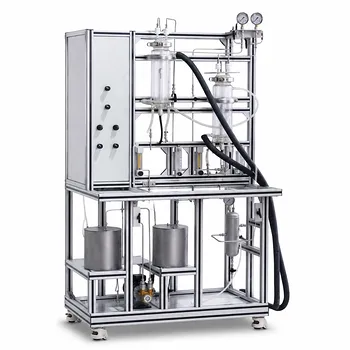
Here’s the concise answer: As the equipment diameter of a cyclone separator increases, its critical separation particle size—the smallest particle that can theoretically be completely removed—also grows. A wider chamber generates weaker centrifugal force, so only larger particles are captured. In pilot-scale process design, this principle is applied by using multiple small-diameter cyclones connected in parallel (a multicyclone block) to process large gas volumes without sacrificing fine-particle separation efficiency.
The core scaling rule is simple: a bigger cyclone has a larger cut‑off size. When you must handle high flow rates at pilot or industrial scale, you avoid the single‑unit trap by clustering small cyclones. This maintains sharp separations, teaches the fundamental capacity‑vs‑efficiency trade‑off, and keeps laboratory‑to‑plant scale‑up predictable and robust.
The Physics Behind Diameter and Critical Particle Size
Defining Critical Particle Diameter ($d_c$)
The critical particle diameter ($d_c$) is the size threshold above which particles are, in theory, separated with 100% efficiency. It represents the limiting particle trajectory that just manages to reach the cyclone wall before the gas exits. Particles smaller than $d_c$ are increasingly likely to escape with the clean gas stream.
The Direct Effect of Cyclone Diameter
The formula for $d_c$ includes the term for inlet width $B$, which scales proportionally with the overall chamber diameter $D$. As $D$ increases, $B$ grows, and $d_c$ increases roughly with $\sqrt{D}$. In practical terms, a doubling of the cyclone body diameter can increase the size of the smallest fully captured particle by about 40%.
Why Larger Cyclones Lose Fine-Particle Efficiency
Centrifugal force is inversely proportional to the radius of rotation. In a small-diameter cyclone, the gas spins in a tight circle, generating high centrifugal acceleration that pushes even fine particles outward. In a large-diameter chamber, the same inlet velocity produces a much weaker force, so tiny particles never reach the wall in time—they follow the gas out. The result is a higher cut size and poorer fine-particle collection.
From Theory to Pilot-Scale Design
The Multicyclone Solution: Parallel Small Cyclones
Pilot plants and industrial units face a dilemma: they need to process substantial gas flows, but a single large cyclone would drastically reduce fine-particle capture. The standard engineering answer is to install a bank of multiple small cyclones in parallel—often called a multicyclone or multiclone block. Each small unit maintains its own tight radius and high centrifugal force, while the combined bank handles the full volumetric flow rate.
Balancing Separation Efficiency with Pressure Drop
Smaller cyclones deliver sharper separations, but they also impose higher pressure drops for the same throughput. The Stairmand equation shows pressure drop depends on inlet and outlet velocities and the cyclone’s geometry. In pilot-scale design, you optimize the diameter to achieve a target cut size without overloading the induced-draft fan or blowing the energy budget. This teaches engineers to think in terms of total system cost, not just separation performance.
The Role of Particle Size Distribution and Cut Size ($d_{50}$)
While $d_c$ defines theoretical completeness, real separations are expressed via the cut size $d_{50}$ —the particle size at which collection efficiency is 50%. A cyclone’s $d_{50}$ also increases with diameter. When designing a pilot rig, you compare the feed’s particle size distribution (especially the Sauter mean diameter $d_{vs}$) with the expected $d_{50}$ of candidate cyclones. If a significant fraction of the solids is below 5 µm, even a small single cyclone may need downstream polishing.
Process Line Integration in Pilot Plants
Upstream Protection: Removing Oversized Particles
Cyclone separators are best suited for particles ~5 µm to 200 µm. For coarse solids above 200 µm, a gravity settling chamber or knockout pot should be placed upstream. This prevents abrasive erosion of the cyclone walls, extends equipment life, and preserves the cyclone’s fine-separation capabilities. In a pilot-plant teaching environment, this modular pre‑treatment step highlights real‑world equipment protection strategies.
Downstream Polishing: Handling Sub‑5 µm Particles
No practical cyclone can perfectly capture the sub‑micron fines that often dominate a gas stream’s mass or opacity. When process requirements demand ultra‑low emissions, the pilot line must include a bag filter or wet scrubber after the cyclone block. This staged approach reinforces that cyclone selection is not an isolated decision; it is part of a complete gas‑solid separation train.
Understanding the Trade‑offs and Pitfalls
Capacity vs. Efficiency: The Core Dilemma
The most common mistake is assuming that a single larger cyclone can just “scale up” the geometry and keep the same cut size. The physics says otherwise—capacity gained by increasing diameter always comes with a loss of fine‑particle capture. The multicyclone approach resolves this tension but adds mechanical complexity and footprint.
Pressure Drop Penalty in Small Cyclones
A bank of small cyclones will naturally consume more fan power than a single large unit at the same total flow. The higher velocities needed to maintain separation inside each tube increase the system pressure drop. If not accounted for early, this can lead to undersized fans and disappointing pilot‑plant performance. The Stairmand or similar empirical correlations should be run early in the design phase.
Erosion Risks and Maintenance
Small-diameter cyclones, especially when handling hard abrasive particles, can suffer rapid wall wear. If an upstream gravity dropout is impractical, the choice of materials and the accessibility of the multiclone tubes for inspection become critical design factors. Pilot plants built for repeated testing often incorporate replaceable cyclone tubes or hardened liners.
Making the Right Choice for Your Pilot‑Scale Goal
After clarifying how diameter influences separation, the right design path depends on your primary objective:
- If your primary focus is maximum fine-particle capture: Design with a multicyclone bank of the smallest practical diameter; accept the higher pressure drop and install a correctly sized blower.
- If your primary focus is energy efficiency and simple maintenance: Use a mid-size single cyclone and accept that sub-5 µm particles will pass through—then add a baghouse downstream to meet the overall removal target.
- If your primary focus is teaching scale‑up principles in a lab: Build a side‑by‑side comparison of a single large cyclone and a small‑cyclone array, allowing students to measure the shift in cut size and pressure drop firsthand.
A well‑designed pilot‑scale cyclone system never treats the equipment in isolation; it always balances diameter, capacity, pressure drop, and the full feed particle size spectrum to deliver dependable, repeatable separation performance.
Summary Table:
| Design Parameter | Small-Diameter Cyclone | Large-Diameter Cyclone |
|---|---|---|
| Centrifugal Force | Stronger (high rotational speed) | Weaker (slower rotational speed) |
| Critical Particle Size ($d_c$) | Smaller (captures fine dust down to ~5 µm) | Larger (only captures coarser particles) |
| Pressure Drop | Higher (demands more fan power) | Lower (more energy-efficient) |
| Pilot-Scale Application | Connected in parallel (multicyclone bank) | Used as a single unit or upstream pre-cleaner |
Optimize Your Process Engineering Lab with LABPARK
Are you looking to demonstrate gas-solid separation principles or train the next generation of process engineers? LABPARK provides premium Educational and Vocational Unit Operations Pilot Plants in chemical engineering, bioprocess & biotech, and environmental & water treatment.
Specifically designed for universities, research institutes, and enterprises, our modular pilot plants help students and researchers hands-on master critical scale-up concepts, pressure drop calculations, and system integrations.
Ready to elevate your laboratory capabilities? Contact our technical experts today to discuss your custom pilot plant requirements!
Related Products
- Gas-Solid Heterogeneous Separation Demonstration Educational Unit Operations Pilot Plant
- Photocatalytic Membrane Separation and Degradation Unit Operations Pilot Plant
- Bench Scale Dual Column Gas Separation and Capture Educational Pilot Plant
People Also Ask
- Why is pressure drop characterization critical in separation pilot plants? Key operational insights.
- What are the key thermodynamic considerations for gas mixture modeling? Expert Guide
- What are the primary operational objectives and physical requirements when running heterogeneous separation pilot plants?
- What are the material limitations of gas separation pilot plants? Key factors to consider.
- What are the trade-offs in olefin-paraffin separation? Optimize Pilot Plant Performance