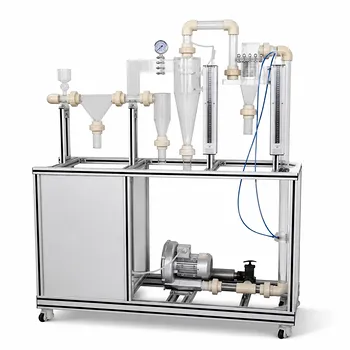
Larger cylinder diameters directly increase a cyclone’s critical particle diameter ((d_c)), reducing its ability to capture fine particulates. In a pilot plant, this means a single large cyclone sacrifices separation sharpness for volumetric capacity. To retain high efficiency at scale, engineers deploy parallel banks of smaller-diameter cyclones—multiclones—rather than simply enlarging a single unit.
The core takeaway for pilot‑plant design is that cyclone diameter and cut‑size are locked together by the scaling of inlet geometry. As a result, a larger‑diameter cyclone shifts the (d_c) upward, making it blind to finer particles. Mastering this tension between throughput and separation precision is what transforms a benchtop curiosity into an industrially relevant pilot‑scale process.
How Cylinder Diameter Governs Critical Particle Diameter
The critical particle diameter ((d_c)) is the threshold below which a particle will not be captured under ideal conditions. Its dependence on cylinder diameter is both direct and indirect.
The Governing Equation and Dimensional Proportionality
(d_c) is defined as:
[ d_c = \sqrt{\frac{9\mu B}{\pi N_c \rho_s u_i}} ]
The inlet width (B) is not an isolated dimension—it scales proportionally with the cyclone’s cylinder diameter (D). This proportionality is a fixed feature of standard cyclone design families (e.g., Stairmand, Lapple). Consequently, as (D) increases, (B) grows, and (d_c) climbs.
A larger cyclone therefore targets a coarser cut. The same gas velocity and particle density will yield a larger (d_c), meaning only bigger solid particles will drop out completely under the same theoretical conditions.
Why Centrifugal Force Falls Off
Centrifugal acceleration is inversely proportional to radius for a given tangential velocity. The centrifugal field weakens as (D) grows, reducing the driving force that pushes particles to the wall. This physical reality underpins the equation’s square‑root relationship.
When you double the diameter, you roughly double the distance a particle must travel, while the outward acceleration drops. The particle spends less of its residence time in a high‑force zone, so the smallest collectable size rises.
Practical Impact on Pilot‑Plant Performance
Pilot‑scale units are the proving ground between lab‑scale perfection and full‑scale reality. Changing cyclone diameter reshapes the entire separation landscape.
Shift in the Grade Efficiency Curve
A larger cyclone does not just lose a few percent of points—its fractional efficiency curve shifts to the right. For particles in the 1‑10 µm range, this shift can mean the difference between 90 % capture and near‑zero capture. In catalyst pilot plants, that translates directly to inventory loss and downstream fouling.
The Pilot Plant Teachable Moment: Students and researchers see firsthand that “bigger is not always better.” A unit operations pilot plant is built to reveal this scale‑up paradox, and the cyclone’s diameter sensitivity is one of the most vivid examples.
Balancing Pressure Drop and Energy Consumption
Smaller‑diameter cyclones generate higher pressure drops for the same inlet velocity, due to tighter flow passages and higher centrifugal loading. This costs energy. A larger unit can be gentler on the blower, but the trade‑off is a coarser cut.
In a pilot plant where you are running total system evaluations, that extra pressure drop matters—it influences compressor sizing, electricity draw, and even fluid‑bed back‑pressure. Therefore, the choice of diameter is never just about separation; it’s about the entire unit operations chain.
Understanding the Trade‑offs
The relationship between cylinder diameter and critical particle diameter exists inside a knot of competing priorities. Pilot‑plant designers must weigh them explicitly.
Throughput Versus Fine‑Particle Capture
A single large cyclone can swallow a huge gas flow, reducing the capital cost and footprint. But it will let the fines slip through. If your process product is the fine powder, that loss is ruinous.
Conversely, a tiny cyclone captures fines superbly, but its gas capacity is limited. To match the plant’s throughput, you need many units in parallel, which adds complexity and cost.
Sharpness of Cut and Process Robustness
A larger cyclone often shows a “softer” cut, with a more gradual S‑shaped efficiency curve. A slender, small‑diameter cyclone gives a steeper curve, meaning particles just above (d_c) are captured with much higher certainty. In pilot plants studying catalyst retention or product classification, that sharpness defines whether the process is controllable at scale.
The Multi‑Clone Solution and Its Costs
Multiclones—arrays of small‑diameter cyclones in parallel—resolve the diameter paradox by preserving high centrifugal force while meeting plant throughput demands. However, they introduce:
- Particulate maldistribution: Uneven flow splits can starve some tubes.
- Plugging risk: Small passages foul more easily with sticky or fibrous solids.
- Higher capital and maintenance: More components, more gaskets, more alignment work.
In a pilot‑plant setting, these trade‑offs are not theoretical; they appear as fluctuating pressure drops and variable catch pots, teaching the importance of uniform inlet manifolding.
The Role of Pre‑ and Post‑Treatment Staging
A large‑diameter cyclone should almost never stand alone. In processes with broad particle size distributions, large abrasives must be removed upstream (gravity settlers) to protect the cyclone from erosion. Fines that escape must be caught downstream (bag filters, scrubbers). The pilot plant that omits these stages fails to replicate real‑world reliability.
How to Apply This to Your Pilot‑Plant Design
The “right” cyclone diameter is a function of what you need the pilot plant to prove. Use these goal‑driven guidelines to anchor your decision.
- If your primary focus is maximizing recovery of fine catalyst or product particles: select the smallest practical cylinder diameter and use a multicyclone configuration. This keeps (d_c) low and delivers steep separation curves.
- If your primary focus is process simplicity, low pressure drop, and robust handling of coarse dust: a single, larger‑diameter cyclone may suffice—especially when paired with a pre‑separator to scalp out the largest particles.
- If your primary focus is replicating a future commercial scale‑up while retaining efficiency: build your pilot skid around a multicyclone block, then instrument it to study flow maldistribution and pressure fluctuations. That data is as valuable as the separation numbers.
- If your primary focus is energy optimization and total‑cost‑of‑ownership studies: map the pressure‑drop versus cut‑size curve for a range of diameters. The pilot plant should prove that the efficiency gain from a smaller cyclone justifies its higher energy footprint.
The diameter of a cyclone separator is the master dial that tunes the balance between raw capacity and separation finesse—knowing how to set that dial is what separates a credible pilot‑plant design from an expensive guess.
Summary Table:
| Parameter | Small Cylinder Diameter | Large Cylinder Diameter |
|---|---|---|
| Critical Particle Diameter ($d_c$) | Smaller (captures finer particles) | Larger (captures coarser particles) |
| Separation Efficiency | High (steep grade efficiency curve) | Lower (flatter grade efficiency curve) |
| Pressure Drop & Energy | Higher pressure drop and energy use | Lower pressure drop and energy use |
| Volumetric Capacity | Limited (requires parallel multicyclones) | High throughput per single unit |
Optimize Your Unit Operations with LABPARK Pilot Plants
Bridging the gap between laboratory theory and industrial-scale reality requires robust, precise equipment. LABPARK provides premium Educational and Vocational Unit Operations Pilot Plants in chemical engineering, bioprocess & biotech, and environmental & water treatment.
Designed specifically for universities, research institutes, and enterprises, our systems offer:
- Accurate Scale-Up Data: Study the effects of geometry, pressure drop, and separation efficiency firsthand.
- Hands-On Learning & Research: Equip your labs with industry-grade instrumentation and controls.
- Customized Configurations: Tailor your pilot plant setup (including single or multiclone separation systems) to your specific research goals.
Ready to elevate your research and vocational training? Contact LABPARK today to discuss your pilot plant requirements!
Related Products
- Gas-Solid Heterogeneous Separation Demonstration Educational Unit Operations Pilot Plant
- Photocatalytic Membrane Separation and Degradation Unit Operations Pilot Plant
- Bench Scale Dual Column Gas Separation and Capture Educational Pilot Plant
People Also Ask
- Why is pressure drop characterization critical in separation pilot plants? Key operational insights.
- What are the key thermodynamic considerations for gas mixture modeling? Expert Guide
- What are the primary operational objectives and physical requirements when running heterogeneous separation pilot plants?
- What are the material limitations of gas separation pilot plants? Key factors to consider.
- What are the trade-offs in olefin-paraffin separation? Optimize Pilot Plant Performance