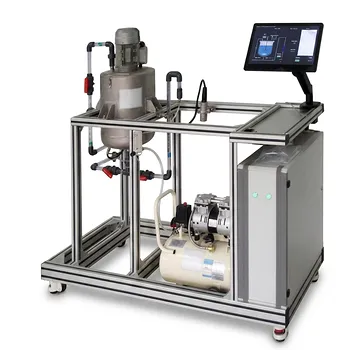
The violent, fiery chemistry of a steelmaking furnace and the controlled, ambient experiments of a chemical engineering pilot plant are, at their core, solving the exact same problem. In both cases, you are performing a liquid-liquid extraction: using a carefully engineered second liquid phase to soak up and carry away unwanted impurities from a primary liquid. The slag in steelmaking is not waste; it is a reactive solvent that, through chemical equilibrium and mass transfer, hijacks silicon, phosphorus, and manganese. The pilot plant, using safe organic and aqueous phases, strips away the heat and danger to expose the identical principles of distribution coefficients, phase contacting, and gravity separation that govern impurity removal at 1,600°C.
Slag formation is a high-temperature liquid-liquid extraction. Impurity oxides react with a basic flux to form a distinct, immiscible liquid phase. Chemical engineering pilot plant experiments on mass transfer and equilibrium isolate this very phenomenon—using safe fluids instead of molten steel—to teach the core kinetics of how a solute moves between phases, reaches equilibrium, and is physically separated by density differences. Mastering one is mastering the fundamental language of the other.
The Chemistry of Slag as a Reactive Liquid-Liquid Extraction
In steelmaking, impurity removal isn't filtration; it's a chemical partitioning process. Understanding this frames the entire relationship.
The Slag Is an Engineered Solvent, Not a Passive Blanket
You add a basic flux, typically calcium oxide (CaO) from limestone, not just to protect the metal but to create a reactive, low-density liquid. This molten slag acts as the "extract" phase.
At furnace temperatures, silicon oxidizes to SiO₂, and phosphorus to P₄O₁₀. These acidic oxides would remain in the metal, ruining its properties. Instead, they react immediately with the basic CaO to form stable, neutral compounds like calcium silicate (CaSiO₃) or calcium phosphate (Ca₃(PO₄)₂). This chemical reaction moves the impurities permanently into the slag phase.
The Driving Force Is a Partition Coefficient, Just Like in the Lab
The impurity atom faces a choice: stay dissolved in the iron or move into the slag. This choice is governed by a distribution coefficient, the ratio of its concentration in the slag to its concentration in the metal at equilibrium.
A high distribution coefficient for phosphorus means it overwhelmingly prefers the slag phase, provided the slag chemistry is right (high basicity, meaning high CaO activity). In the pilot plant, you see the exact same principle when a solute partitions between water and an organic solvent. By changing the slag's basicity—analogous to changing the aqueous phase's pH in a lab experiment—you directly manipulate the impurity's "preference" and therefore its removal efficiency.
How Pilot Plant Mass Transfer Experiments Mirror the Converter
Educational pilot plants use systems like a water-kerosene extraction in a packed column or a stirred tank. These setups replicate the multistep mass transfer journey of an impurity atom.
Step 1: Bulk Transport and Interfacial Contact
For silicon to become calcium silicate, an oxygen ion must meet a silicon atom at the metal-slag interface. In a Bessemer converter, air or oxygen is blasted through, creating violent turbulence and a massive interfacial area. This maximizes the rate of mass transfer.
In a pilot-plant liquid-liquid extraction column, you achieve the same by forcing the two immiscible liquids through packing or by mechanical agitation. Students measure how flow rates and turbulence affect the overall mass transfer coefficient. The lesson is directly transferable: in steelmaking, the "boil" and gas injection are your agitators, and their intensity determines how fast impurities reach the slag.
Step 2: Chemical Reaction at the Interface
Once at the interface, the simple oxidation in the metal phase is often followed by a rapid neutralization reaction with CaO in the slag. This chemical sink is crucial. It consumes the oxidized impurity, keeping its concentration at the interface effectively zero and maintaining a steep concentration gradient—the engine of fast mass transfer.
Pilot plants model this with a reactive extraction. For example, extracting an acid from an organic phase into an aqueous phase containing a base. The base (like the CaO) reacts instantly with the acid (like SiO₂), "locking" it in the extract phase. Students can see how this dramatically increases the extraction rate compared to a purely physical partitioning.
Step 3: Phase Separation by Density-Driven Settling
The final act is physical separation. The slag, chemically designed to be lighter than molten steel, floats to the top. The impurities are now permanently segregated by gravity.
In a pilot plant gravity settler, two immiscible phases of different densities separate into distinct layers. Students study the settling velocity, which depends on density difference and droplet size. This models exactly how a steel shop taps the metal from beneath a supernatant slag layer. Controlling this interface is about fluid dynamics, a skill honed on the pilot plant's transparent vessels before facing a furnace.
Understanding the Trade-offs of the Analogy
No model is perfect. Recognizing the gaps sharpens your understanding.
Temperature and Reaction Rate Extremes
A pilot plant operates at room temperature with slow, measurable kinetics. A converter runs at 1,600°C, where reactions and diffusion happen in seconds. The core concepts are identical, but the time scales are compressed by orders of magnitude. A student learning on a pilot system must extrapolate the kinetic principles, not the numerical rates.
Safe Simulacra Replace Multiphase Complexity
The educational pilot plant uses simplified, inert fluids to avoid the extreme hazard of molten metal and slag. This removes the simultaneous gas-metal-slag emulsion that characterizes real oxygen steelmaking. The pilot plant isolates the liquid-liquid extraction step, abstracting away the gas injection mass transfer that feeds oxygen. The analogy focuses on the partition and separation between two liquid phases, which is the heart of the slag's chemical function.
Thermodynamic Ideality vs. Industrial Slag Activity
Laboratory experiments often involve dilute solutions where Henry's law or simple partition constants apply neatly. Real steelmaking slags are highly non-ideal ionic melts. The "distribution coefficient" isn't a fixed number but a complex function of slag composition and oxygen potential. The pilot plant teaches the conceptual tool, but the industrial application requires the use of activity coefficients and phase diagrams.
Making the Right Choice for Your Learning or Process Goal
Whether you are a student or a process engineer, the bridge between the pilot plant and the steel plant is built on a few core principles.
- If your primary focus is mastering mass transfer fundamentals: Use the pilot plant to isolate and measure the effect of interfacial area, contact time, and agitation on the rate of solute transfer between phases. Treat the slag-metal interface as the reactor’s active zone.
- If your primary focus is optimizing impurity removal via chemistry: Study reactive extraction in the pilot plant (e.g., acid-base neutralization during phase transfer). Recognize that slag basicity (CaO/SiO₂ ratio) is your primary chemical lever, directly analogous to pH adjustment in an aqueous extraction.
- If your primary focus is ensuring clean phase separation: Focus on pilot-scale gravity settlers. Analyze how density differences and droplet coalescence rate control final product purity, directly paralleling the challenge of minimizing slag carryover into the steel taphole stream.
- If your primary focus is scaling from lab to production: Treat the pilot plant as a kinetic physics simulator. The measured distribution coefficients and rate equations provide the functional form; you then populate them with the high-temperature, non-ideal thermodynamic data of the real steel-slag system.
The fiery furnace and the quiet pilot plant are separated only by temperature and material. By understanding one, you gain the interpretive framework to control the other.
Summary Table:
| Parameter | Steelmaking Converter | Pilot Plant Extraction |
|---|---|---|
| Process Type | High-temp liquid-liquid extraction | Ambient liquid-liquid extraction |
| Extract Phase | Molten basic slag (e.g., CaO) | Organic solvent or aqueous phase |
| Driving Force | Distribution coefficient & reaction | Partition coefficient & pH control |
| Mass Transfer | Gas-driven turbulence (oxygen boil) | Mechanical agitation or column packing |
| Separation | Gravity settling (slag floats on steel) | Gravity settling (density differences) |
Bring Industrial Mass Transfer Principles to Life in Your Lab
Bridge the gap between complex pyrometallurgy and fundamental transport phenomena. LABPARK provides industry-grade Educational and Vocational Unit Operations Pilot Plants in chemical engineering, bioprocess & biotech, and environmental & water treatment designed specifically for universities, research institutes, and enterprises.
Help your students and researchers master liquid-liquid extraction, mass transfer kinetics, and phase separation with safe, reliable, and transparent pilot systems. Contact LABPARK today to find the perfect pilot plant solution for your institution!
Related Products
People Also Ask
- How do cost-capacity exponents vary across chemical equipment? Scaling insights.
- What are the primary considerations when managing and scaling up shear rates in pilot plant mixing operations? Guide
- What are the differences between set-point, servo, and program control? Master unit operations training.
- Evaluate Tablet Compaction: Force, Density & Porosity in Unit Operations Pilot Plants
- Why Switch Unit Operations Flow Configurations? Impact on Experimental Measurements