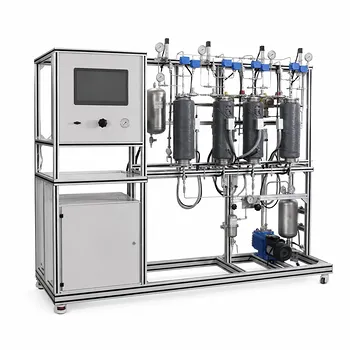
Heat-sensitive materials force a fundamental redesign of educational drying pilot plants. When a product, such as a pharmaceutical powder or a food ingredient, cannot withstand high temperatures, the inlet gas temperature must be lowered to prevent scorching or chemical degradation. This single constraint triggers a cascade of changes—specifically, a need for higher gas flow rates and, as a result, a physically larger dryer to keep the operation stable and effective.
A low inlet temperature, mandated by material heat sensitivity, reduces the driving force for heat transfer. To compensate, you must push more gas through the system. That higher volumetric flow directly dictates a wider vessel cross-section to stay within safe fluidization limits, making the dryer larger even for the same production throughput.
Why Heat Sensitivity Rewrites the Drying Rulebook
The Temperature Ceiling for Sensitive Solids
Every material has a thermal degradation threshold. For proteins, it might be denaturation; for polymers, it could be softening or discoloration; for many foods, it’s the loss of volatile aromas or the onset of Maillard browning.
In a pilot plant, this limit is not a suggestion—it is an absolute operating constraint. Exceeding it, even briefly, can destroy a batch and invalidate experimental data. So, the inlet gas temperature becomes fixed at or below this safe ceiling, not at any thermodynamically ideal value.
The Inseparable Link: Heat Transfer and Mass Removal
Drying is two sides of the same coin: heat input and moisture removal. The energy needed to evaporate water comes from the hot inlet gas.
When you force the inlet temperature lower, you shrink the temperature gradient between the gas and the wet solid. This weakens the heat transfer rate per unit volume of gas. Yet the same quantity of water still must be evaporated to reach the target moisture content. A lower temperature difference means each cubic meter of gas carries less usable energy into the dryer.
From Lower Temperature to Larger Dryer: The Sizing Cascade
Gas Flow Must Compensate for Reduced Temperature
To deliver the same total thermal energy despite a lower inlet temperature, the mass flow rate of gas must increase. You essentially swap temperature for volume. A 20% reduction in allowable temperature difference might demand a 30–40% increase in gas flow to maintain the same drying rate, because energy content is proportional to both temperature and flow.
Fluidization Velocity Sets the Minimum Vessel Diameter
This is where the physical sizing logic becomes unavoidable. In a fluidized bed dryer or a pneumatic conveying dryer, the gas velocity inside the vessel must be carefully controlled.
For a given particle size and density, there is a minimum fluidization velocity and an inherent safe operating range. If the gas flow rate increases dramatically to offset low temperature, the superficial velocity through any fixed cross-sectional area will spike. This leads to premature fluidization, slugging, or excessive entrainment of fine particles into the exhaust.
The only way to bring that velocity back within the optimal window is to increase the vessel’s cross-sectional area. That means a larger diameter. And because bed height and residence time must be preserved for proper mass transfer, the overall dryer volume—and its footprint—grow significantly.
Contact Time and Bed Depth Considerations
A larger diameter alone does not solve everything. Adequate drying requires sufficient contact time between the gas and the solids. If you simply enlarge the vessel but keep the same solids inventory, the bed depth becomes shallower, and the gas can break through unevenly (channeling).
Therefore, a low-temperature, high-flow operation often forces you to increase both diameter and bed depth to maintain the required residence time and a stable fluidization regime. This is why educational pilot dryers designed for heat-sensitive powders are noticeably bulkier than those for robust minerals.
Understanding the Trade-offs
The Energy Penalty of High Flow, Low Temperature Drying
Blowing a larger volume of gas requires more fan power, and because the inlet temperature is lower, the exhaust gas still leaves at a relatively high temperature, wasting sensible heat. The thermal efficiency of the system drops. Students must weigh capital cost (a bigger dryer) against operating cost (higher energy consumption).
Risk of Material Degradation from Mechanical Attrition
Higher gas velocities, even at the increased diameter, can still exert greater shear forces on particles, especially in fluidized beds. For friable materials like agglomerated instant coffee or soft granules, the mechanical attrition might degrade the product, defeating the purpose of gentle thermal treatment. A careful balance between thermal protection and mechanical impact is essential.
Scalability Lessons That Can Be Misleading
An educational pilot plant is meant to teach scalability. But if the pilot dryer is oversized due to low-allowed temperatures, a naive linear scale-up to a production unit might lead to an unrealistically large capital investment. The real lesson is that process design constraints—especially heat sensitivity—can dominate economic decisions, and sometimes it is better to switch to an entirely different drying technology (like vacuum drying) than to over-compensate with air flow.
Making the Right Choice for Your Educational Drying Pilot Plant
Your choice of dryer dimensions and operating parameters will depend on the pedagogical goals and the range of materials you plan to test.
- If your primary focus is teaching the physics of heat-sensitive drying: Size the pilot dryer generously. A larger vessel allows you to demonstrate the trade-off between temperature, flow rate, and fluidization stability clearly and safely. Students will see the cascade effect firsthand.
- If your primary focus is maximizing throughput for diverse research materials: Install a dryer with modular internals (e.g., variable distributors, adjustable bed heights) that can accommodate both heat-sensitive powders and high-temperature minerals without requiring a full redesign.
- If your primary focus is demonstrating energy-efficient design principles: Integrate heat recovery or humidification-dehumidification loops into the pilot plant to show that low inlet temperature does not have to mean abysmal energy efficiency; it simply demands smarter engineering.
By recognizing that material heat sensitivity is the true starting point of dryer design, you equip your students not just with operating procedures, but with the critical thinking skills needed to make sound process decisions when the thermal limits are tight.
Summary Table:
| Parameter | Impact of Heat Sensitivity | Engineering Reason |
|---|---|---|
| Inlet Gas Temperature | Must be lowered | Prevents scorching and thermal degradation |
| Gas Flow Rate | Must be increased | Compensates for the reduced heat transfer driving force |
| Vessel Diameter | Must be increased | Keeps superficial gas velocity within safe fluidization limits |
| Dryer Footprint | Becomes larger | Maintains necessary residence time and bed depth |
Equip Your Lab with LABPARK's Advanced Pilot Plants
Designing drying processes for heat-sensitive materials requires balancing precise temperatures and fluid dynamics. LABPARK provides premium Educational and Vocational Unit Operations Pilot Plants in chemical engineering, bioprocess & biotech, and environmental & water treatment for universities, research institutes, and enterprises.
Whether you need modular dryers or custom configurations, we deliver reliable, scale-accurate systems that enhance student learning and research outcomes.
Contact our engineering experts today to discuss your laboratory requirements!
Related Products
- Multi-Functional Drying Educational Unit Operations Pilot Plant
- Continuous Batch Extractive Distillation Educational Pilot Plant
- Green Anhydrous Ethanol Refining Practical Training Pilot Plant
- Multi-Functional Special Distillation Educational Pilot Plant
- Dual-Mode Rectification Pilot Plant for Practical Training Unit Operations
People Also Ask
- Vacuum vs. Atmospheric Drying: How to Choose the Right Pilot Plant Configuration for Your Lab
- How do seasonal changes affect drying pilot plant blower requirements? Key sizing tips.
- Why is dry-basis moisture content preferred over wet-basis? Simplify your drying pilot plant balances.
- How can unit operations pilot plants demonstrate simultaneous removal of light and heavy impurities? Configure a modular setup
- Why are particle density, bulk density & voidage critical in pilot plants? Master Bed Fluid Dynamics