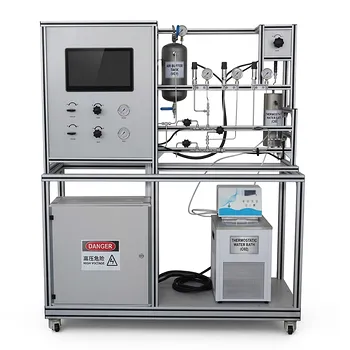
Here's the core principle that makes this a fundamental lesson in unit operations training: a vacuum adiabatic crystallizer minimizes scaling and heat transfer resistance by completely eliminating the physical heat exchange surface.
Instead of cooling a solution against a cold metal wall—where solutes inevitably deposit and form an insulating scale—the vacuum adiabatic process cools the solution by flashing off the solvent under vacuum. This method shifts the point of phase change from a solid surface directly into the bulk liquid mass itself. For a trainee piloting this equipment, the critical insight is that without a thermal gradient driving force across a wall, the primary mechanism for fouling simply ceases to exist.
Understanding how to prevent fouling is often taught as a lesson in tight parameter control within conventional systems. The vacuum adiabatic crystallizer, however, reframes the problem as one of design elimination: you solve scaling and heat transfer resistance not by managing them, but by engineering the heat transfer surface out of the process entirely.
The Root Cause of Scaling in Crystallization Training
Before trainees can appreciate a solution, they must understand the baseline problem that plagues cooling and evaporative crystallizers.
The Heat Transfer Boundary Layer Disaster
Scaling in conventional systems is predominantly a surface phenomenon. When a metallic wall acts as a cooling interface, a stagnant film of supersaturated solution forms right at that wall.
This boundary layer is precisely where the temperature is lowest, and therefore supersaturation is highest. Solutes rush to nucleate and grow on the cool, solid wall, creating a crystalline crust.
The Vicious Cycle of Efficiency Loss
Once a scale layer forms, it acts as a thermal insulator. Even a thin layer of crystal deposits dramatically increases resistance to heat flow.
To compensate, operators must increase the temperature differential across the coolant. Paradoxically, this steeper gradient drives supersaturation even higher at the wall, accelerating the scaling rate until the pilot run must be shut down for cleaning.
The Adiabatic Solution: Moving the Goalposts
The vacuum adiabatic crystallizer, as detailed in the primary reference, avoids the entire cycle by changing the physics of cooling.
Substituting a Solid Surface for a Vacuum Flash
In a vacuum adiabatic unit, the hot, concentrated feed enters a chamber maintained under vacuum. The boiling point of the solvent drops correspondingly.
The liquid boils immediately upon entry, and the latent heat required for vaporization is drawn directly from the solution itself. This is the adiabatic cooling effect. The liquid cools without ever transferring energy across a tube wall.
Where Nucleation Occurs is Everything
Because cooling is driven by flashing at the vapor-liquid interface and within the bulk fluid, there is no cold metal surface onto which a solute can lock. Any nucleation occurs on existing crystals in suspension, not on process equipment.
For students running pilot-scale experiments, this demonstrates a powerful principle: by relocating the mass transfer driving force from a wall to the bulk fluid, you eliminate the thermodynamic conditions necessary for wall scaling to begin.
Contrasting with Conventional Anti-Scaling Methods
To solidify this understanding during unit operations training, it's instructive to contrast the vacuum approach with other "seeded fluid" methods that still rely on heat transfer surfaces.
The DTB and Oslo Crystallizer Strategy: Management, Not Elimination
As the supplementary references detail, Draft Tube Baffle (DTB) and Oslo-type crystallizers combat scaling by carefully managing hydrodynamics and thermal driving force, not by removing the heat exchanger.
- The DTB Method: It uses high internal circulation rates to slurry past a boiling zone, consuming supersaturation quickly and keeping the boiling action at the liquid surface, away from the walls. This can allow for months of continuous operation, provided circulation remains vigorous.
- The Oslo Method: It relies on precise temperature control. The temperature difference between the recirculating mother liquor and the coolant is kept extremely low (≤ 2°C) to stay within the metastable zone width where scaling is slow. In training, monitoring this delta-T is the critical control parameter.
The Operating Philosophy Shift in Training
These methods teach students to monitor flow rates, slurry densities, and temperature differences as a delicate balancing act. The vacuum adiabatic method, however, teaches a lesson in process intensification.
It simplifies the operator's task from fighting a boundary layer to maintaining a vacuum pressure and feed temperature. The prevention of fouling is intrinsic to the equipment design, not a constant operational battle. Below is a summary of the contrast:
| Design Principle | Driving Force Control | Primary Anti-Scaling Mechanism | Pilot Training Focus |
|---|---|---|---|
| Jacketed/ Oslo | Conduction (Coolant ΔT) | Strict ΔT limit (≤ 2°C) | Monitoring coolant temps, circulation loops. |
| DTB | Flash at Liquid Surface | High circulation to consume supersaturation. | Maintaining internal slurry velocity. |
| Vacuum Adiabatic | Adiabatic Flash (Latent Heat) | No heat transfer surface; bulk nucleation. | Vacuum pressure vs. boiling point curve. |
Understanding the Trade-offs and Practical Limits
While the vacuum adiabatic crystallizer elegantly solves the fouling problem, an objective technical advisor must highlight the constraints students will encounter in a pilot plant setting.
The Energy Cost and Throughput Limitation
Unlike a multi-effect evaporative system that recovers latent heat, a vacuum adiabatic unit typically relies on the sensible heat brought in by the feed.
This limits the total cooling capacity. To achieve a large temperature drop, you must either pre-heat the feed substantially or operate with a very high vacuum, which can constrain throughput and energy efficiency compared to surface-cooled systems.
Handling Heat-Sensitive Materials, Not All Materials
This method excels with heat-sensitive feeds because it avoids thermal degradation on hot walls. However, for highly viscous solutions where bubble dynamics are suppressed, adiabatic flashing can be inefficient.
Furthermore, the lack of a heat exchanger means you have less direct control over the crystallization curve. You are committed to the temperature path dictated by the vacuum flash, which demands a feed with fixed sensible heat content.
Making the Right Choice for Your Pilot-Scale Goal
Whether a vacuum adiabatic unit or a managed-contact circulator is right for your pilot program depends entirely on your objective.
- If your primary focus is demonstrating zero-fouling, low-maintenance operation: Prioritize the vacuum adiabatic crystallizer. Its core value is the complete elimination of the heat transfer wall, making the link between process physics and reliability crystal clear.
- If your primary focus is teaching precision control of supersaturation via delicate thermal balancing: Choose an Oslo or forced-circulation unit with a strict focus on maintaining the critical ≤ 2°C temperature difference and monitoring slurry density for metastable zone control.
- If your primary focus is maximizing uptime with a surface-cooled system: Implement a Draft Tube Baffle (DTB) design to show how high internal circulation can mimic some benefits of a wall-free design by preventing localized supersaturation spikes.
Ultimately, the vacuum adiabatic crystallizer provides a foundational lesson: the most robust way to solve a heat transfer resistance problem is often to design a process that doesn't need the surface in the first place.
Summary Table:
| Crystallizer Type | Heat Transfer Method | Scaling Prevention Mechanism |
|---|---|---|
| Jacketed / Oslo | Conduction (Coolant Wall) | Strict temperature difference control (ΔT ≤ 2°C) |
| Draft Tube Baffle (DTB) | Conduction & Surface Flash | High internal circulation rates to consume supersaturation |
| Vacuum Adiabatic | Adiabatic Flash (No Wall) | Bulk nucleation (eliminates physical heat exchange surfaces) |
Upgrade Your Engineering Lab with LABPARK Pilot Plants
Bring complex chemical engineering principles to life for your students and researchers. LABPARK designs and supplies premium Educational and Vocational Unit Operations Pilot Plants across chemical engineering, bioprocess & biotech, and environmental & water treatment fields.
Whether you are demonstrating zero-fouling process design with vacuum adiabatic systems or teaching precision temperature control, our pilot units help universities, research institutes, and enterprises bridge the gap between theory and practical industrial application.
Ready to equip your lab? Contact LABPARK today to receive a customized technical proposal!
Related Products
People Also Ask
- How does kinetic theory explain ideal vs real gas energy differences? Key Pilot Plant Insights
- How does nuclear yield inefficiency translate to chemical engineering education? Optimize kinetics with pilot plants.
- Why Correct Sig Figs & Rounding Matter in Educational Pilot Plants: Ensure Data Accuracy
- How can educational pilot plants be used to teach process safety and risk assessment in chemical engineering curricula?
- How are phase diagrams and triple point values applied practically in thermodynamics unit operations pilot plants?