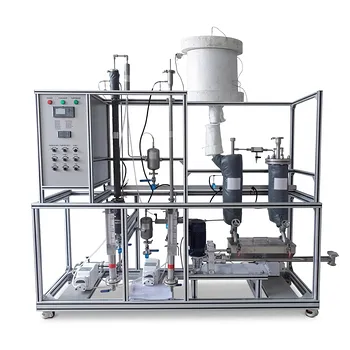
Here’s the critical distinction in a nutshell: SRR uses a series of fixed-bed reactors that operate at higher pressure and require periodic, full-unit shutdowns for catalyst regeneration, while CRR continuously circulates catalyst through a moving-bed system at much lower pressure, enabling non-stop operation and on-the-fly coke removal. In educational pilot units, comparing these two configurations instantly reveals how pressure, temperature, and catalyst management are inextricably linked—and why CRR achieves superior product quality but demands far more complex hardware.
The central trade-off students discover is that SRR slows catalyst deactivation by sacrificing reaction severity (higher pressure, lower temperature), whereas CRR accepts aggressive, high-coke conditions by engineering a continuous regeneration loop. This directly impacts product octane, liquid yield, and operational complexity in the pilot plant.
How Operating Conditions Diverge: Pressure, Temperature, and Reactor Design
Pressure as the Master Lever
Semi-regenerative reforming deliberately runs at elevated pressures, typically 15–35 bar. The higher hydrogen partial pressure suppresses coke formation, protecting the fixed catalyst bed.
This buys long run times—six months to over a year—without intervention. But the thermodynamic penalty is real: higher pressure shifts equilibrium away from aromatics and hydrogen, capping the octane uplift.
In contrast, CRR drops the pressure floor to just 3–4 bar. Since coke is continuously burned off, there’s no need to restrain its formation.
The result is a massive boost in aromatics yield and, consequently, a higher-octane reformate stream that an SRR unit simply cannot match at comparable temperatures.
Why Reactor Architecture Changes Everything
SRR relies on multiple adiabatic fixed-bed reactors in series, with inter-stage heaters to compensate for endothermic reactions. This design is inherently static—catalyst pellets stay put from startup to shutdown.
CRR replaces that fixed-bed logic with a moving-bed system. Catalyst particles flow downward by gravity through stacked reactor stages, then lift to a separate regenerator vessel.
This continuous circulation is what enables the low-pressure, high-temperature operation. In a pilot unit, students see immediately that the moving bed is the enabling technology, not just a supplementary feature.
Temperature Profiles and Their Consequences
Because SRR catalyst deactivates slowly but surely, operators often start at a lower temperature and gradually increase it over the run to maintain conversion. The unit therefore never consistently operates at its peak potential.
CRR, on the other hand, can sustain near-maximum temperature throughout the campaign. The regenerator constantly restores catalyst activity, so the reactor inlet temperature stays high and stable.
This stability transforms the product slate: liquid yields improve, and the hydrogen purity remains high. The pilot plant data logs will show the SRR profile drifting while the CRR profile holds a tight line.
Contrasting Regeneration Strategies: Scheduled Shutdown vs. Continuous Renewal
The SRR Off-Stream Cycle
Regeneration in an SRR unit is a production-halting event. The entire reactor train must come offline, depressurize, and undergo a carefully controlled burn.
The procedure typically uses diluted air and injected chlorine to re-disperse the metal function on the catalyst. This in-situ regeneration can take days, and the corrosive environment demands robust metallurgy.
Students learn that every off-stream cycle introduces a risk—thermal stress, improper chlorine distribution, or incomplete coke removal can permanently damage the catalyst bed and shorten the next run.
The CRR “Never Stop” Philosophy
CRR units never take a break for regeneration. Instead, they continuously withdraw partially deactivated catalyst from the bottom of the last reactor, lift it pneumatically, and feed it into a dedicated regenerator.
Inside the regenerator, coke is burned off in a controlled oxygen environment. The rejuvenated catalyst then returns to the top of the first reactor, completing the loop.
This is where the pilot plant becomes a vivid teaching tool: students can physically trace the catalyst circuit, from the reactor cones to the regenerator tower, and measure the steady-state coke profile along the path.
The True Cost of Continuity
The continuous regeneration strategy needs an entirely separate process control layer. You’re managing two moving inventories—catalyst and coke—plus sophisticated valves and lift gas systems.
An SRR unit, by comparison, is mechanically simpler. Its complexity is procedural (the regeneration recipe) rather than mechanical. That simplicity is why many educational pilots start with an SRR configuration before scaling up to the moving-bed complexity of CRR.
Understanding the Trade-offs in a Pilot Environment
Product Quality vs. Process Simplicity
CRR’s lower pressure and constant activity deliver a clear liquid yield and octane advantage. In a pilot unit, the reformate from the CRR line will consistently show higher aromatics content and a lower benzene precursor load.
But this performance comes at the cost of substantially more complex equipment. The moving-bed seals, catalyst lift lines, and regenerator air/fuel ratio controls create a web of interlocks that an SRR skid simply avoids.
Catalyst Lifespan and Handling
In SRR, catalyst life is measured in years per charge, but when the end comes, replacing it means a lengthy shutdown and tedious bed dumping.
CRR’s continuous attrition means you’re constantly adding fresh catalyst in small amounts. This keeps overall activity high but introduces a steady opex stream and a catalyst handling logistics chain that a fixed-bed pilot doesn’t need.
The Educational Sweet Spot
The biggest pedagogical value is that an SRR pilot teaches students time-dependent deactivation and regeneration planning. They learn to interpret declining temperature profiles and schedule the turnaround.
A CRR pilot teaches steady-state deactivation management and integrated material handling. They grapple with maintaining catalyst circulation, minimizing attrition, and optimizing the regenerator’s burn zone temperature.
How to Apply This to Your Educational Pilot Design
The choice between building or demonstrating an SRR versus a CRR pilot unit depends entirely on your core learning objectives.
- If your primary focus is fundamental reaction kinetics and deactivation curves: An SRR unit is invaluable. Students directly observe how activity loss forces temperature hikes, cementing the link between coke, pressure, and equilibrium.
- If your primary focus is integrated process dynamics and modern refinery operations: A CRR pilot is essential. It demonstrates the operational philosophy behind low-pressure reforming and forces students to master interacting catalyst-flow and heat-balance loops.
- If your primary focus is comparative techno-economic analysis: Run both configurations side-by-side. The stark difference in pressure levels, product octane, and downtime frequency gives students a complete picture of how regeneration strategy dictates both capex and profitability.
Nothing reveals the true genius of continuous regeneration like watching a fixed-bed unit inch toward shutdown while the moving-bed system hums along unchanged, producing premium reformate hour after hour.
Summary Table:
| Feature | Semi-Regenerative Reforming (SRR) | Continuous-Regenerative Reforming (CRR) |
|---|---|---|
| Operating Pressure | High (15–35 bar) | Low (3–4 bar) |
| Reactor Design | Fixed-bed (adiabatic, series) | Moving-bed (gravity flow) |
| Temperature Profile | Gradually increases over run | Constant, near-maximum |
| Regeneration Strategy | In-situ (periodic, production halts) | Ex-situ (continuous loop) |
| Reformate Quality | Lower octane & aromatics yield | Higher octane & aromatics yield |
| Hardware Complexity | Moderate (procedural focus) | High (mechanical & control focus) |
Bring Advanced Refining Processes to Your Lab
Looking to equip your students or research team with hands-on experience in catalytic reforming? LABPARK designs and manufactures state-of-the-art Educational and Vocational Unit Operations Pilot Plants in chemical engineering, bioprocess & biotech, and environmental & water treatment.
Whether you need a robust fixed-bed SRR configuration to teach deactivation kinetics or an advanced moving-bed CRR system to demonstrate continuous process dynamics, we deliver tailored solutions for universities, research institutes, and enterprises worldwide.
Contact LABPARK today to discuss your pilot plant requirements and get a custom quote!
Related Products
- Steam Methane Reforming Hydrogen Production and Purification Educational Pilot Plant
- Dual-Mode Rectification Pilot Plant for Practical Training Unit Operations
- Residence Time Distribution and Reactor Flow Characteristics Determination Educational Pilot Plant
People Also Ask
- How does integrating unit operations impact pilot plant thermal efficiency & CO management? Key design insights.
- How Do Temp, Pressure & S:C Ratio Affect Methane Reforming? Optimize Your Pilot Reactor
- In educational chemical engineering pilot plants, why use absorption and adsorption before reforming?
- SMR, POX, or ATR? Trade-offs in Hydrogen Production Educational Pilot Plants
- What are steam reforming pilot plant challenges? Master Feedstock Selection & Design