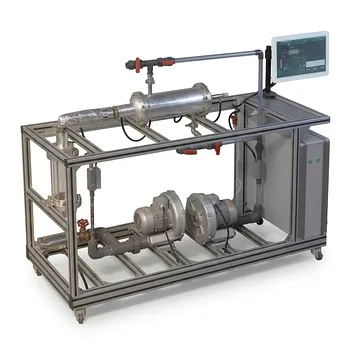
Hairpin heat exchangers are the more economical, space-saving choice for small-scale chemical pilot operations requiring heat transfer areas under approximately 150 m². Their U‑tube design inherently delivers true counter‑current flow, maximizing the temperature driving force, while removable covers make manual cleaning and inspection straightforward. Shell‑and‑tube exchangers remain the go‑to when experiments demand the high‑pressure and high‑temperature capabilities of full‑scale industrial units.
For pilot‑scale operations that prioritize cost, compact footprints, and frequent changeovers, hairpin heat exchangers offer a decisive edge. They combine simple maintenance with the thermal efficiency of complete counter‑current flow, making them ideal for teaching and research where space is tight and process fluids vary. Shell‑and‑tube systems fill the gap only when you must simulate harsh industrial environments or study complex shell‑side phenomena.
Understanding the Design Fundamentals
Both designs transfer heat between two fluids, but the way they handle thermal stress, flow patterns, and accessibility shapes their suitability for small‑scale pilot work.
How Hairpin Exchangers Maximize Thermal Driving Force
A hairpin exchanger consists of a U‑tube bundle housed inside an outer pipe. This architecture physically forces the fluids into pure counter‑current flow, which yields the maximum possible log-mean temperature difference (LMTD) for a given set of inlet and outlet temperatures.
The U‑tube design also accommodates thermal expansion without the need for expansion joints, reducing mechanical complexity. Removable covers on the outer pipe make it possible to mechanically clean the shell side by simply pulling the bundle. This is a significant practical advantage in pilot plants that handle sticky, viscous, or fouling fluids and must be cleaned often.
The Industrial Backbone: Shell‑and‑Tube Construction
A shell‑and‑tube exchanger uses a bundle of straight tubes mounted inside a cylindrical shell. Baffles on the shell side direct flow across the tubes, creating a more mixed flow pattern that deviates from true counter‑current contact. That deviation is quantified through the temperature correction factor (F_t), which is always less than 1.0.
The design is mechanically robust and can handle pressures well above 20 MPa and temperatures exceeding 500°C. It therefore remains the standard for teaching traditional industrial processes where large temperature differences, high pressures, and phase‑change phenomena (condensation, boiling) are the norm.
Operational and Maintenance Considerations at Pilot Scale
Pilot plants are not just miniature factories—they are learning platforms and research tools. Downtime for cleaning, reconfiguration, and troubleshooting directly impacts training schedules and experimental throughput.
Cleaning and Changeover Agility
Hairpin exchangers excel here because of their removable outer covers. A technician can slide the U‑tube bundle out, mechanically clean both the tube exterior and the shell interior, and have the unit back online quickly. This is critical when you are running short‑duration experiments with different process fluids.
Shell‑and‑tube exchangers are more cumbersome to clean mechanically, especially on the shell side. The fixed tube bundle, baffle plates, and tie rods create numerous crevices where fouling can accumulate. Chemical cleaning is often the only practical option, which adds cost and complicates rapid experiment turnarounds.
Space and Cost Efficiency for Small Installations
Hairpin exchangers are more economical than shell‑and‑tube units for heat transfer areas between roughly 7 and 150 m². Their compact footprint makes them easy to integrate into crowded pilot‑plant skids where floor space is at a premium.
Shell‑and‑tube exchangers, by contrast, are designed for larger duty scales. Building a shell‑and‑tube unit with a small heat transfer area often results in a disproportionately large, costly shell relative to the heat transfer surface actually needed. For pilot operations that rarely exceed the 150 m² threshold, the economics favour the hairpin.
Understanding the Trade‑offs
No single design is universally superior. The right choice depends on the physical limits you must honor and the skills you aim to teach.
When You Need High Pressure and Temperature
Shell‑and‑tube exchangers are unchallenged when your pilot process demands operating pressures above 2 MPa or temperatures beyond 250°C. Gasket‑free welded construction and thick‑walled shells allow them to contain high‑energy fluids safely.
Hairpin exchangers can be designed for moderate pressures, but their removable covers typically rely on gaskets that impose upper pressure and temperature limits. If your pilot plant must replicate superheated steam or high‑pressure reaction loops, a shell‑and‑tube unit is the only safe choice.
Teaching Industrial Standard Configurations
A unit operations lab that aims to train students for traditional chemical plants will benefit from showing baffle arrangements, multi‑pass tube layouts, and shell‑side bypass management. Shell‑and‑tube exchangers make these visible and measurable.
Hairpin exchangers primarily teach the value of complete counter‑current flow and mechanical simplicity. While extremely practical, they do not expose learners to the baffle‑related pressure‑drop and bypass phenomena they will encounter in most large‑scale installations.
Limitations of Hairpin Designs
The U‑tube bundle can pose a challenge if you need to mechanically clean the inside of the tubes, particularly the tightly curved U‑bend region. Specialized flexible cleaning tools may be required, though in many pilot‑scale settings chemical cleaning of the tube side is acceptable.
Additionally, the tube‑side flow in a hairpin is limited to a single pass per unit, which can restrict the fluid’s velocity if a specific Reynolds number is needed for heat‑transfer enhancement. Shell‑and‑tube units offer multiple tube passes to raise velocity without increasing overall flow rate.
Making the Right Choice for Your Pilot Operation
Your decision hinges on whether your primary goal is agile, low‑cost experimentation or faithful recreation of high‑severity industrial conditions.
After a brief introductory analysis of your pilot plant’s priorities, use the following goal‑driven guide.
- If your primary focus is low‑cost, frequent changeovers and hands‑on maintenance training: Choose a hairpin heat exchanger. Its removable cover and U‑tube bundle slash cleaning downtime, and its compact size frees up valuable lab floor space while delivering true counter‑current thermal performance.
- If your primary focus is simulating high‑pressure reactions or steam‑heated processes exceeding 150°C: Select a shell‑and‑tube exchanger. It handles extreme temperatures and pressures safely and allows you to demonstrate industrial‑standard features like baffles, tube passes, and shell‑side flow maldistribution.
- If your primary focus is teaching heat‑transfer fundamentals with highly viscous or fouling fluids: A hairpin exchanger’s easy shell‑side access and true counter‑current flow simplify analysis, while plate heat exchangers—mentioned for context—could also be considered but are outside this comparison.
- If your primary focus is measuring shell‑side pressure drop and bypass phenomena for process design education: Incorporate a shell‑and‑tube unit. It reveals flow characteristics that hairpin designs inherently mask.
Ultimately, for the vast majority of small‑scale chemical engineering pilot operations, a hairpin heat exchanger provides the most practical blend of efficiency, serviceability, and cost control—reserving shell‑and‑tube designs for the minority of experiments that truly require their high‑pressure, high‑temperature backbone.
Summary Table:
| Feature | Hairpin Exchangers | Shell-and-Tube Exchangers |
|---|---|---|
| Flow Pattern | True counter-current (Max LMTD) | Mixed cross-flow (Lower LMTD) |
| Optimal Heat Area | Under 150 m² (Compact) | Over 150 m² (Large scale) |
| Maintenance | Easy (Removable U-tube bundle) | Complex (Fixed tubes and baffles) |
| Temp & Pressure | Moderate (Gasket-limited) | High (Welded construction, >20 MPa) |
| Ideal Application | Low-cost, frequent changeovers | High-pressure industrial simulation |
Scale Up Your Lab's Capabilities with LABPARK
Looking to equip your facility with the right heat transfer and process systems? LABPARK provides premium Educational and Vocational Unit Operations Pilot Plants in chemical engineering, bioprocess & biotech, and environmental & water treatment.
We help universities, research institutes, and enterprises select and implement the ideal pilot setups—from compact, easy-to-clean hairpin designs to high-pressure shell-and-tube systems.
Contact our engineering team today to find the perfect pilot plant solution for your curriculum or research goals!
Related Products
- Shell and Tube Heat Exchanger Heat Transfer Coefficient Determination Educational Pilot Plant
- Dual Mode Heat Transfer Pilot Plant for Unit Operations Training
- Three-Tube Heat Transfer Educational Pilot Plant for Unit Operations Training
- Comprehensive Multi-Modal Heat Transfer Unit Operations Pilot Plant for Engineering Training
People Also Ask
- Why Apply LMTD Correction in Shell-and-Tube Pilot Plants & How to Determine It
- Why adjust baffle spacing in shell-and-tube heat exchanger pilot plants? Master heat transfer & pressure drop.
- How to Estimate Shell-Side Pressure Drop in a Shell-and-Tube Heat Exchanger Pilot Plant: Key Parameters Explained
- How is the fouling factor (Rd) evaluated? Key Pilot Plant Insights for Students
- How is fouling factor demonstrated using shell and tube pilot plants? Practical Lab Guide