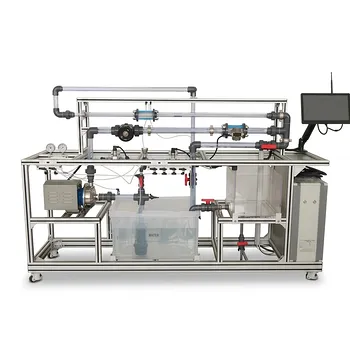
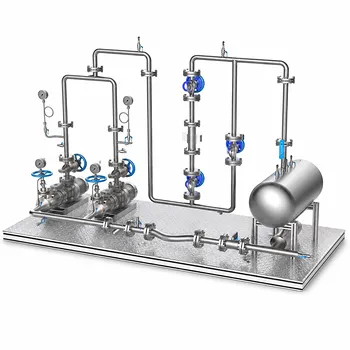
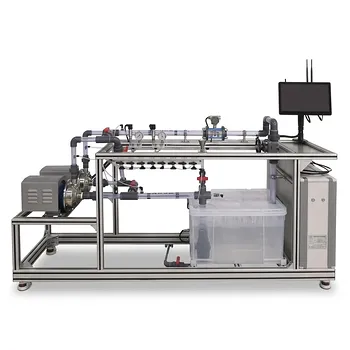
The fundamental difference is in the fluid path: a single-suction impeller draws liquid in from one side only, while a double-suction impeller draws it in from both sides simultaneously. In a fluid transport training system, this single design change transforms the pump’s behavior. The single-suction design creates an unbalanced axial force pushing the impeller toward its inlet, a problem that must be actively managed. The double-suction design naturally balances these forces, eliminating the problematic axial thrust while also drastically increasing the pump’s capacity.
In a training context, double-suction impellers are not just a larger-capacity option—they are a practical demonstration of how symmetrical hydraulic loading can solve the inherent force imbalances of single-suction designs. The engineering problem they address is axial thrust, but the learning extends to force balance, capacity scaling, and real-world industrial pump reliability.
The Single-Suction Impeller: A Simple Design with an Inherent Flaw
A single-suction impeller is the most intuitive pump configuration. Liquid enters through an eye on one side of the impeller, is accelerated by the vanes, and exits at the periphery. However, this straightforward geometry introduces a hidden mechanical penalty.
How Axial Thrust Develops
The inlet side of the impeller experiences a lower pressure than the back side. This pressure differential is because the eye area is connected to the suction piping where pressure is minimal, while the back shroud is exposed to discharge pressure that leaks past the wear rings. This asymmetry creates a net force that relentlessly pushes the entire rotating assembly toward the suction inlet. In training systems, this thrust can be felt as a load on the thrust bearing, and if unmanaged, it causes rapid bearing wear or impeller contact with the casing.
The Role of Balance Holes
To mitigate this, single-suction impellers often incorporate balance holes drilled through the back shroud. These holes allow higher-pressure fluid to bleed into the eye area, reducing the pressure differential and thereby the net thrust. While common, this method is a compromise—it recirculates some fluid, slightly lowering efficiency, and it never completely eliminates the thrust across a pump’s full operating range. It is a workaround, not a solution, giving students a perfect example of an engineering trade-off.
The Double-Suction Impeller: Symmetry for Balance and Capacity
The double-suction impeller addresses the root cause of axial thrust by introducing geometric symmetry. It is essentially two single-suction impellers placed back-to-back in a single casting, sharing a common discharge.
The Natural Elimination of Axial Thrust
Because liquid enters from both sides symmetrically, the hydraulic forces on the left and right shrouds are identical and opposite. They cancel each other out, resulting in near-zero net axial thrust across most operating conditions. No balance holes or complex thrust bearings are needed to compensate—the physics of the design itself solves the problem. For students, this is a powerful visual of how symmetry in force vectors leads to mechanical equilibrium.
A Step Change in Liquid-Carrying Capacity
The dual inlets also effectively double the flow area available for a given impeller diameter. With liquid entering from both sides, the impeller can handle a substantially larger volume of fluid without increasing the velocity at the eye to damaging levels that would cause cavitation. This makes the double-suction configuration the default choice in virtually all high-capacity, moderate-head applications such as cooling water circulation, municipal water supply, and industrial transfer. The training system directly demonstrates how scaling capacity is not simply a matter of making an impeller bigger, but of rethinking the flow geometry.
Understanding the Trade-offs
The double-suction impeller is not universally superior. Its educational value lies in revealing when its advantages justify its additional complexity.
Complexity in Casing and Maintenance
A pump with a double-suction impeller requires a more complex casing, typically a horizontally split design that allows access to the impeller from the top. This adds weight, cost, and more sealing faces compared to the simple end-suction configuration. For the same total head and a lower flow rate, an end-suction pump is often the more economical and maintainable choice. The training system shows that the "best" design is always a function of the operating point.
Axial Balance is Not Perfectly Static
While the design largely cancels axial thrust, some residual thrust can still occur under extreme off-design conditions or due to uneven wear on the two sides of the impeller. Pump designers may still include a small thrust bearing for these edge cases. This nuance is critical learning: engineering solutions often move from a large problem to a manageable one, rather than achieving theoretical perfection.
How to Apply This to Your Training Curriculum
The choice between single and double-suction impellers in a training system should align with the specific physical principle you need to demonstrate.
- If your primary focus is illustrating force imbalance and corrective measures: Use a single-suction pump; let students measure bearing loads and calculate the impact of balance holes, giving them a direct encounter with a classic mechanical design compromise.
- If your primary focus is demonstrating hydraulic symmetry and high-capacity design logic: Deploy a double-suction pump; have students observe the near-elimination of axial thrust and measure the flow advantage, connecting symmetrical flow paths to load cancellation and volume scaling.
- If your primary focus is comparative analysis and design trade-offs: Include both pump types in the same training loop, allowing students to quantify efficiency, thrust, and capacity differences under identical conditions to fully grasp that component design is never isolated from system performance.
Mastering the difference between these impeller types transforms a student’s thinking from simple pump operation to the deliberate balancing of forces that underpins all reliable fluid transport systems.
Summary Table:
| Feature | Single-Suction Impeller | Double-Suction Impeller |
|---|---|---|
| Fluid Entry | One side only | Both sides simultaneously |
| Axial Thrust | Unbalanced (needs balance holes) | Naturally balanced (symmetrical) |
| Flow Capacity | Standard | High (doubled inlet area) |
| Complexity | Simple, lower maintenance cost | Complex casing, higher cost |
Enhance Your Engineering Lab with LABPARK
Looking to bring theoretical hydraulics to life? LABPARK designs and manufactures premium Educational and Vocational Unit Operations Pilot Plants in chemical engineering, bioprocess & biotech, and environmental & water treatment for universities, research institutes, and enterprises.
Our systems provide hands-on experience with real-world pump configurations, helping students visualize complex forces like axial thrust and capacity scaling. Contact our experts today to find the perfect pilot plant for your training and research needs!
Related Products
- Centrifugal Pump Performance and Orifice Flowmeter Calibration Educational Pilot Plant
- Chemical Pipeline Assembly and Fluid Transport Practical Training Unit Operations Pilot Plant
- Centrifugal Pump Performance Determination Educational Unit Operations Pilot Plant
People Also Ask
- What features should instructors look for in pump & flowmeter pilot plants? Key Selection Guide
- Why start a centrifugal pump with a closed outlet valve? Protect your pilot plant motors.
- How to update chemometric calibration models in pilot plants? Best practices for process engineers.
- How can cavitation and slurry erosion be studied and mitigated using fluid transport and centrifugal pump pilot plants?
- How do pilot plants demonstrate siphon pressure variations? Visualizing Bernoulli's Energy Balance