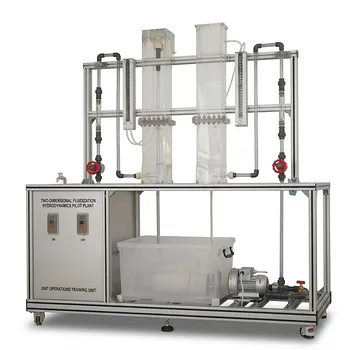
Liquid distributors are not mere plumbing accessories; they are the primary control lever for defining what a student can learn from a packed column pilot plant. The choice of distributor directly dictates the range of valid operating conditions, the types of fluids that can be safely studied, and the clarity of the mass transfer theory being demonstrated. While a simple nozzle might be sufficient for a narrow, clean-water experiment, a sophisticated trough-sieve design unlocks the ability to safely demonstrate a full turndown ratio of up to 10:1, showing students the tangible limits of column hydrodynamics.
While packed columns offer superior efficiency over plate columns for demonstrating continuous mass transfer, their performance is entirely dependent on initial liquid distribution. In an educational pilot plant, the distributor choice is a trade-off between simplicity (nozzle/pipe), which proves the concept cheaply, and operational flexibility (trough/weir), which allows students to safely explore complex fluid behaviors, high viscosities, and wide flow rate ranges without immediate failure.
Beyond Spraying: How Distributor Design Defines the Curriculum
The Fundamental Flaw in Simplistic Designs
The primary_reference establishes a clear performance hierarchy, confirmed by physical flow principles. The lowest-cost options—nozzle and pipe distributors—suffer from a critical educational liability: they are easily clogged and structurally limited.
Nozzle distributors function as a single-point source. They are adequate only for columns under 600 mm, but their vulnerability to fouling makes them a poor choice for a shared teaching lab where system cleanliness may vary between student groups.
Pipe distributors offer low resistance to gas flow, a hydraulically sound feature. However, their low operating flexibility means that if a student significantly reduces the liquid feed rate, the distribution becomes uneven almost immediately. This turns a controlled experiment into an unpredictable one, severing the link between the student's input and the column's output.
The Precision Tier: Trough and Weir Mechanisms
To truly demonstrate the hydrodynamics outlined in the supplementary_references—particularly dynamic liquid holdup and surface renewal—the distributor must maintain integrity across a wide operating range.
Trough-type distributors represent a significant step up in anti-clogging performance. This directly enables the use of fluids with higher viscosity or suspended solids, expanding the pilot plant’s capability beyond ideal water-air systems to more realistic, "dirty" industrial simulants.
The highest pedagogical value comes from trough-sieve distributors. By integrating liquid collection, distribution, and gas flow into a compact unit, they achieve an operational flexibility ratio of up to 10:1. This metric is vital. It allows a single piece of equipment to demonstrate the onset of flooding, the minimum wetting rate, and the efficiency plateau—all in a single lab session without swapping hardware.
The Holdup Connection: A Distributed Reality
The supplementary_references highlight a vital performance metric: liquid holdup.
Packed columns are chosen partly for their low liquid holdup (typically <6%), which enables rapid startup and stabilization. However, this benefit is nullified by poor distribution.
If a pipe distributor sends a heavy stream down one side of the packing (channeling), the local holdup in that zone will spike, restricting gas pathways and inducing premature flooding. The student sees a catastrophic pressure drop long before the theoretical limit, not because the packing is inadequate, but because the distributor failed. A high-quality trough or orifice distributor enforces the uniform initial distribution required to keep holdup consistent across the column's cross-section, ensuring the measured pressure drop correlates accurately with textbook predictions.
Critical Contextual Factors for Pilot Plant Performance
The Risk of Leveling and Pressure Assumptions
Operational flexibility is not just about flow rates; it's about physical setup. The supplementary_references stress that gravity-based distributors (including most trough and orifice types) must be perfectly horizontal.
In a teaching lab, a slight misalignment during installation creates a persistent, uneven flow pattern that no amount of valve adjustment can correct. For educational setups where precision installation tools may be limited, a pipe-type distributor fed under constant pressure offers a "foolproof" alternative. It sacrifices range for setup reliability, ensuring that the fundamental principles of mass transfer are still observable even if the equipment isn't perfectly leveled.
The Gas Side of Liquid Distribution
A common pedagogical blind spot is ignoring the gas phase in liquid distributors. The supplementary_references clarify the distinction: Orifice distributors require dedicated gas risers; if these are too small, the column experiences a high gas pressure drop unrelated to the packing.
In contrast, weir-type distributors manage this more elegantly, using notches in the chimneys to pass liquid. This design inherently decouples the liquid flow path from the gas up-flow area, handling a significantly wider range of liquid flow rates without choking the gas. For a student calculating the overall column pressure drop, a weir-type distributor provides a clean signal, isolating the packing's contribution from the distributor's internal resistance.
The Pedagogical Trade-off: Plate vs. Packed
The distributor choice must be justified within the broader curriculum. Plate columns, as noted in the references, offer stage-wise contact and high built-in turndown flexibility without external precision distributors. A packed column equipped with a cheap nozzle will compare poorly to a plate column, not because packed technology is inferior, but because the liquid distribution is the intellectual bottleneck. To demonstrate the packed column's true advantage—superior continuous contact and lower pressure drop per theoretical stage—the pilot plant must employ a distributor (like the trough-sieve) that can defend the mass transfer kinetics by maintaining a uniform film across the packing surface.
Matching the Distributor to Your Educational Goal
The optimal liquid distributor depends entirely on which physical phenomena you intend to expose to the student.
- If your primary focus is demonstrating the basic equilibrium curve and mass transfer concept without complex fluids: A simple pressurized pipe distributor is acceptable. It minimizes installation errors and ensures a consistent, single-flow-rate experiment, keeping the focus on mass balance calculations.
- If your primary focus is exploring hydrodynamic limits, such as turndown ratio, flooding points, and weir loading: A weir-type or trough-sieve distributor is non-negotiable. Its 10:1 flexibility allows students to generate a full operational curve, visually observing the transition from efficient wetting to entrainment and flooding in real-time.
- If your primary focus is simulating industrial conditions with viscous or fouling services: You must select a trough-type distributor. The anti-clogging design prevents the experiment from ending prematurely due to blockages, allowing for the safe study of high-viscosity fluids and the associated impact on mass transfer coefficients.
The success of a packed column pilot plant does not rest on the height of its bed or the surface area of its packing, but on the intelligent distribution of liquid directly above that bed. Choosing the right distributor transforms the column from a tall, confusing pipe into a responsive, transparent instrument for chemical engineering truth.
Summary Table:
| Distributor Type | Turndown / Flexibility | Key Advantages | Best Educational Use Case |
|---|---|---|---|
| Nozzle | Low | Low cost, simple design | Small columns (<600mm), clean-water tests |
| Pipe | Low | Low gas resistance, level-tolerant | Basic mass balance, single-flow experiments |
| Trough | Medium | Excellent anti-clogging performance | Viscous fluids, industrial simulation |
| Trough-Sieve / Weir | High (Up to 10:1) | Decouples gas/liquid flow, prevents channeling | Hydrodynamic limits, flooding, wide flow ranges |
Upgrade Your Chemical Engineering Lab with LABPARK
Ready to provide your students and researchers with hands-on, industry-aligned learning? LABPARK designs and manufactures high-performance Educational and Vocational Unit Operations Pilot Plants tailored for universities, research institutes, and enterprises.
Whether you need advanced packed columns with precise trough-sieve distributors or comprehensive systems in chemical engineering, bioprocess & biotech, and environmental & water treatment, we deliver the reliability and flexibility your curriculum demands.
Contact LABPARK today to discuss your laboratory specifications and request a customized quote!
Related Products
- Educational Rotary Disc Liquid-Liquid Extraction Pilot Plant
- Comprehensive Liquid-Liquid Extraction Pilot Plant for Engineering Education
- Liquid-Liquid Mass Transfer Coefficient Determination Educational Pilot Plant
- Ternary Liquid-Liquid Equilibrium Educational Pilot Plant
- Quantitative Dosing and Liquid Flow Control Educational Unit Operations Pilot Plant
People Also Ask
- How do density and IFT affect liquid-liquid extraction pilot plants? Optimize Column Performance
- How are ternary phase diagrams and LLE data applied in extraction experiments? Optimize Pilot Plant Scale-up
- In a liquid-liquid extraction pilot plant, how is a ternary-phase diagram utilized to determine solvent feed requirements?
- How Do Selectivity & Distribution Coefficients Influence LLE Pilot Plant Solvent Choice?
- How to Validate BIPs for LLE Pilot Plants? Steps to Align Simulations with Reality