Palladium’s selective permeability to hydrogen is the direct bridge from a laboratory partial-pressure gauge to a pilot‑scale purification unit. When a heated palladium membrane separates a hydrogen‑containing feed gas from a low‑pressure permeate side, the metal’s atomic‑scale filtering action lets only hydrogen pass through. By sustaining a strong hydrogen partial‑pressure gradient, the same property that makes Pd an unrivaled sensor becomes the working core of a continuous, ultra‑high‑purity hydrogen separator.
The single hydrogen‑transparent nature of palladium—exploited for decades to verify hydrogen partial pressures—translates directly into a membrane separation module. In a pilot plant, maintaining a partial‑pressure driving force across a heated Pd‑alloy membrane reliably delivers hydrogen with purity exceeding 99.999%, creating a rich platform for studying kinetics, mass transfer, and process‑scale trade‑offs.
How Palladium’s Selective Permeability Drives Hydrogen Purification
The Atomic‑Scale Filtering Mechanism
Hydrogen molecules (H₂) adsorb and dissociate into atoms on the catalytic Pd surface. The tiny hydrogen atoms then dissolve into the metal lattice and diffuse through it under the partial‑pressure gradient.
All other gas molecules—nitrogen, argon, methane, water vapor—are physically unable to penetrate the dense metallic structure. This makes a defect‑free Pd membrane a near‑absolute barrier to everything except hydrogen.
From Partial‑Pressure Verification to Continuous Separation
In a hydrogen pressure gauge, a Pd capsule equilibrates with the hydrogen in a gas stream, allowing measurement of the partial pressure. The same selective permeation becomes an active separation when the two sides of the membrane are held at different hydrogen partial pressures.
In a pilot‑plant permeator, the feed side carries the mixed gas at high pressure (high hydrogen partial pressure), while the permeate side is kept at low pressure—often with a sweep gas like nitrogen. This gradient is the engine that pulls hydrogen through the membrane and produces a pure permeate stream.
Implementing Pd Membrane Units in a Pilot Plant
The Critical Operating Window
Palladium membranes function reliably above 300–400°C. Elevated temperature accelerates diffusion and avoids the phase‑transition region that causes hydrogen embrittlement in pure palladium. Feed‑side pressures typically range from 100–400 psi (about 7–28 bar) to create a sufficient driving force.
Sweep gas or vacuum is applied to the permeate side to continuously remove hydrogen and sustain the gradient. The sweep also helps control partial pressure and recover hydrogen at a usable pressure.
Module Configurations for Pilot‑Scale Research
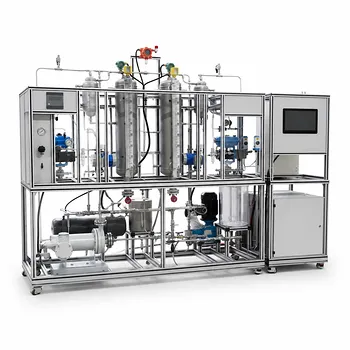
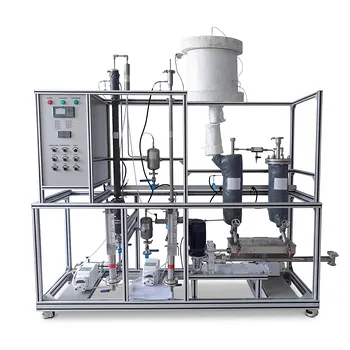
Commercial pilot systems often use spiral‑wound Pd‑alloy foil modules or small tubular membranes. These compact units integrate heating jackets and differential‑pressure controls, allowing researchers to study flux, selectivity, and temperature dependence with fast experimental turnaround.
Key operating data to monitor include membrane temperature, feed and permeate pressures, sweep flow rate, and hydrogen concentration in the permeate. These measurements let students and operators directly observe mass‑transfer coefficients and the Arrhenius behavior of hydrogen diffusion.
Quantifying Separation Efficiency
The selectivity of a membrane is captured by the separation factor (α):
α = (y_H₂ / y_other) / (x_H₂ / x_other)
where y are permeate mole fractions and x are feed mole fractions.
For a sound Pd membrane, y_H₂ approaches 1 and y_other negligible, giving an α that is effectively infinite—far exceeding any polymeric membrane. The practical limit is not selectivity but the permeation flux (amount of hydrogen per membrane area per time), which depends on temperature, pressure gradient, and membrane thickness. Pilot plant studies often focus on maximizing this flux while maintaining membrane integrity.
Overcoming Critical Operational Challenges
Hydrogen Embrittlement and Alloy Stabilization
Pure palladium undergoes a hydride phase change near 300°C that causes severe embrittlement with repeated thermal cycling. Palladium‑alloy membranes—particularly Pd‑Ag and Pd‑Cu—suppress this phase transition and are standard in pilot units.
Thermal management remains crucial: startup and shutdown procedures must avoid steep temperature swings that can cause micro‑cracking and loss of selectivity.
Fouling from Unsaturated Hydrocarbons and Contaminants
Gas streams containing olefins, acetylenes, or sulfur compounds can poison the catalytic surface, drastically reducing permeation flux and requiring costly membrane regeneration. Pilot plants typically install guard beds (e.g., activated carbon, zinc oxide) upstream to trap these foulants before the membrane housing.
This practical necessity highlights why membrane‑based hydrogen purification is often paired with gas pretreatment, and why surface‑modification research (protective coatings, alloying) remains a hot topic in pilot experiments.
Understanding the Trade‑offs: Pd Membranes vs. Alternative Purification Methods
Compared to Pressure Swing Adsorption (PSA)
PSA is robust and widely used, but typical pilot‑scale PSA units require high operating pressures (~17 atm) and complex multi‑bed valve cycling. Pd membranes, in contrast, provide a simpler, continuous‑flow process with far higher hydrogen purity—at the cost of high‑temperature operation and sensitivity to contaminants.
Compared to Preferential Oxidation (PrOx) and Methanation
PrOx reactors add precise air injection to oxidize CO; one mistake can burn product hydrogen. Selective methanation consumes three moles of hydrogen for every mole of CO converted. Pd membranes avoid hydrogen consumption and air‑control hazards, but they introduce thermal management complexity and a more expensive membrane material.
Cost and Stability Over Time
Palladium is expensive, and membrane degradation from thermal cycles or fouling can raise lifecycle costs. Pilot plants allow deliberate testing of membrane lifespan, pressure‑cycle endurance, and the economic break‑even point compared to PSA or cryogenic methods—critical data before scaling up.
Making the Right Choice for Your Pilot‑Plant Hydrogen Purification Goal
After analyzing the operating window, challenges, and alternatives, the ideal application of Pd‑membrane purification depends on your primary objective.
- If your primary focus is producing ultra‑pure hydrogen (>99.999%) for fuel‑cell or semiconductor research: A Pd membrane module is the gold standard. Prioritize robust feed pretreatment and a well‑controlled thermal cycle to avoid embrittlement.
- If your primary focus is teaching membrane flux and mass‑transfer fundamentals: Use a Pd module to demonstrate how temperature, pressure gradient, and sweep gas flow directly drive flux. Contrast its near‑infinite selectivity with classical polymeric membrane systems to anchor theoretical concepts.
- If your primary focus is evaluating process‑scale economics and durability: Run side‑by‑side comparisons with PSA or methanation units. Measure membrane deactivation rates with simulated industrial feeds, and test Pd‑alloy variants to balance cost against lifetime.
- If your primary focus is integrating hydrogen purification into a catalytic reactor: Exploit the membrane as an in‑situ product remover—a membrane reactor. Shifting equilibrium by pulling out hydrogen can boost conversion, a powerful application that links separation science directly with reaction engineering.
By translating the same selective permeability that makes palladium an exquisite hydrogen sensor into a heated membrane module, pilot plants gain a direct, high‑purity separation pathway that connects textbook principles to industrial‑scale process design.
Summary Table:
| Parameter / Aspect | Typical Range / Specification | Key Considerations |
|---|---|---|
| Operating Temperature | 300–400°C | Accelerates diffusion; avoids phase-transition embrittlement. |
| Feed-Side Pressure | 100–400 psi (7–28 bar) | Sustains the hydrogen partial-pressure gradient driving force. |
| Hydrogen Purity | >99.999% | Ideal for fuel-cell, semiconductor, and catalyst research. |
| Common Alloys | Pd-Ag, Pd-Cu | Suppresses phase changes to prevent cracking during thermal cycles. |
| Upstream Protection | Guard beds (Activated carbon, ZnO) | Crucial to prevent surface poisoning from sulfur and olefins. |
Scale Up Your Separation Research with LABPARK
To effectively study advanced hydrogen purification and membrane reactors, you need pilot equipment that delivers precise, industrial-grade data. LABPARK provides state-of-the-art Educational and Vocational Unit Operations Pilot Plants in chemical engineering, bioprocess & biotech, and environmental & water treatment for universities, research institutes, and enterprises.
Our custom-engineered pilot systems help you bridge the gap between lab-scale theory and industrial reality. Ready to enhance your engineering curriculum or research capabilities?
Contact LABPARK today to request a quote or discuss your project requirements!
Related Products
- Alkaline Membrane Water Electrolysis Educational Pilot Plant Unit Operations Training System
- Steam Methane Reforming Hydrogen Production and Purification Educational Pilot Plant
- Multifunctional Membrane Separation Educational Pilot Plant with Ultrafiltration, Nanofiltration, Reverse Osmosis
People Also Ask
- How do chemical engineering pilot plants demonstrate electrolysis? Bridge Theory & Industrial Scale
- How do alkaline and PEM electrolysis technologies differ in pilot plant operations?
- Why is the selection of electrode materials critical when configuring or operating educational electrolysis pilot plants?
- Bipolar vs Monopolar Electrolysis: Key Configuration Details to Analyze in Pilot Plants
- Which Electrolysis Pilot Plant Parameters Ensure Safety & Efficiency? Key Controls Explained