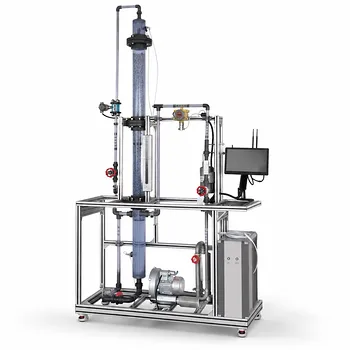
The Onda correlation reveals that the ratio of a packing material's critical surface tension to the liquid's surface tension controls the effective wetted area and, in turn, the column's mass transfer efficiency. In unit operations pilot plants, switching from ceramic or metal packing to plastic typically reduces the wetted area for aqueous systems, leading to measurably lower overall mass transfer coefficients ((K_Ya)) and taller required column heights. This principle lets students quantify how surface chemistry—not just geometry—drives packed column performance.
The effective interfacial area and column efficiency hinge on how well the liquid wets the packing. According to the Onda correlation, a higher material critical surface tension ((\sigma_c)) relative to the liquid surface tension ((\sigma_L)) increases wetting. For water-based systems, metal and ceramic packings outperform plastic because they possess the high (\sigma_c) needed to form a stable liquid film, delivering more active mass transfer area per unit volume.
The Science Behind Wetting: The Onda Correlation
Critical Surface Tension Is the Wettability Gatekeeper
The Onda correlation models the effective wetted area of random packing as a function of the ratio (\sigma_c/\sigma_L).
A packing’s critical surface tension ((\sigma_c)) is a material property—the highest liquid surface tension that will completely wet it.
If (\sigma_L) exceeds (\sigma_c), the liquid beads up instead of spreading, sharply reducing the wetted area.
Typical values clarify the difference.
- Stainless steel: (\sigma_c \approx 75) mN/m
- Ceramic (e.g., stoneware): (\sigma_c \approx 61) mN/m
- Polypropylene plastic: (\sigma_c \approx 33) mN/m Water has a surface tension around 72 mN/m, so metal is fully wettable, ceramic is partially wettable, and plastic is poorly wettable in an aqueous system.
The Link to Effective Interfacial Area
The Onda equation directly ties this wettability to the effective wetted area ((a_w))—the portion of the total geometric packing surface that actually contacts the liquid film.
A higher (\sigma_c/\sigma_L) ratio increases (a_w) because more of the packing surface becomes covered by the flowing liquid.
For a given liquid, choosing a packing with a (\sigma_c) well above (\sigma_L) can nearly double the effective interfacial area compared to a low-(\sigma_c) material, even if both have the same nominal surface area.
Impact on Mass Transfer Coefficients and Column Efficiency
The wetted area (a_w) feeds directly into the volumetric mass transfer coefficients:
- Gas-side: (k_G a)
- Liquid-side: (k_L a)
A larger (a_w) increases these coefficients, raising the overall coefficient (K_Ya) and reducing the Height of a Transfer Unit (H_OG).
Since the required column height equals (H_OG \times N_OG), better wetting leads to significantly shorter columns for the same separation.
In a pilot plant, this is seen as a drop in measured H_OG when moving from plastic to ceramic or metal packing under identical flow rates.
Demonstrating the Effect in a Unit Operations Pilot Plant
Comparing Plastic, Metal, and Ceramic in Aqueous Systems
A classic student experiment uses an air-water CO₂ absorption column packed with three different materials but identical nominal size.
- Metal packing yields the highest (K_Ya) and shortest H_OG because (\sigma_c) far exceeds 72 mN/m, promoting complete wetting.
- Ceramic packing performs moderately—its (\sigma_c) is below 72 mN/m but still high enough to maintain useful wetting, especially if the liquid is not ultra-pure.
- Plastic packing shows the lowest efficiency; water beads on the surface, (a_w) plummets, and H_OG can increase by 30–50% or more, clearly illustrating the Onda relationship.
Experimental Measurement of H_OG and a_w
Pilot plants allow direct calculation of (H_OG) from inlet/outlet concentration profiles under controlled gas and liquid rates.
By keeping the flow rates and system chemistry constant and swapping only the packing material, students can isolate the effect of (\sigma_c) on efficiency.
They can then back-calculate (a_w) using the Onda correlation and see how well the experimental data match the predicted wetted area, reinforcing the theory.
Relating Observations to the Onda Correlation
The measured reduction in (K_Ya) with plastic follows the correlation’s (\sigma_c/\sigma_L) term raised to the 0.75 power.
This exponent amplifies the penalty when (\sigma_c) drops below the liquid’s surface tension.
Observing this in real equipment helps students internalize why industrial distillation and absorption columns rarely use untreated plastic packings for aqueous service—the efficiency penalty is simply too large.
Trade-offs in Packing Material Selection
While the Onda correlation pushes you toward high-(\sigma_c) materials for aqueous wetting, real pilot plant design involves compromises.
It is critical to recognize the following limitations and practical factors beyond wettability alone.
Chemical Compatibility Limits
Ceramic resists many acids but is attacked by strong alkalis and can be fragile.
Plastic (e.g., polypropylene) is cost-effective and handles most aqueous solutions but swells or dissolves in many organic solvents.
Metal packings offer strength and high temperature tolerance but may corrode if the fluid chemistry is not precisely matched, even though they wet perfectly.
Operational Temperature and Mechanical Strength
Plastic packings are typically limited to low-to-medium temperatures (<120 °C) and can deform under load.
Ceramic and metal options withstand much higher temperatures, making them suitable for distillation or vacuum operations conducted in advanced pilot experiments.
Thus, a material that wets poorly for a water system might still be chosen if the experiment involves a low-surface-tension organic liquid where the (\sigma_c) difference disappears.
Wetting Is Not the Only Efficiency Driver
The Onda correlation assumes ideal liquid distribution; in practice, poor distributor design can starve even high-(\sigma_c) packings of the necessary liquid film.
Also, surface roughness and packing shape influence liquid holdup and turbulence, which affect (k_L) and (k_G) independently of (a_w).
Therefore, the highest-(\sigma_c) material is not always the most efficient if other factors become dominant.
Applying This Knowledge in the Pilot Plant
Use the material–wetting relationship to design purposeful experiments and make informed selections.
- If your primary focus is demonstrating the Onda correlation’s σc effect: Run an aqueous absorption with polypropylene, ceramic, and stainless steel packings of the same nominal size. Measure H_OG, calculate a_w, and plot against σc/σL to let students witness the near-exponential drop in wetting.
- If your primary focus is simulating an industrial separation that uses organic solvents: Choose a plastic packing if the liquid’s surface tension falls well below the plastic’s σc of 33 mN/m; for many organic systems, plastic wets adequately and offers cost and corrosion advantages.
- If your primary focus is maximizing column efficiency for a generic air-water pilot experiment: Select a metal or ceramic packing with a critical surface tension above 70 mN/m. This ensures the highest effective wetted area and the lowest H_OG, giving you clear, repeatable mass transfer data.
- If your primary focus is comparing surface modification techniques: Start with a low-σc plastic, measure its poor wetting, then repeat the experiment with a hydrophilized version (σc raised to ~54 mN/m) to show how treatment brings performance closer to that of ceramic.
Understanding the Onda correlation transforms packing material selection from a catalog exercise into a predictable science, giving you full control over the efficiency and educational impact of your pilot plant.
Summary Table:
| Packing Material | Critical Surface Tension ($\sigma_c$) | Aqueous Wettability | Mass Transfer Efficiency ($K_Ya$) |
|---|---|---|---|
| Stainless Steel | ~75 mN/m | High (Fully wettable) | Highest efficiency, lowest $H_{OG}$ |
| Ceramic | ~61 mN/m | Moderate (Partially wettable) | Moderate efficiency |
| Polypropylene (Plastic) | ~33 mN/m | Low (Poorly wettable) | Lowest efficiency, $H_{OG}$ increases by 30–50% |
Optimize Your Mass Transfer Experiments with LABPARK
Are you looking to provide hands-on training on mass transfer theories like the Onda correlation? LABPARK delivers state-of-the-art Educational and Vocational Unit Operations Pilot Plants designed specifically for universities, research institutes, and enterprises.
Our custom-engineered pilot systems for chemical engineering, bioprocess & biotech, and environmental & water treatment help students and researchers accurately measure parameters like wetted area, pressure drop, and column efficiency.
Bring real-world separation technology to your laboratory—contact us today to explore our pilot plant configurations!
Related Products
- Packed Bed Absorption Educational Unit Operations Pilot Plant
- Absorption and Desorption Educational Unit Operations Pilot Plant
People Also Ask
- How Do Flow Regimes Transition in Packed Bed Pilot Plants? Key Scale-up Insights
- How does reactant concentration determine absorption column control? Gas-film vs. dual-film.
- How is the packing height of an absorption column calculated? Master HTU & NTU Concepts
- How does the wall effect impact packed-bed conversion? Essential pilot plant scale-up tips.
- How does static vs. operating holdup affect pilot plant calibration? Avoid Critical Scale-Up Errors